Abstract
Background: Collabieae is a medium-sized group within the orchid subfamily Epidendroideae that is distributed primarily across tropical Asia. Most Collabieae species are known for their considerable ornamental and medicinal merits. However, habitat destruction and overharvesting have led to severe decline in their wild populations. Chloroplast (cp) genomes are highly valued in evolutionary studies, due to comparative conservation and accumulation of genomic variations. Elucidating the structure of chloroplast genome is instrumental in conserving genetic diversity within the Collabieae. Methods: we explored the chloroplast genome characteristics of Collabieae. We incorporated three newly sequenced genomes from species (Acanthophippium sylhetense, Eriodes barbata, and Spathoglottis plicata), along with seven related species. Results: all analyzed cp genomes displayed a typical quadripartite circular structure. The total lengths ranged from 157,036 bp to 158,321 bp. Each genome contained 136 genes: 88 protein-coding genes, 38 tRNA genes, eight rRNA genes, and two pseudogenes. Across the ten Collabieae species, gene number, order, orientation, GC content, and codon usage bias were highly consistent, indicative of strong sequence conservation. However, notable structural divergence was observed at the plastome junctions, alongside variations in SSR and repetitive element frequencies. Moreover, six hypervariable regions were identified. Noncoding regions exhibited higher variability compared to protein-coding regions. Phylogenetic analysis indicated that E. barbata forms a distinct, small branch sister to the rest of the Collabieae members. Genera Acanthophippium and Spathoglottis were sister to the remaining groups within the tribe. Conclusions: this overall phylogenetic framework aligns well with previous findings. Our study provides valuable cp genomic resources and advances evolutionary research in Collabieae.
Abstract from the paper’s OpenAlex record; open copy licensed cc-by. Read at the source ↗
The text the model read, with the source record’s inline markup (italics, sub- and superscripts) rendered and its character entities decoded; quote offsets refer to the raw text.
Claims 13
Claim · model-written summary
All analyzed chloroplast genomes had a typical quadripartite circular structure.
- Taxon
- CollabieaeCollabieaet0
- Outcome
- typical quadripartite circular structuree0
Verbatim
e0“all analyzed cp genomes displayed a typical quadripartite circular structure”
t0“Collabieae”
Claim · model-written summary
Genome lengths ranged from 157,036 to 158,321 bp.
- Taxon
- CollabieaeCollabieaet0
- Outcome
- total lengthse0
- Value
- 157,036 bp to 158,321 bpe0
Verbatim
e0“The total lengths ranged from 157,036 bp to 158,321 bp”
t0“Collabieae”
Claim · model-written summary
Each genome contained 136 genes.
- Taxon
- CollabieaeCollabieaet0
- Outcome
- genese0
- Value
- 136 genese0
Verbatim
e0“Each genome contained 136 genes: 88 protein-coding genes, 38 tRNA genes, eight rRNA genes, and two pseudogenes”
t0“Collabieae”
Claim · model-written summary
Each genome contained 88 protein-coding genes.
- Taxon
- CollabieaeCollabieaet0
- Outcome
- protein-coding genese0
- Value
- 88 protein-coding genese0
Verbatim
e0“88 protein-coding genes”
t0“Collabieae”
Claim · model-written summary
Each genome contained 38 tRNA genes.
- Taxon
- CollabieaeCollabieaet0
- Outcome
- tRNA genese0
- Value
- 38 tRNA genese0
Verbatim
e0“38 tRNA genes”
t0“Collabieae”
Claim · model-written summary
Each genome contained eight rRNA genes.
- Taxon
- CollabieaeCollabieaet0
- Outcome
- rRNA genese0
- Value
- eight rRNA genese0
Verbatim
e0“eight rRNA genes”
t0“Collabieae”
Claim · model-written summary
Each genome contained two pseudogenes.
- Taxon
- CollabieaeCollabieaet0
- Outcome
- pseudogenese0
- Value
- two pseudogenese0
Verbatim
e0“two pseudogenes”
t0“Collabieae”
Claim · model-written summary
Gene number, order, orientation, GC content and codon usage bias were highly consistent across ten species.
- Taxon
- CollabieaeCollabieaee0
- Outcome
- gene number, order, orientation, GC content, and codon usage biase0
- Direction
- highly consistente0
Verbatim
e0“Across the ten Collabieae species, gene number, order, orientation, GC content, and codon usage bias were highly consistent”
Claim · model-written summary
Plastome junctions showed structural divergence and SSR and repeat frequencies varied.
- Taxon
- CollabieaeCollabieaet0
- Outcome
- structural divergencee0
- Qualifier
- variations in SSR and repetitive element frequenciese0
Verbatim
e0“notable structural divergence was observed at the plastome junctions, alongside variations in SSR and repetitive element frequencies”
t0“Collabieae”
Claim · model-written summary
Six hypervariable regions were identified.
- Taxon
- CollabieaeCollabieaet0
- Outcome
- hypervariable regionse0
- Value
- sixe0
Verbatim
e0“six hypervariable regions were identified”
t0“Collabieae”
Claim · model-written summary
Noncoding regions were more variable than protein-coding regions.
- Taxon
- CollabieaeCollabieaet0
- Outcome
- variabilitye0
- Direction
- highere0
- Comparator
- protein-coding regionse0
Verbatim
e0“Noncoding regions exhibited higher variability compared to protein-coding regions”
t0“Collabieae”
Claim · model-written summary
E. barbata was sister to the remaining Collabieae members.
- Taxon
- E. barbata
 Eriodes barbatae0
- Outcome
- distinct, small branch sister to the rest of the Collabieae memberse0
Organisms pictured · Representative pictures of the matched species, not figures from the paper.

Verbatim
e0“E. barbata forms a distinct, small branch sister to the rest of the Collabieae members”
Claim · model-written summary
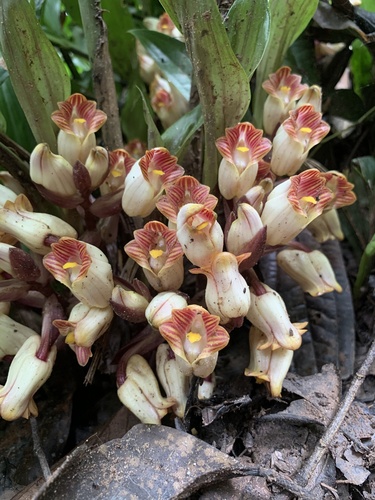
Acanthophippium and Spathoglottis were sister to the remaining groups.
- Taxon
- Acanthophippium and Spathoglottis
 Spathoglottis
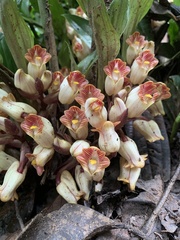 Acanthophippiume0
- Outcome
- sister to the remaining groups within the tribee0
Organisms pictured · Representative pictures of the matched species, not figures from the paper.

Verbatim
e0“Genera Acanthophippium and Spathoglottis were sister to the remaining groups within the tribe”