Abstract
Abstract Understanding the spatial dynamics of plant-associated microbial communities is increasingly urgent in the context of habitat loss and the biodiversity crisis. However, the influence of reduced habitat size and connectivity on the assembly mechanisms underlying microbial associations is fundamental to advancing microbial ecology and conservation. In the Brazilian Amazon, we investigated nitrogen-fixing (diazotrophic) bacterial communities associated with two epiphyllous liverworts, Cololejeunea surinamensis and Radula flaccida, across 11 forest sites within the Biological Dynamics of Forest Fragments Project landscape. Using amplicon sequencing targeting the nitrogenase gene (nifH), we characterized diazotroph community diversity, inferred assembly mechanisms through null models, and analyzed co-occurrence network structure. Host-specific associations were evident: C. surinamensis predominantly hosted Hassallia, while R. flaccida was primarily associated with Fischerella. Despite habitat fragmentation, diazotrophic richness and composition remained similar across habitats of different sizes, consistent with strong homogenizing dispersal. Network analyses revealed that smaller fragments harbored more modular communities with fewer module hubs, pronounced shifts in key species relative abundance, and reduced network robustness. Our findings underscore the influence of habitat size on the stability of liverwort-associated diazotrophs, with smaller fragments exhibiting lower key species specificity and disruption of microbe-microbe interactions. Our results emphasize the importance of conserving large, connected forest habitats to maintain the functional integrity of phyllosphere N-fixing microbiota.
Abstract from the paper’s OpenAlex record; open copy licensed cc-by. Read at the source ↗
The text the model read, with the source record’s inline markup (italics, sub- and superscripts) rendered and its character entities decoded; quote offsets refer to the raw text.
Claims 10
Claim · model-written summary
Cololejeunea surinamensis predominantly hosted Hassallia diazotrophs.
- Taxon
- Cololejeunea surinamensisCololejeunea surinamensise0
- Outcome
- predominantly hostede1
Verbatim
e0“two epiphyllous liverworts, Cololejeunea surinamensis and Radula flaccida”
e1“C. surinamensis predominantly hosted Hassallia”
Claim · model-written summary
Radula flaccida was primarily associated with Fischerella diazotrophs.
- Taxon
- Radula flaccidaRadula flaccidae0
- Interactor
- Fischerella
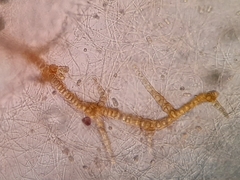 Fischerellae2symbiont
- Outcome
- primarily associatede2
Organisms pictured · Representative pictures of the matched species, not figures from the paper.

Verbatim
e0“two epiphyllous liverworts, Cololejeunea surinamensis and Radula flaccida”
e2“R. flaccida was primarily associated with Fischerella”
Claim · model-written summary
Diazotrophic richness and composition remained similar across habitats of different sizes despite habitat fragmentation.
Verbatim
e0“two epiphyllous liverworts, Cololejeunea surinamensis and Radula flaccida”
e3“Despite habitat fragmentation, diazotrophic richness and composition remained similar across habitats of different sizes”
Claim · model-written summary
Smaller fragments harboured more modular liverwort-associated diazotroph networks.
- Taxon
- Cololejeunea surinamensisCololejeunea surinamensise0
- Treatment
- smaller fragmentse4
- Outcome
- modular communitiese4
- Direction
- moree4
Verbatim
e0“two epiphyllous liverworts, Cololejeunea surinamensis and Radula flaccida”
e4“smaller fragments harbored more modular communities”
Claim · model-written summary
Smaller fragments had fewer module hubs in the diazotroph networks.
- Taxon
- Cololejeunea surinamensisCololejeunea surinamensise0
- Treatment
- smaller fragmentse5
- Outcome
- module hubse5
- Direction
- fewere5
Verbatim
e0“two epiphyllous liverworts, Cololejeunea surinamensis and Radula flaccida”
e5“smaller fragments harbored more modular communities with fewer module hubs”
Claim · model-written summary
Smaller fragments showed reduced network robustness.
- Taxon
- Cololejeunea surinamensisCololejeunea surinamensise0
- Treatment
- smaller fragmentse6
- Outcome
- network robustnesse6
- Direction
- reducede6
Verbatim
e0“two epiphyllous liverworts, Cololejeunea surinamensis and Radula flaccida”
e6“smaller fragments harbored more modular communities with fewer module hubs, pronounced shifts in key species relative abundance, and reduced network robustness”
Claim · model-written summary
Smaller fragments showed pronounced shifts in key species relative abundance.
- Taxon
- Cololejeunea surinamensisCololejeunea surinamensise0
- Treatment
- smaller fragmentse6
- Outcome
- key species relative abundancee6
- Direction
- pronounced shiftse6
Verbatim
e0“two epiphyllous liverworts, Cololejeunea surinamensis and Radula flaccida”
e6“smaller fragments harbored more modular communities with fewer module hubs, pronounced shifts in key species relative abundance, and reduced network robustness”
Claim · model-written summary
Smaller fragments had lower key species specificity.
- Taxon
- Cololejeunea surinamensisCololejeunea surinamensise0
- Treatment
- smaller fragmentse7
- Outcome
- key species specificitye7
- Direction
- lowere7
Verbatim
e0“two epiphyllous liverworts, Cololejeunea surinamensis and Radula flaccida”
e7“smaller fragments exhibiting lower key species specificity and disruption of microbe-microbe interactions”
Claim · model-written summary
Smaller fragments showed disruption of microbe-microbe interactions.
- Taxon
- Cololejeunea surinamensisCololejeunea surinamensise0
- Treatment
- smaller fragmentse7
- Outcome
- microbe-microbe interactionse7
- Direction
- disruptione7
Verbatim
e0“two epiphyllous liverworts, Cololejeunea surinamensis and Radula flaccida”
e7“smaller fragments exhibiting lower key species specificity and disruption of microbe-microbe interactions”
Claim · model-written summary
Similar diazotroph richness and composition across habitat sizes is consistent with strong homogenizing dispersal.
- Taxon
- Cololejeunea surinamensisCololejeunea surinamensise0
- Outcome
- diazotrophic richness and compositione3
- Qualifier
- strong homogenizing dispersale7
Verbatim
e0“two epiphyllous liverworts, Cololejeunea surinamensis and Radula flaccida”
e3“diazotrophic richness and composition remained similar across habitats of different sizes”
e7“consistent with strong homogenizing dispersal”