Abstract
Pythium soft rot in ginger is caused by Pythium myriotylum, leading to significant reductions in ginger yields. In this study, a loop-mediated isothermal amplification (LAMP) detection method was established for Py. myriotylum in infected ginger plants and infested soil. The Py. myriotylum genome was compared with the genomes of seven additional oomycete species to obtain species-specific sequences. LAMP primer sets were designed and assessed at temperatures from 58°C to 68°C and tested for their specificity. Furthermore, the sensitivity of the screened primer set was evaluated, and the detection limit was 1 pg of Py. myriotylum genomic DNA (gDNA) in a 25-µl reaction volume. LAMP was used to detect Py. myriotylum zoospores in solution (1×10 2 /ml), vermiculite (1×10 2 /g), and soil (1×10 4 /g). A rapid and portable gDNA extraction method from ginger seedlings and rhizomes using solid-phase reversible immobilization beads for purification was adopted. The LAMP assay could reliably detect Py. myriotylum in artificially inoculated diseased ginger seedlings and rhizosphere vermiculite. The portable gDNA extraction method coupled with the LAMP assay facilitates point-of-care pathogen detection, requiring 2 to 3 hours for eight samples, greatly reducing the time needed for Py. myriotylum detection of Pythium soft rot in ginger.
Abstract from the paper’s OpenAlex record, shown for indexing and research. Copyright remains with the authors or the publisher. Read at the source ↗
The text the model read, with the source record’s inline markup (italics, sub- and superscripts) rendered and its character entities decoded; quote offsets refer to the raw text.
Claims 7
Claim · model-written summary
Species-specific sequences were obtained by genome comparison.
- Taxon
- ginger
 Zingiber officinalet0
- Interactor
- Py. myriotylume0pathogen
- Outcome
- species-specific sequencese0
- Value
- seven additional oomycete speciese0
Organisms pictured · Representative pictures of the matched species, not figures from the paper.
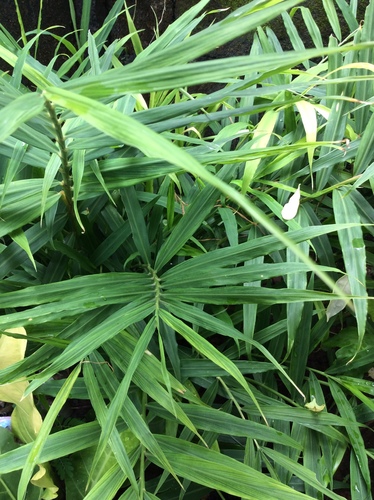
Verbatim
e0“The Py. myriotylum genome was compared with the genomes of seven additional oomycete species to obtain species-specific sequences”
t0“ginger”
Claim · model-written summary
The primer set detected 1 pg of pathogen DNA per reaction.
- Taxon
- gingerZingiber officinalet0
- Interactor
- Py. myriotylume0pathogen
- Outcome
- detection limite0
- Value
- 1 pge0
- Qualifier
- 25-µl reaction volumee0
Organisms pictured · Representative pictures of the matched species, not figures from the paper.
Verbatim
e0“the detection limit was 1 pg of Py. myriotylum genomic DNA (gDNA) in a 25-µl reaction volume”
t0“ginger”
Claim · model-written summary
LAMP detected zoospores in solution at 1×10 2 /ml.
- Taxon
- gingerZingiber officinalet0
- Interactor
- Py. myriotylume0pathogen
- Outcome
- detect Py. myriotylum zoosporese0
- Value
- 1×10 2 /mle0
- Setting
- solutione0
Organisms pictured · Representative pictures of the matched species, not figures from the paper.
Verbatim
e0“LAMP was used to detect Py. myriotylum zoospores in solution (1×10 2 /ml)”
t0“ginger”
Claim · model-written summary
LAMP detected zoospores in vermiculite at 1×10 2 /g.
- Taxon
- gingerZingiber officinalet0
- Interactor
- Pythium myriotylumPythium myriotylumt0pathogen
- Outcome
- vermiculitee0
- Value
- 1×10 2 /ge0
Organisms pictured · Representative pictures of the matched species, not figures from the paper.
Verbatim
e0“vermiculite (1×10 2 /g)”
t0“ginger ( Zingiber officinale ) caused by Pythium myriotylum”
Claim · model-written summary
LAMP detected zoospores in soil at 1×10 4 /g.
- Taxon
- gingerZingiber officinalet0
- Interactor
- Pythium myriotylumPythium myriotylumt0pathogen
- Outcome
- soile0
- Value
- 1×10 4 /ge0
Organisms pictured · Representative pictures of the matched species, not figures from the paper.
Verbatim
e0“soil (1×10 4 /g)”
t0“ginger ( Zingiber officinale ) caused by Pythium myriotylum”
Claim · model-written summary
The assay reliably detected pathogen in inoculated ginger seedlings and rhizosphere vermiculite.
- Taxon
- gingerZingiber officinalee0
- Organ / stage
- ginger seedlingse0
- Interactor
- Py. myriotylume0pathogen
- Outcome
- reliably detect Py. myriotylume0
- Setting
- rhizosphere vermiculitee0
Not reportedComparator
Organisms pictured · Representative pictures of the matched species, not figures from the paper.
Verbatim
e0“The LAMP assay could reliably detect Py. myriotylum in artificially inoculated diseased ginger seedlings and rhizosphere vermiculite”
Claim · model-written summary
Portable extraction plus LAMP required 2 to 3 hours for eight samples.
- Taxon
- gingerZingiber officinalee0
- Interactor
- Py. myriotylume0pathogen
- Outcome
- time needed for Py. myriotylum detectione0
- Direction
- reducinge0
- Value
- 2 to 3 hours for eight samplese0
Organisms pictured · Representative pictures of the matched species, not figures from the paper.
Verbatim
e0“requiring 2 to 3 hours for eight samples, greatly reducing the time needed for Py. myriotylum detection of Pythium soft rot in ginger”