Abstract
Abstract Regional seed sources are increasingly used in ecological restoration. Polyploid complexes, i.e. taxa comprising multiple ploidy levels, are often part of regional seed mixtures, where ploidy levels are often not distinguished. However, mixing ploidy levels may foster their hybridisation, severely reduce offspring fitness and disrupt existing patterns of the geographic distribution of individual ploidy levels. Furthermore, ploidy levels may represent distinct genetic lineages. Yet, the exact geographic distribution of the ploidy levels and their genetic differentiation are rarely known. Here, we focus on six polyploid complexes commonly used for the restoration of species‐rich grasslands. We present high‐resolution, national‐scale geographic distributions of their ploidy levels, test their association with environmental gradients and quantify genetic differentiation between ploidy levels. Ploidy levels within polyploid complexes were more differentiated than seed zones within individual ploidy levels. The abundance, spatial distribution and levels of sympatry versus parapatry of ploidy levels varied widely among polyploid complexes. Nevertheless, the spatial distribution of ploidy levels was always associated with environmental gradients. Mixed‐ploidy populations were generally rare. Campanula rotundifolia , Euphorbia cyparissias , and Pimpinella saxifraga showed regional parapatry of ploidy levels, whereas Achillea millefolium agg., Knautia arvensis , and Leucanthemum vulgare agg. showed rather sympatric distribution patterns. Diploid K. arvensis was very rare and potentially non‐native to Germany. Using these datasets as case studies, we present a management decision framework for polyploid complexes in seed zone‐based grassland restoration, requiring only cytotype distribution data that can be acquired at reasonable cost. The framework recommends four different per‐zone management options based on data availability, cytotype presence, distribution, and frequency. Synthesis and applications . Our decision framework enables seed producers and managers to take consistent action on the challenge of polyploid complexes in restoration. Different ploidy levels should not be mixed to avoid fitness losses. Depending on abundance and distribution, either the dominant ploidy level should be prioritised, or multiple ploidy levels need to be managed independently at the seed zone level.
Abstract from the paper’s OpenAlex record; open copy licensed cc-by. Read at the source ↗
The text the model read, with the source record’s inline markup (italics, sub- and superscripts) rendered and its character entities decoded; quote offsets refer to the raw text.
Claims 10
Claim · model-written summary
Ploidy levels within polyploid complexes were more differentiated than seed zones within individual ploidy levels.
Verbatim
e1“we focus on six polyploid complexes commonly used for the restoration”
e2“Ploidy levels within polyploid complexes were more differentiated than seed zones within individual ploidy levels”
Claim · model-written summary
Abundance, spatial distribution and sympatry versus parapatry of ploidy levels varied widely among polyploid complexes.
Verbatim
e1“we focus on six polyploid complexes commonly used for the restoration”
e3“The abundance, spatial distribution and levels of sympatry versus parapatry of ploidy levels varied widely among polyploid complexes”
Claim · model-written summary
The spatial distribution of ploidy levels is associated with environmental gradients.
- Taxon
- polyploid complexese1
- Treatment
- environmental gradientse4
- Outcome
- spatial distribution of ploidy levelse4
Not reportedDirection
Verbatim
e1“we focus on six polyploid complexes commonly used for the restoration”
e4“the spatial distribution of ploidy levels was always associated with environmental gradients”
Claim · model-written summary
Mixed-ploidy populations were generally rare.
Verbatim
e1“we focus on six polyploid complexes commonly used for the restoration”
e5“Mixed‐ploidy populations were generally rare”
Claim · model-written summary
Campanula rotundifolia, Euphorbia cyparissias and Pimpinella saxifraga showed regional parapatry of ploidy levels.
- Taxon
- Campanula rotundifolia , Euphorbia cyparissias , and Pimpinella saxifraga
 Euphorbia cyparissias
 Pimpinella saxifraga
 Campanula rotundifoliae6
- Outcome
- regional parapatry of ploidy levelse6
Organisms pictured · Representative pictures of the matched species, not figures from the paper.

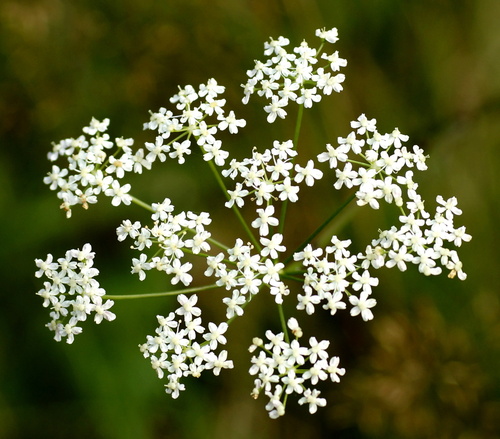

Verbatim
e1“we focus on six polyploid complexes commonly used for the restoration”
e6“Campanula rotundifolia , Euphorbia cyparissias , and Pimpinella saxifraga showed regional parapatry of ploidy levels”
Claim · model-written summary
Achillea millefolium agg., Knautia arvensis and Leucanthemum vulgare agg. showed rather sympatric distribution patterns.
- Taxon
- Achillea millefolium agg., Knautia arvensis , and Leucanthemum vulgare agg.
 Achillea millefolium
 Leucanthemum vulgare
 Knautia arvensise7
- Outcome
- sympatric distribution patternse7
Organisms pictured · Representative pictures of the matched species, not figures from the paper.


Verbatim
e1“we focus on six polyploid complexes commonly used for the restoration”
e7“Achillea millefolium agg., Knautia arvensis , and Leucanthemum vulgare agg. showed rather sympatric distribution patterns”
Claim · model-written summary
Diploid Knautia arvensis was very rare and potentially non-native to Germany.
- Taxon
- K. arvensisKnautia arvensise2
- Material
- Diploide2
- Outcome
- very raree2
- Qualifier
- potentially non‐nativee2
- Setting
- Germanye2
Organisms pictured · Representative pictures of the matched species, not figures from the paper.
Verbatim
e1“we focus on six polyploid complexes commonly used for the restoration”
e2“Diploid K. arvensis was very rare and potentially non‐native to Germany”
Claim · model-written summary
The framework recommends four different per-zone management options.
Verbatim
e1“we focus on six polyploid complexes commonly used for the restoration”
e2“The framework recommends four different per‐zone management options based on data availability, cytotype presence, distribution, and frequency”
Claim · model-written summary
Different ploidy levels should not be mixed to avoid fitness losses.
Verbatim
e1“we focus on six polyploid complexes commonly used for the restoration”
e2“Different ploidy levels should not be mixed to avoid fitness losses”
Claim · model-written summary
Either the dominant ploidy level should be prioritised, or multiple ploidy levels should be managed independently at the seed zone level.
Verbatim
e1“we focus on six polyploid complexes commonly used for the restoration”
e2“either the dominant ploidy level should be prioritised, or multiple ploidy levels need to be managed independently at the seed zone level”