Abstract
PREMISE: Juncaceae has needed taxonomic revision for some time. Specifically, the genus Juncus s.l. is known to be paraphyletic because five small southern-hemisphere genera have been shown repeatedly to be nested within it. In 2022, a new classification was proposed, based on phylogenies built from one nuclear and three plastid regions sequenced across much of Juncaceae, meant to resolve the paraphyletic nature of Juncus s.l. It created six new genera and was criticized on the basis that the genera proposed are not necessarily monophyletic, given the limited nature of the phylogenetic analyses available and the fact that the generic circumscriptions draw heavily on the morphology-based classifications in the latest monograph of Juncaceae from 2002. METHODS: We used the Angiosperms 353 target capture probe set to assemble a data set consisting of hundreds of plastid and nuclear loci to assess the monophyly of the newly proposed genera of Juncaceae. RESULTS: The proposed genera mostly represent monophyletic groups, but the proposed genus Juncinella is nested within the proposed genus Boreojuncus. Additionally, Juncinella capitata was placed as sister to either Luzula or Oreojuncus and should be recognized as a monotypic genus. Finally, Australojuncus cyperoides and Verojuncus chlorocephalus were recovered outside of their morphologically assigned genera and require further investigation to be placed confidently. CONCLUSIONS: We proposed taxonomic revisions to rectify the stated issues, but further research is necessary, particularly to correctly place the South African annual taxa in Juncus s.l.
Abstract from the paper’s OpenAlex record; open copy licensed cc-by-nc. Read at the source ↗
The text the model read, with the source record’s inline markup (italics, sub- and superscripts) rendered and its character entities decoded; quote offsets refer to the raw text.
Claims 7
Claim · model-written summary
Most proposed Juncaceae genera are monophyletic.
- Outcome
- monophyletic groupse0
Verbatim
e0“The proposed genera mostly represent monophyletic groups”
t0“Juncaceae”
Claim · model-written summary
Juncinella is nested within Boreojuncus.
Verbatim
e0“the proposed genus Juncinella is nested within the proposed genus Boreojuncus”
Claim · model-written summary
Juncinella capitata is sister to either Luzula or Oreojuncus.
- Taxon
- Juncinella capitata
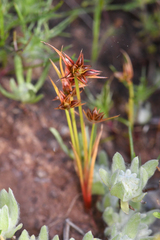 Juncus capitatuse0
- Outcome
- sister to either Luzula or Oreojuncuse0
Organisms pictured · Representative pictures of the matched species, not figures from the paper.

Verbatim
e0“Juncinella capitata was placed as sister to either Luzula or Oreojuncus”
Claim · model-written summary
Juncinella capitata should be recognized as a monotypic genus.
- Taxon
- Juncinella capitataJuncus capitatuse0
- Outcome
- recognized as a monotypic genuse0
Organisms pictured · Representative pictures of the matched species, not figures from the paper.
Verbatim
e0“Juncinella capitata was placed as sister to either Luzula or Oreojuncus and should be recognized as a monotypic genus”
Claim · model-written summary
Australojuncus cyperoides was recovered outside its morphologically assigned genus.
- Taxon
- Australojuncus cyperoidesJuncus cyperoidese0
- Outcome
- outside of their morphologically assigned generae0
Verbatim
e0“Australojuncus cyperoides and Verojuncus chlorocephalus were recovered outside of their morphologically assigned genera”
Claim · model-written summary
Verojuncus chlorocephalus was recovered outside its morphologically assigned genus.
Verbatim
e0“Australojuncus cyperoides and Verojuncus chlorocephalus were recovered outside of their morphologically assigned genera”
Claim · model-written summary
Placement of the two misplaced taxa requires further investigation.
- Outcome
- further investigation to be placed confidentlye0
Not reportedTaxon
Verbatim
e0“require further investigation to be placed confidently”