Abstract
Soil moisture influences the composition and diversity of weed species, as well as the competitive dynamics between crops and weeds. The purpose of this study was to determine how soil moisture shape weed community structure in flood recession farming systems. Vegetation sampling was conducted in 17 fields using 1 m² quadrats along gradient-oriented transects, and soil samples were collected at the upper and lower slopes of each field across the 2 cropping seasons at depth of 15 cm, 30 cm, 45 cm and 60 cm, each field had 4 composite samples per cropping season giving a total of 136 composite samples. Statistical analyses, including Kruskal–Wallis, hierarchical cluster analysis, indicator species analysis, multi-response permutation procedures, and Canonical Correspondence Analysis, were employed to evaluate weed distribution and their relationship with environmental variables. The findings showed statistically significant differences (p < 0.05) in soil moisture distribution across the various zones, with distinct weed communities corresponding to specific moisture levels. Species such as Cenchrus biflorus and Tricholaena monachne were more abundant in well-irrigated areas, while Boerhavia coccinea and Portulaca oleracea thrived by accessing moisture near the surface at a depth of 15 cm. In contrast, deep-rooted weeds like Sida cordifolia and drought-resistant species such as Panicum repens favored deeper soil moisture found at 45 cm and beyond. These results emphasise the critical role of soil moisture in shaping weed community composition, affecting both species competition and ecological adaptation within cropping systems. The study highlights the need for effective moisture management to enhance weed control and support sustainable agricultural productivity.
Abstract from the paper’s OpenAlex record; open copy licensed cc-by-nc-nd. Read at the source ↗
The text the model read, with the source record’s inline markup (italics, sub- and superscripts) rendered and its character entities decoded; quote offsets refer to the raw text.
Claims 8
Claim · model-written summary
Distinct weed communities corresponded to specific soil moisture levels.
Not reportedDirection
Verbatim
e0“with distinct weed communities corresponding to specific moisture levels”
t0“weed species composition and diversity”
Claim · model-written summary
Cenchrus biflorus was more abundant in well-irrigated areas.
- Taxon
- Cenchrus biflorus
 Cenchrus bifloruse0
- Outcome
- abundante0
- Direction
- more abundante0
- Setting
- well-irrigated arease0
Organisms pictured · Representative pictures of the matched species, not figures from the paper.

Verbatim
e0“Species such as Cenchrus biflorus and Tricholaena monachne were more abundant in well-irrigated areas”
Claim · model-written summary
Tricholaena monachne was more abundant in well-irrigated areas.
- Taxon
- Tricholaena monachne
 Tricholaena monachnee0
- Outcome
- abundante0
- Direction
- more abundante0
- Setting
- well-irrigated arease0
Organisms pictured · Representative pictures of the matched species, not figures from the paper.
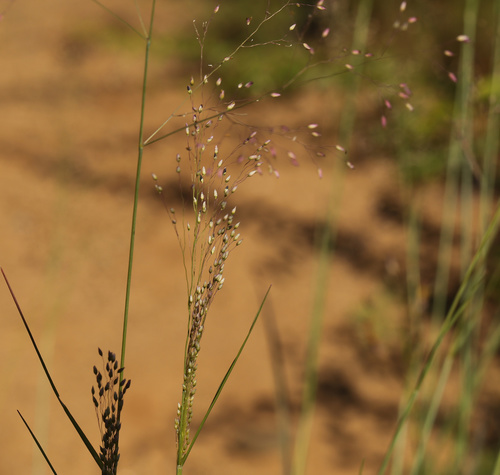
Verbatim
e0“Species such as Cenchrus biflorus and Tricholaena monachne were more abundant in well-irrigated areas”
Claim · model-written summary
Boerhavia coccinea thrived by accessing moisture near the surface at 15 cm depth.
- Taxon
- Boerhavia coccinea
 Boerhavia coccineae0
- Outcome
- thrivede0
- Direction
- thrivede0
- Setting
- near the surface at a depth of 15 cme0
Organisms pictured · Representative pictures of the matched species, not figures from the paper.

Verbatim
e0“Boerhavia coccinea and Portulaca oleracea thrived by accessing moisture near the surface at a depth of 15 cm”
Claim · model-written summary
Portulaca oleracea thrived by accessing moisture near the surface at 15 cm depth.
- Taxon
- Portulaca oleracea
 Portulaca oleraceae0
- Outcome
- thrivede0
- Direction
- thrivede0
- Setting
- near the surface at a depth of 15 cme0
Organisms pictured · Representative pictures of the matched species, not figures from the paper.

Verbatim
e0“Boerhavia coccinea and Portulaca oleracea thrived by accessing moisture near the surface at a depth of 15 cm”
Claim · model-written summary
The deep-rooted weed Sida cordifolia favored deeper soil moisture at 45 cm and beyond.
- Taxon
- Sida cordifolia
 Sida cordifoliae0
- Outcome
- favorede0
- Direction
- favorede0
- Setting
- deeper soil moisture found at 45 cm and beyonde0
Organisms pictured · Representative pictures of the matched species, not figures from the paper.

Verbatim
e0“deep-rooted weeds like Sida cordifolia and drought-resistant species such as Panicum repens favored deeper soil moisture found at 45 cm and beyond”
Claim · model-written summary
The drought-resistant Panicum repens favored deeper soil moisture at 45 cm and beyond.
- Taxon
- Panicum repens
 Panicum repense0
- Outcome
- favorede0
- Direction
- favorede0
- Setting
- deeper soil moisture found at 45 cm and beyonde0
Organisms pictured · Representative pictures of the matched species, not figures from the paper.

Verbatim
e0“deep-rooted weeds like Sida cordifolia and drought-resistant species such as Panicum repens favored deeper soil moisture found at 45 cm and beyond”
Claim · model-written summary
The authors conclude that soil moisture plays a critical role in shaping weed community composition.
Verbatim
e0“These results emphasise the critical role of soil moisture in shaping weed community composition”
t0“weed species composition and diversity”