Abstract
Background: The species richness and endemism of the species of the tribes Astragaleae, Crotalarieae, Genisteae, Indigofereae, and Loteae in northeastern Mexico are poorly documented and the systematics of these groups in the study area have not been updated according to the new taxonomic modifications proposed by the LPWG. Objective: Our objective is to update the taxonomy and to document the richness and endemism of legumes of the tribes Astragaleae, Crotalarieae, Genisteae, Indigoferae, and Loteae distributed in northeastern Mexico. Methods: This work is based primarily on fieldwork conducted by some of the authors over the past 40 years, and on the review of botanical specimens held in national and international herbaria. Results: Five tribes, eight genera, and 60 species of legumes were recorded and distributed as follows: Astragaleae, one genus (Astragalus), 29 species, and eight infraspecific categories; Crotalarieae, one genus (Crotalaria), 10 species, and three infraspecific categories; Genisteae, two genera (Lupinus and Spartium) and 11 species; Indigofereae, one genus (Indigofera), six species; Loteae, three genera (Acmispon, Coronilla, and Hosackia), and four species. Four introduced species were recorded: Coronilla varia, Crotalaria retusa var. retusa, Indigofera subulata var. scabra, and Spartium junceum, all of them with few records in the wild or cultivated as ornamentals, with no reports of weedy behavior or threats of population expansion. Twenty-nine species and two infraspecific categories are endemic to Mexico, of which 18 are exclusive to the northeastern region. Half and one-third of the recorded species are endemic to Mexico and northeastern Mexico, respectively, demonstrating their uniqueness and importance for conservation purposes. Astragalus and Lupinus constitute up to 95% of the endemic species for the northeastern part of the country. The taxa richness of legumes in NE Mexico is unique, because almost half of them are endemic to the country and a third are endemic to this region, which requires the creation of appropriate measures for the conservation of the specific ecosystems where these species grow.
Abstract from the paper’s OpenAlex record; open copy licensed cc-by. Read at the source ↗
The text the model read, with the source record’s inline markup (italics, sub- and superscripts) rendered and its character entities decoded; quote offsets refer to the raw text.
Claims 12
Claim · model-written summary
The survey recorded five tribes, eight genera, and 60 legume species in northeastern Mexico.
Verbatim
e0“Five tribes, eight genera, and 60 species of legumes were recorded”
t0“Northeastern Mexico”
Claim · model-written summary
Astragaleae comprised one genus (Astragalus), 29 species, and eight infraspecific categories in northeastern Mexico.
Verbatim
e0“Astragaleae, one genus (Astragalus), 29 species, and eight infraspecific categories”
t0“Northeastern Mexico”
Claim · model-written summary
Crotalarieae comprised one genus (Crotalaria), 10 species, and three infraspecific categories in northeastern Mexico.
- Taxon
- CrotalarieaeCrotalarieaee0
- Outcome
- one genus (Crotalaria), 10 species, and three infraspecific categoriese0
- Value
- 10 speciese0
- Setting
- northeastern Mexicot0
Verbatim
e0“Crotalarieae, one genus (Crotalaria), 10 species, and three infraspecific categories”
t0“Northeastern Mexico”
Claim · model-written summary
Genisteae comprised two genera (Lupinus and Spartium) and 11 species in northeastern Mexico.
Verbatim
e0“Genisteae, two genera (Lupinus and Spartium) and 11 species”
t0“Northeastern Mexico”
Claim · model-written summary
Indigofereae comprised one genus (Indigofera), six species in northeastern Mexico.
- Taxon
- IndigofereaeIndigofereaee0
- Outcome
- one genus (Indigofera), six speciese0
- Value
- six speciese0
- Setting
- northeastern Mexicot0
Verbatim
e0“Indigofereae, one genus (Indigofera), six species”
t0“Northeastern Mexico”
Claim · model-written summary
Loteae comprised three genera (Acmispon, Coronilla, and Hosackia), and four species in northeastern Mexico.
Verbatim
e0“Loteae, three genera (Acmispon, Coronilla, and Hosackia), and four species”
t0“Northeastern Mexico”
Claim · model-written summary
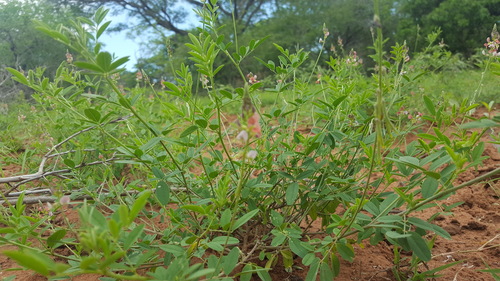
Four introduced species were recorded.
- Taxon
- Coronilla varia, Crotalaria retusa var. retusa, Indigofera subulata var. scabra, and Spartium junceum
 Spartium junceum
 Securigera varia
 Crotalaria retusa
 Indigofera subulata var. scabrae0
- Outcome
- introduced speciese0
- Value
- Foure0
- Setting
- northeastern Mexicot0
Organisms pictured · Representative pictures of the matched species, not figures from the paper.


Verbatim
e0“Four introduced species were recorded: Coronilla varia, Crotalaria retusa var. retusa, Indigofera subulata var. scabra, and Spartium junceum”
t0“Northeastern Mexico”
Claim · model-written summary
The introduced species had few wild records or were cultivated as ornamentals, with no reported weedy behavior or expansion threat.
Verbatim
e0“all of them with few records in the wild or cultivated as ornamentals, with no reports of weedy behavior or threats of population expansion”
e1“species of legumes”
t0“Northeastern Mexico”
Claim · model-written summary
Twenty-nine species and two infraspecific categories were endemic to Mexico.
Verbatim
e0“Twenty-nine species and two infraspecific categories are endemic to Mexico”
e1“species of legumes”
t0“Northeastern Mexico”
Claim · model-written summary
Eighteen endemic taxa were exclusive to northeastern Mexico.
Verbatim
e0“18 are exclusive to the northeastern region”
e1“species of legumes”
t0“Northeastern Mexico”
Claim · model-written summary
Astragalus and Lupinus accounted for up to 95% of endemic species in the northeast.
- Taxon
- Astragalus and Lupinus
 Lupinus
 Astragaluse0
- Outcome
- endemic speciese0
- Value
- up to 95%e0
- Setting
- northeastern part of the countrye0
Organisms pictured · Representative pictures of the matched species, not figures from the paper.


Verbatim
e0“Astragalus and Lupinus constitute up to 95% of the endemic species for the northeastern part of the country”
t0“Northeastern Mexico”
Claim · model-written summary
The authors call for conservation measures for ecosystems supporting these legumes.
Verbatim
e0“requires the creation of appropriate measures for the conservation of the specific ecosystems where these species grow”
e1“richness of legumes”
t0“Northeastern Mexico”