Abstract
Horizontal gene transfer (HGT), a well-established driver of genome evolution in prokaryotes, was historically considered rare in plants. However, accumulating genomic evidence supports its occurrence in angiosperms, impacting both nuclear and mitochondrial genomes, particularly in parasitic species that establish vascular connections with their hosts. Despite the increasing recognition of HGT in a few clades of parasitic plants (e.g., Cuscuta, Balanophoraceae, Rafflesiaceae, and Orobanchaceae), the underlying mechanisms and evolutionary consequences of these transfers are still not fully understood, and a few parasitic lineages have not been thoroughly examined yet (i.e., Apodanthaceae, Cytinaceae, Lennoaceae, Mitrastemonaceae). In this study, we assembled the first mtDNA of Mitrastemonaceae. Mitrastemon yamamotoi, a holoparasitic endoparasite in the order Ericales, invades the roots of host trees in the Fagaceae family, creating favorable conditions for HGT. The M. yamamotoi mtDNA exhibits a multipartite structure consisting of 54 circular-mapping chromosomes. Phylogenetic and comparative genomic analyses uncovered extensive HGT from Fagaceae hosts, affecting both coding and non-coding regions. Notably, almost 60% of the M. yamamotoi mtDNA is of foreign origin, and seven chromosomes are entirely foreign, with structural signatures in the donor mtDNA consistent with the recently proposed circle-mediated HGT model. Additionally, we detected six protein-coding genes of foreign origin and one chimeric gene. Remarkably, a foreign atp1 gene has replaced the missing native copy and represents a rare event of functional HGT in plant mitochondria. These results position M. yamamotoi as a valuable model for studying mtDNA evolution and deepening our understanding of the HGT process. Our findings expand the range of lineages in which circle-mediated HGT has been documented, suggesting it is a more widespread and fundamental mode of mitochondrial HGT in plants.
Abstract from the paper’s OpenAlex record, shown for indexing and research. Copyright remains with the authors or the publisher. Read at the source ↗
The text the model read, with the source record’s inline markup (italics, sub- and superscripts) rendered and its character entities decoded; quote offsets refer to the raw text.
Claims 7
Claim · model-written summary
The M. yamamotoi mtDNA has a multipartite structure of 54 circular-mapping chromosomes
- Taxon
- Mitrastemon yamamotoi
 Mitrastemon yamamotoie1
- Outcome
- multipartite structuree2
- Value
- 54 circular-mapping chromosomese2
Organisms pictured · Representative pictures of the matched species, not figures from the paper.
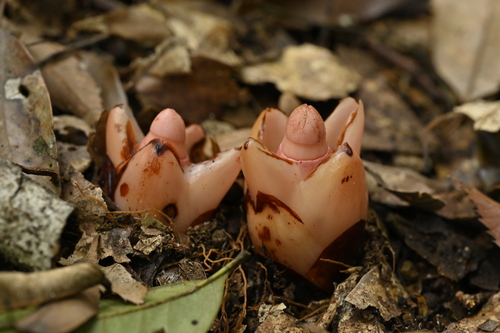
Verbatim
e1“Mitrastemon yamamotoi, a holoparasitic endoparasite in the order Ericales, invades the roots of host trees in the Fagaceae family”
e2“The M. yamamotoi mtDNA exhibits a multipartite structure consisting of 54 circular-mapping chromosomes”
Claim · model-written summary
Phylogenetic and comparative genomic analyses uncovered extensive HGT from Fagaceae hosts in M. yamamotoi, affecting coding and non-coding regions
- Taxon
- Mitrastemon yamamotoiMitrastemon yamamotoie1
- Outcome
- extensive HGT from Fagaceae hostse3
- Qualifier
- affecting both coding and non-coding regionse3
Organisms pictured · Representative pictures of the matched species, not figures from the paper.
Verbatim
e1“Mitrastemon yamamotoi, a holoparasitic endoparasite in the order Ericales, invades the roots of host trees in the Fagaceae family”
e3“Phylogenetic and comparative genomic analyses uncovered extensive HGT from Fagaceae hosts, affecting both coding and non-coding regions”
Claim · model-written summary
Almost 60% of the M. yamamotoi mtDNA is of foreign origin
- Taxon
- Mitrastemon yamamotoiMitrastemon yamamotoie1
- Outcome
- foreign origine4
- Value
- almost 60%e4
Organisms pictured · Representative pictures of the matched species, not figures from the paper.
Verbatim
e1“Mitrastemon yamamotoi, a holoparasitic endoparasite in the order Ericales, invades the roots of host trees in the Fagaceae family”
e4“almost 60% of the M. yamamotoi mtDNA is of foreign origin”
Claim · model-written summary
Seven M. yamamotoi chromosomes are entirely foreign, with structural signatures consistent with circle-mediated HGT
- Taxon
- Mitrastemon yamamotoiMitrastemon yamamotoie1
- Outcome
- chromosomes are entirely foreigne5
- Value
- sevene5
- Qualifier
- structural signatures in the donor mtDNA consistent with the recently proposed circle-mediated HGT modele5
Organisms pictured · Representative pictures of the matched species, not figures from the paper.
Verbatim
e1“Mitrastemon yamamotoi, a holoparasitic endoparasite in the order Ericales, invades the roots of host trees in the Fagaceae family”
e5“seven chromosomes are entirely foreign, with structural signatures in the donor mtDNA consistent with the recently proposed circle-mediated HGT model”
Claim · model-written summary
Six protein-coding genes in the M. yamamotoi mtDNA are of foreign origin
- Taxon
- Mitrastemon yamamotoiMitrastemon yamamotoie1
- Outcome
- protein-coding genes of foreign origine6
- Value
- sixe6
Organisms pictured · Representative pictures of the matched species, not figures from the paper.
Verbatim
e1“Mitrastemon yamamotoi, a holoparasitic endoparasite in the order Ericales, invades the roots of host trees in the Fagaceae family”
e6“we detected six protein-coding genes of foreign origin and one chimeric gene”
Claim · model-written summary
One chimeric gene was detected in the M. yamamotoi mtDNA
- Taxon
- Mitrastemon yamamotoiMitrastemon yamamotoie1
- Outcome
- chimeric genee6
- Value
- onee6
Organisms pictured · Representative pictures of the matched species, not figures from the paper.
Verbatim
e1“Mitrastemon yamamotoi, a holoparasitic endoparasite in the order Ericales, invades the roots of host trees in the Fagaceae family”
e6“we detected six protein-coding genes of foreign origin and one chimeric gene”
Claim · model-written summary
A foreign atp1 gene has replaced the missing native copy in M. yamamotoi, a rare functional HGT in plant mitochondria
- Taxon
- Mitrastemon yamamotoiMitrastemon yamamotoie1
- Gene
- atp1e7
- Outcome
- foreign atp1 gene has replaced the missing native copye7
- Qualifier
- rare event of functional HGT in plant mitochondriae7
Organisms pictured · Representative pictures of the matched species, not figures from the paper.
Verbatim
e1“Mitrastemon yamamotoi, a holoparasitic endoparasite in the order Ericales, invades the roots of host trees in the Fagaceae family”
e7“a foreign atp1 gene has replaced the missing native copy and represents a rare event of functional HGT in plant mitochondria”