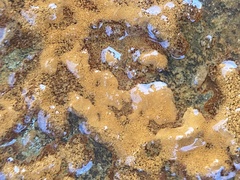
Gallionellaceae 7 claims

family · order Nitrosomonadales · 5 taxa · NCBI Taxonomy ↗

5 entries

Intervention effectobservedoriginal resultpositivesignificant (as stated)measured

Claim · model-written summary

W1 significantly increased the abundance of the genus Sideroxydans within Proteobacteria by 37% compared with W0, averaged across N rates.

Treatment
W1e0
Interactor
SideroxydansSideroxydanse0other
Outcome
abundance of the genus Sideroxydanse0
Direction
increasede0
Value
37%e0
Qualifier
averaged across N ratese0
Comparator
W0e0

Verbatim

e0

“W1 significantly increased soil OC content by 7%, the relative abundance of the phylum Proteobacteria by 16%, and the abundance of the genus Sideroxydans within Proteobacteria by 37% compared with W0, averaged across N rates”

✓ located verbatim in the source · abstract, characters 1151–1375
t0

“rice”

✓ located verbatim in the source · title, characters 131–135

Title

Temporary carbon capture potential of winter fallow weeds and their effects on topsoil organic carbon and bacterial communities in rice cropping systems

Weiqin Wang; Ge Chen; Yuling Kang; et al. Farming System 2026. doi:10.1016/j.farsys.2026.100233

Other claims from this paper (8)
Mechanismobservedoriginal resultpositivemeasured

Claim · model-written summary

Shoot-to-root signaling recruited Desulfovibrio, Gallionellaceae, and Bacillus.

Interactor
DesulfovibrioDesulfovibrioe0symbiont
Second interactor
GallionellaceaeGallionellaceaee0symbiont
Outcome
recruited functional microbese0
Qualifier
shoot-to-root signalinge1

Verbatim

e0

“recruited functional microbes ( Desulfovibrio, Gallionellaceae, and Bacillus )”

✓ located verbatim in the source · abstract, characters 828–906
e1

“this shoot-to-root signaling induced rhizosphere metabolic reprogramming”

✓ located verbatim in the source · abstract, characters 686–758
t0

“Rice”

✓ located verbatim in the source · title, characters 75–79

Title

Foliar Silicon Nanoparticles Induce Coordinated Defense against Cadmium in Rice via Jasmonate-Mediated Metabolic Reprogramming

Linfeng Li; Min Chen; Fenghua Zhai; et al. Journal of Agricultural and Food Chemistry 2026. doi:10.1021/acs.jafc.5c14175

Other claims from this paper (7)
Intervention effectobservedoriginal resultmeasured

Claim · model-written summary

Carbon dots reshaped rhizosphere bacterial community composition.

Treatment
CDse0
Interactor
SideroxydansSideroxydanse0symbiont
Outcome
bacterial community compositione0

Not reportedComparatorDirection

Verbatim

t0

“rice”

✓ located verbatim in the source · title, characters 128–132
e0

“CDs reshaped bacterial community composition (e.g., Sideroxydans)”

✓ located verbatim in the source · abstract, characters 939–1004

Title

Foliar carbon dots reprogram leaf redox metabolism and rhizosphere iron cycling to mitigate cadmium accumulation in field-grown rice

Meng Zhao; Cheng Zhang; Minggang Xu; et al. Carbon Research 2026. doi:10.1007/s44246-026-00286-0

Other claims from this paper (9)
Intervention effectobservedoriginal resultpositivemeasured

Claim · model-written summary

The RCW-HD no-till system favoured nitrogen-fixing bacterial genera.

Treatment
RCW-HD no-till systeme0
Interactor
Terrihabitans, Ferriphaselus, Azospira and RhodopseudomonasRhodopseudomonasAzospiraFerriphaselusTerrihabitanse0symbiont
Outcome
N-fixing bacterial generae0
Direction
favourede0

Not reportedComparator

Verbatim

e0

“The RCW-HD no-till system increased nitrate reduction assimilation (+13 % nrtABC ) and favoured N-fixing bacterial genera such as Terrihabitans, Ferriphaselus, Azospira and Rhodopseudomonas .”

✓ located verbatim in the source · abstract, characters 1402–1593
e1

“The experiment was conducted using tomato ( Solanum lycopersicum ) as a crop species in the Mediterranean region.”

✓ located verbatim in the source · abstract, characters 636–749

Title

Early-stage effects of carbon-rich soil amendments stimulate retention-related nitrogen genes while maintaining nitrogen and yield levels

Johana González-Coria; Michelle-Danielle Ioan; Pierre Hohmann; et al. Soil and Tillage Research 2025. doi:10.1016/j.still.2025.106729

Other claims from this paper (8)
Observationobservedoriginal resultmeasured

Claim · model-written summary

Gallionella-related bacteria increased in the oxidized root zone.

Taxon
HYDRILLA VERTICILLATAHydrilla verticillatat0
Interactor
GallionellaGallionellae0other
Outcome
Gallionella-related iron-oxidizing bacteriae0
Direction
increasede0

Verbatim

e0

“Gallionella-related iron-oxidizing bacteria and Geobacter-related iron-reducing bacteria were all increased in root oxidized zone.”

✓ located verbatim in the source · abstract, characters 575–705
t0

“HYDRILLA VERTICILLATA”

✓ located verbatim in the source · title, characters 120–141

Title

EFFECTS OF ROOT RADIAL OXYGEN LOSS ON MICROBIAL IRON CYCLING AND PHOSPHORUS REMOVAL CHARACTERISTICS IN SUBMERGED PLANT (HYDRILLA VERTICILLATA) RHIZOSPHERE

Cuicui Tian; Chunbo Wang; Yingying Tian; et al. 2017

Other claims from this paper (6)
Intervention effectobservedoriginal resultpositivemeasured

Claim · model-written summary

The Fe(II)-oxidizing bacterium Sideroxydans paludicola increased Fe(II) oxidation rates in Juncus effusus rhizosphere microcosms by 1.3 to 1.7 times relative to bacterium-free microcosms.

Taxon
Juncus effususJuncus effususe1
Treatment
Fe(II)-oxidizing bacteriume3
Interactor
Sideroxydans paludicolaSideroxydans paludicolae3other
Outcome
Fe(II) oxidation ratese2
Direction
increasede2
Value
1.3 to 1.7 timese2
Comparator
FeOB-free microcosmse2
Setting
axenic hydroponic microcosmse3

Verbatim

e1

“roots of intact Juncus effusus (soft rush) plants”

✓ located verbatim in the source · abstract, characters 436–485
e2

“the FeOB increased Fe(II) oxidation rates by 1.3 to 1.7 times relative to FeOB-free microcosms”

✓ located verbatim in the source · abstract, characters 747–841
e3

“manipulated the presence/absence of an Fe(II)-oxidizing bacterium (Sideroxydans paludicola, strain BrT) in axenic hydroponic microcosms”

✓ located verbatim in the source · abstract, characters 285–420

Title

Returning to Their Roots: Iron-Oxidizing Bacteria Enhance Short-Term Plaque Formation in the Wetland-Plant Rhizosphere

Scott C. Neubauer; Gloried E. Toledo-Durán; David Emerson; et al. Geomicrobiology Journal 2007. doi:10.1080/01490450601134309

Other claims from this paper (4)
Mechanismauthor interpretationoriginal resultnegativemeasured

Claim · model-written summary

Iron bacteria crust following rainfall was a likely cause of adult mortality in seepage areas.

Taxon
Drosera intermediaDrosera intermediat0e1
Interactor
iron bacteriaGallionellaceaee0other
Outcome
cover with a crust of iron bacteriae0
Setting
seepage areae0

Verbatim

e0

“cover with a crust of iron bacteria after heavy summer rainfall (seepage area)”

✓ located verbatim in the source · abstract, characters 931–1009
t0

“Drosera intermedia”

✓ located verbatim in the source · title, characters 77–95
e1

“Likely adult mortality causes were summer drought (all habitats), winter frost (path habitat), cover with a crust of iron bacteria after heavy summer rainfall (seepage area) and shading by Sphagnum and algae (pool edge)”

✓ located verbatim in the source · abstract, characters 836–1055

Title

The demography of a clonal herbaceous perennial plant, the longleaved sundew Drosera intermedia, in different heathland habitats

Filip De Ridder; André A. Dhondt Ecography 1992. doi:10.1111/j.1600-0587.1992.tb00016.x

Other claims from this paper (11)