Claim · model-written summary
The isolates formed a distinct lineage within Sphacelotheca with strong statistical support.
- Taxon
- Fagopyrum dibotrys
 Fagopyrum dibotryst0
- Interactor
- Sphacelotheca
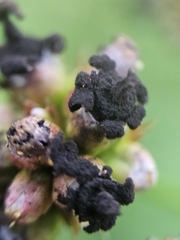 Sphacelothecae1pathogen
- Outcome
- formed a distinct lineage within Sphacelothecae1
- Value
- 100% ML/1.00 PPe1
Verbatim
t0“causing smut disease of Fagopyrum dibotrys in Yunnan, China”
e1“these isolates formed a distinct lineage within Sphacelotheca with a strong statistical support (100% ML/1.00 PP)”
Title
Sphacelotheca dibotrys , a new species causing smut disease of Fagopyrum dibotrys in Yunnan, China
Guang Wang; JiFen Cao; Chao Huo; et al. Plant Disease 2026. doi:10.1094/pdis-01-26-0113-pdn
Other claims from this paper (13)
- Observation Sphacelotheca dibotrys was identified as a distinct new species causing smut disease of Fagopyrum dibotrys.
- Intervention effect Spore suspension inoculation of F. dibotrys stems produced flower symptoms, whereas sterile-water control plants remained symptomless.
- Observation Smut symptoms appeared in ovaries of field-grown F. dibotrys in Yunnan Province, China.
- Observation Symptomatic flowers showed ovary swelling and malformation, necrotic petals with brown-to-black lesions, and spurted smuts.
- Observation Most floral organs abscised, resulting in an inability to grow.
- Observation This is the first report of S. dibotrys causing smut disease on F. dibotrys in China.
- Observation The inoculation results collectively fulfill Koch postulates for S. dibotrys on F. dibotrys.
- Observation Most nodules on the spore surface were interconnected, forming an irregular reticulum.
- Observation Spores are pale violaceous or violaceous, globose, subglobose, broadly ellipsoid or rarely ovoid.
- Observation Spores of the new species are larger than those of S. polygoni-serrulati.
- Observation Spores of the new species are larger than those of S. reiliana.
- Observation Spores of the new species are larger than those of S. polygoni-persicariae.
- Observation Spherical to broadly ellipsoid spores were occasionally observed in chains.
 Silene latifolia
 Microbotryum lychnidis-dioicae
 Silene uniflora
 Microbotryum