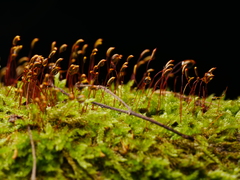
Hypnaceae 4 claims

family · order Hypnales · 3 taxa · NCBI Taxonomy ↗

3 entries

Associationobservedoriginal resultmeasured

Claim · model-written summary

On smooth bark, Dicranum viride occurrence was strongly related to Hypnum cupressiforme var. filiforme abundance.

Taxon
Dicranum virideDicranum viridet0
Interactor
Hypnum cupressiforme var. filiformeHypnum cupressiforme var. filiformee0other
Outcome
occurrence of D. viridee0
Qualifier
trees with a smooth barke0

Not reportedDirection

Verbatim

t0

“Dicranum viride”

✓ located verbatim in the source · title, characters 31–46
e0

“The occurrence of D. viride on trees with a smooth bark is strongly related to the abundance of Hypnum cupressiforme var. filiforme”

✓ located verbatim in the source · abstract, characters 386–517

Title

The vegetative reproduction of Dicranum viride (Sull. & Lesq.) Lindb. as a likely explanation for micro-habitat and stand-type relationships – implications for forest management

Aurélien Gréaume; Vincent Hugonnot; Florine Pépin; et al. Lindbergia 2023. doi:10.25227/linbg.01166

Other claims from this paper (5)
Mechanismhypothesisoriginal resultmeasured

Claim · model-written summary

Hypnum cupressiforme var. filiforme may help large Dicranum viride leaf fragments establish on smooth bark.

Taxon
Dicranum virideDicranum viridet0
Interactor
Hypnum cupressiforme var. filiformeHypnum cupressiforme var. filiformee0other
Outcome
establishment of large leaf fragments on smooth barke0

Verbatim

t0

“Dicranum viride”

✓ located verbatim in the source · title, characters 31–46
e0

“Hypnum cupressiforme var. filiforme, which may facilitate establishment of large leaf fragments on smooth bark”

✓ located verbatim in the source · abstract, characters 482–592

Title

The vegetative reproduction of Dicranum viride (Sull. & Lesq.) Lindb. as a likely explanation for micro-habitat and stand-type relationships – implications for forest management

Aurélien Gréaume; Vincent Hugonnot; Florine Pépin; et al. Lindbergia 2023. doi:10.25227/linbg.01166

Other claims from this paper (5)
Intervention effectobservedoriginal resultnegativemeasured

Claim · model-written summary

H. plumaeforme EtOAc extracts inhibited growth of angiosperms, moss and liverwort plants.

Taxon
angiosperms, moss, and liverwort plantse0
Treatment
EtOAc extracts from H. plumaeformee0
Interactor
H. plumaeformeCalohypnum plumiformee0other
Outcome
growth inhibitory activitye0
Direction
inhibitorye0

Not reportedComparator

Verbatim

e0

“EtOAc extracts from H. plumaeforme and 2 showed growth inhibitory activity against angiosperms, moss, and liverwort plants.”

✓ located verbatim in the source · abstract, characters 361–484

Title

Momilactone A and B as Allelochemicals from MossHypnum plumaeforme: First Occurrence in Bryophytes

Hiroshi NOZAKI; Ken-ichiro HAYASHI; Naoki NISHIMURA; et al. Bioscience Biotechnology and Biochemistry 2007. doi:10.1271/bbb.70625

Other claims from this paper (7)
Associationobservedoriginal resultmeasured

Claim · model-written summary

Layering was associated with absent or scarce Hypnum cupressiforme/jutlandicum and lichens.

Taxon
Calluna vulgarisCalluna vulgarist0
Interactor
Hypnum cupressiforme/jutlandicumHypnum cupressiformee0other
Outcome
Layeringe0
Qualifier
absence or low abundancee0

Not reportedDirection

Verbatim

e0

“Layering was associated with the absence or low abundance of Hypnum cupressiforme/jutlandicum and lichens (mainly Cladonia spp.)”

✓ located verbatim in the source · abstract, characters 812–940
t0

“Heather (Calluna vulgaris)”

✓ located verbatim in the source · title, characters 36–62

Title

Regeneration by Natural Layering of Heather (Calluna vulgaris): Frequency and Characteristics in Upland Britain

A. J. MacDonald; A. H. Kirkpatrick; A. J. Hester; et al. Journal of Applied Ecology 1995. doi:10.2307/2404418

Other claims from this paper (16)