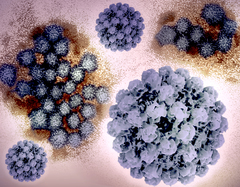
Caliciviridae 17 claims

family · order Picornavirales · 5 taxa · NCBI Taxonomy ↗

5 entries

Observationobservedoriginal resultmeasured

Claim · model-written summary

Murine norovirus translocated through the vascular system to the stems and leaves of green onion.

Taxon
green oniont0
Organ / stage
stems and leavese2
Interactor
Murine NorovirusMurine norovirust0other
Outcome
translocating through the vascular systeme2

Verbatim

t0

“Murine Norovirus in Hydroponically Grown Green Onion”

✓ located verbatim in the source · title, characters 36–88
e2

“subsequently translocating through the vascular system to the stems and leaves”

✓ located verbatim in the source · abstract, characters 510–588

Title

Internalization and Localization of Murine Norovirus in Hydroponically Grown Green Onion (Allium Fistulosum L.)

Soontag Jung; Hansaem Shin; Daseul Yeo; et al. Food and Environmental Virology 2026. doi:10.1007/s12560-026-09679-1

Other claims from this paper (8)
Observationobservedoriginal resultmeasured

Claim · model-written summary

Murine norovirus viral loads peaked in green onion roots and persisted for at least 21 days post-inoculation.

Taxon
green oniont0
Organ / stage
rootse3
Interactor
Murine NorovirusMurine norovirust0other
Outcome
Viral loadse3
Qualifier
persisted for at least 21 days post-inoculatione3

Verbatim

t0

“Murine Norovirus in Hydroponically Grown Green Onion”

✓ located verbatim in the source · title, characters 36–88
e3

“Viral loads consistently peaked in the roots and persisted for at least 21 days post-inoculation”

✓ located verbatim in the source · abstract, characters 590–686

Title

Internalization and Localization of Murine Norovirus in Hydroponically Grown Green Onion (Allium Fistulosum L.)

Soontag Jung; Hansaem Shin; Daseul Yeo; et al. Food and Environmental Virology 2026. doi:10.1007/s12560-026-09679-1

Other claims from this paper (8)
Intervention effectobservedoriginal resultpositivemeasured

Claim · model-written summary

A single water exchange decreased murine norovirus load within green onion tissues, although viral genomes stayed detectable for up to 21 days.

Taxon
green oniont0
Treatment
A single water exchange proceduree4
Interactor
Murine NorovirusMurine norovirust0other
Outcome
viral load within plant tissuese4
Direction
decreasee4

Not reportedComparator

Verbatim

t0

“Murine Norovirus in Hydroponically Grown Green Onion”

✓ located verbatim in the source · title, characters 36–88
e4

“A single water exchange procedure resulted in a gradual decrease in viral load within plant tissues, although viral genomes remained detectable for up to 21 days”

✓ located verbatim in the source · abstract, characters 688–849

Title

Internalization and Localization of Murine Norovirus in Hydroponically Grown Green Onion (Allium Fistulosum L.)

Soontag Jung; Hansaem Shin; Daseul Yeo; et al. Food and Environmental Virology 2026. doi:10.1007/s12560-026-09679-1

Other claims from this paper (8)
Intervention effectobservedoriginal resultpositivemeasured

Claim · model-written summary

Repeated water exchanges cleared murine norovirus from green onion leaves and stems.

Taxon
green oniont0
Organ / stage
leaves and stemse5
Treatment
Repeated water exchangese5
Interactor
Murine NorovirusMurine norovirust0other
Outcome
the virus from leaves and stemse5
Direction
clearede5

Not reportedComparator

Verbatim

t0

“Murine Norovirus in Hydroponically Grown Green Onion”

✓ located verbatim in the source · title, characters 36–88
e5

“Repeated water exchanges effectively cleared the virus from leaves and stems but failed to eradicate it entirely from the roots”

✓ located verbatim in the source · abstract, characters 851–978

Title

Internalization and Localization of Murine Norovirus in Hydroponically Grown Green Onion (Allium Fistulosum L.)

Soontag Jung; Hansaem Shin; Daseul Yeo; et al. Food and Environmental Virology 2026. doi:10.1007/s12560-026-09679-1

Other claims from this paper (8)
Intervention effectobservedoriginal resultnegativemeasured

Claim · model-written summary

Repeated water exchanges failed to eradicate murine norovirus entirely from green onion roots.

Taxon
green oniont0
Organ / stage
rootse5
Treatment
Repeated water exchangese5
Interactor
Murine NorovirusMurine norovirust0other
Outcome
eradicate it entirelye5
Direction
failed to eradicatee5

Not reportedComparator

Verbatim

t0

“Murine Norovirus in Hydroponically Grown Green Onion”

✓ located verbatim in the source · title, characters 36–88
e5

“Repeated water exchanges effectively cleared the virus from leaves and stems but failed to eradicate it entirely from the roots”

✓ located verbatim in the source · abstract, characters 851–978

Title

Internalization and Localization of Murine Norovirus in Hydroponically Grown Green Onion (Allium Fistulosum L.)

Soontag Jung; Hansaem Shin; Daseul Yeo; et al. Food and Environmental Virology 2026. doi:10.1007/s12560-026-09679-1

Other claims from this paper (8)
Observationobservedoriginal resultmeasured

Claim · model-written summary

Immunofluorescence localized murine norovirus predominantly within green onion xylem and phloem vessels.

Taxon
green oniont0
Organ / stage
xylem and phloem vesselse6
Interactor
Murine NorovirusMurine norovirust0other
Outcome
localized the viruse6

Verbatim

t0

“Murine Norovirus in Hydroponically Grown Green Onion”

✓ located verbatim in the source · title, characters 36–88
e6

“Immunofluorescence analysis localized the virus predominantly within the vascular tissues, specifically the xylem and phloem vessels”

✓ located verbatim in the source · abstract, characters 980–1112

Title

Internalization and Localization of Murine Norovirus in Hydroponically Grown Green Onion (Allium Fistulosum L.)

Soontag Jung; Hansaem Shin; Daseul Yeo; et al. Food and Environmental Virology 2026. doi:10.1007/s12560-026-09679-1

Other claims from this paper (8)
Observationobservedoriginal resultmeasured

Claim · model-written summary

Murine norovirus particles persisted on green onion root hair surfaces despite rigorous washing.

Taxon
green oniont0
Organ / stage
root hairse7
Treatment
rigorous washing protocolse7
Interactor
Murine NorovirusMurine norovirust0other
Outcome
viral particles persistede7

Verbatim

t0

“Murine Norovirus in Hydroponically Grown Green Onion”

✓ located verbatim in the source · title, characters 36–88
e7

“most notably on the rough, porous surfaces of root hairs, where viral particles persisted despite rigorous washing protocols”

✓ located verbatim in the source · abstract, characters 1118–1242

Title

Internalization and Localization of Murine Norovirus in Hydroponically Grown Green Onion (Allium Fistulosum L.)

Soontag Jung; Hansaem Shin; Daseul Yeo; et al. Food and Environmental Virology 2026. doi:10.1007/s12560-026-09679-1

Other claims from this paper (8)
Observationobservedoriginal resultnegativemeasured

Claim · model-written summary

FCV incidence in sampled fig trees was 45%.

Taxon
Figt0
Interactor
FCVFeline caliciviruse0pathogen
Outcome
incidencee0
Value
45%e0

Verbatim

e0

“FCV was the prevailing virus with an incidence of 45% followed by FLMaV-1 (39%), FMV (37%), FMMaV (28%), FFkaV (16%) and FLMaV-2 (10%)”

✓ located verbatim in the source · abstract, characters 923–1057
t0

“Fig Mosaic Disease”

✓ located verbatim in the source · title, characters 55–73

Title

Prevalence and Distribution of Viruses Associated with Fig Mosaic Disease in Iraq

Nabeel Al-Kaeath; Manel Elair; Naima Mahfoudhi Tunisian Journal of Plant Protection 2024. doi:10.4314/tjpp.v19i1.1

Other claims from this paper (14)
Observationobservedoriginal resultpositivesimulated

Claim · model-written summary

Estimated annual infection risk from Norovirus through lettuce is 10−10–10−11.

Taxon
lettuceLactuca sativae2
Interactor
NorovirusNoroviruse4pathogen
Outcome
estimated annual infection riske4
Value
10−10–10−11e4

Verbatim

e4

“The estimated annual infection risk for Cryptosporidium, Campylobacter, and Norovirus was 10−6–10−8, 10−8–10−10, and 10−10–10−11 respectively”

✓ located verbatim in the source · abstract, characters 1114–1255
e2

“The final effluent from the system was used to grow three lettuce varieties by adding urine as a nutrient solution”

✓ located verbatim in the source · abstract, characters 741–855

Title

Treated Greywater Reuse for Hydroponic Lettuce Production in a Green Wall System: Quantitative Health Risk Assessment

Fasil Eregno; Melesse Moges; Arve Heistad Water 2017. doi:10.3390/w9070454

schema checkedfield values found in the cited quotesPermalinkReport an issue

Other claims from this paper (6)
Associationobservedoriginal resultmeasured

Claim · model-written summary

Effectiveness of meristem culture against FCV was related to meristem size.

Taxon
Ficus carica L.Ficus caricat0
Organ / stage
meristem sizee0
Interactor
FCVFeline caliciviruse0pathogen
Outcome
elimination of FCVe0

Not reportedDirection

Verbatim

e0

“the effectiveness of meristem culture for the elimination of FCV and FMMaV viruses was related to meristem size.”

✓ located verbatim in the source · abstract, characters 223–335
t0

“Ficus carica L.”

✓ located verbatim in the source · title, characters 88–103

Title

Efficacy of Tissue Culture in Virus Elimination from Caprifig and Female Fig Varieties (Ficus carica L.)

Chokri Bayoudh; Manel Elair; Rahma Labidi; et al. The Plant Pathology Journal 2017. doi:10.5423/ppj.oa.10.2016.0205

Other claims from this paper (6)