Claim · model-written summary
Aspergillus flavus, A. welwitschiae, A. niger and A. brasiliensis had the highest incidences.
- Interactor
- A. flavus, A. welwitschiae, A. niger and A. brasiliensis
 Aspergillus flavus
 Aspergillus niger
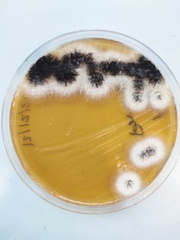 Aspergillus brasiliensisAspergillus welwitschiaee2other
- Outcome
- incidencese2
 Zea mays
Verbatim
e1“Spreading of fall armyworm [Spodoptera frugiperda (J.E. Smith) (Lepidoptera: Noctuidae)] on cobs of maize (Zea mays) plants”
e2“The fungal species A. flavus, A. welwitschiae, A. niger and A. brasiliensis were found to have the height incidences”
Title
A. A. A. Mahmoud; M. M. S. Bakry; Mohamed ahmed Hussein; et al. SVU-International Journal of Agricultural Sciences 2025. doi:10.21608/svuijas.2025.341028.1415
Other claims from this paper (7)
- Observation The highest larval counts and infestation percentages occurred in July, August and September in 2021 and 2022.
- Association Number of larvae was strongly correlated with the extent of infestation by pests.
- Observation Thirteen fungal species were isolated from infested maize cobs.
- Observation The isolated fungi belonged to the genera Aspergillus, Fusarium, Myrothecium, Penicillium, Rhizopus and Trichoderma.
- Observation Trichoderma virdi had the lowest incidence percentage among the isolated fungi.
- Observation The invasion of fall armyworm on maize plants was observed from the third week of June to harvest.
- Recommendation The results can help farmers and decision makers develop strategies to manage fall armyworm on maize.