Literal values, not normalised. 437,395 distinct spellings cover 11,236,429 claims; only letter case and spacing are merged, so “maize”, “corn” and “Zea mays L.” are three separate entries here. The By organism view merges spellings of one organism through NCBI Taxonomy.
Observation observed original result measured Claim · model-written summary
The wasp developed in culms from older stalks during winter and early summer.
wasp e0 herbivore wasp utilizes A . donax culm stems e0 winter and early summer e0 Verbatim
e0 “The wasp utilizes A . donax culm stems growing from hardening ≥1st‐year stalks for development in the winter and early summer when the larvae pupate and emerge as adults ”
✓ located verbatim in the source · abstract, characters 1260–1429 Other claims from this paper (6) Observation observed original result measured Claim · model-written summary
Appreciable parasitism occurred during only 8.3–16.7% of the plant lifespan.
T . romana parasitism e0 Verbatim
e0 “appreciable T . romana parasitism of an A . donax plant only occurs for 8.3–16.7% of the plant's 2‐year lifespan ”
✓ located verbatim in the source · abstract, characters 1445–1557 Other claims from this paper (6) Observation author interpretation original result measured Claim · model-written summary
The authors judged the wasp ineffective for biological control.
wasp e0 herbivore ineffective as a biological control agent e0 Verbatim
e0 “Hence, the exotic wasp is ineffective as a biological control agent against A . donax ”
✓ located verbatim in the source · abstract, characters 1767–1852 Other claims from this paper (6) Observation observed original result positive measured Claim · model-written summary
A. donax had zero mortality across the salinity treatments.
Not reported Direction
Verbatim
e0 “Yet, there was zero mortality indicating that A . donax is able to tolerate high levels of salt. ”
✓ located verbatim in the source · abstract, characters 785–881 Other claims from this paper (7) Observation observed original result positive measured Claim · model-written summary
Assimilation rates remained 7–12 μmol m −2 s −1 at 38–42 dS m −1 salinity.
salinities were 38–42 dS m −1 e0 assimilation rates e0 7–12 μmol m −2 s −1 e0 Verbatim
e0 “even when salinities were 38–42 dS m −1 A . donax was able to maintain assimilation rates 7–12 μmol m −2 s −1 ”
✓ located verbatim in the source · abstract, characters 1185–1294 Other claims from this paper (7) Observation observed original result positive measured Claim · model-written summary
A. donax retained 50% relative growth at about 12 dS m −1 and was classified moderately salt tolerant.
salinities ~12 dS m −1 e0 ‘moderately salt tolerant’ e0 Verbatim
e0 “by maintaining 50% relative growth at salinities ~12 dS m −1 A . donax can now be classified as ‘moderately salt tolerant’. ”
✓ located verbatim in the source · abstract, characters 1306–1429 Other claims from this paper (7) Observation observed original result positive measured Claim · model-written summary
A. donax leaf gas exchange and whole-plant salt tolerance exceeded the listed crop and wild species.
leaf gas exchange and whole‐plant salt tolerance e0 many important food crops e0 Verbatim
e0 “A . donax leaf gas exchange and whole‐plant salt tolerance are greater than many important food crops (i.e. maize, rice), the bioenergy feedstock M iscanthus × giganteus, as well as some uncultivated plant species (i.e. P opulus and S alix ) ”
✓ located verbatim in the source · abstract, characters 1430–1671 Other claims from this paper (7)  Arundo donaxe0
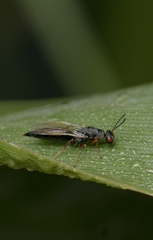 Tetramesa romana