Claim · model-written summary
The authors suggest that at least the sixth-century specimens may be classified as domesticated azuki.
- Taxon
- V. angularis var. angularis
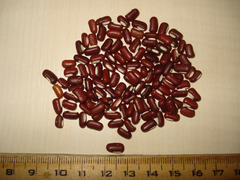 Vigna angularis var. angularise0
- Outcome
- may be addressed as azukie0
- Qualifier
- specimens dating to the 6th century CEe0
Verbatim
e0“at least the specimens dating to the 6th century CE may be addressed as azuki (V. angularis var. angularis), the domesticated form of V. angularis var. nipponensis”
Title
Christian Leipe; Jou-chun Lu; Ko-an Chi; et al. Quaternary International 2021. doi:10.1016/j.quaint.2021.06.032
Other claims from this paper (8)
- Observation The study presents the first directly dated archaeobotanical record of V. angularis from Taiwan.
- Observation Results suggest V. angularis was used locally from the first half of the first millennium BCE to the sixth century CE.
- Observation The authors infer that V. angularis was an important part of the local diet.
- Observation Younger V. angularis specimens were larger on average than older ones.
- Association The authors suggest that the pulse may have undergone selection for increased size.
- Observation Prehistoric Taiwan may have been an independent center of azuki cultivation or domestication.
- Observation The larger pulses from Taiwan appeared 4500–1500 years later than comparative domestication evidence from Japan, Korea and China.
- Observation The authors offer introduction by immigrating farmers or exchange across the Taiwan Strait as an alternative explanation for azuki on Taiwan.