Claim · model-written summary
Vaccinium myrtillus recovered after disturbance primarily by resprouting from intact rhizomes.
- Taxon
- Vaccinium myrtillus
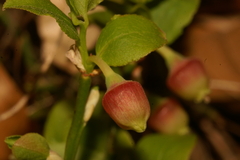 Vaccinium myrtilluse6
- Outcome
- recoverede5
- Qualifier
- primarily by resprouting from intact rhizomese5
Not reportedMaterialGeneCompoundOrgan / stageInteractorInteractor roleSecond interactorSecond interactor roleTreatmentComparatorSettingDirectionValue
Organisms pictured · Representative pictures of the matched species, not figures from the paper.

Verbatim
e5“recovered during a three‐year period primarily by resprouting from intact rhizomes”
e6“Vaccinium myrtillus”
Title
Revegetation following experimental disturbance in a boreal old‐growth Picea abies forest
Knut Rydgren; Geir Hestmark; Rune H. Økland Journal of Vegetation Science 1998. doi:10.2307/3237042
Other claims from this paper (13)
- Intervention effect Cover of vascular plants recovered slowly after disturbance.
- Intervention effect Cover of bryophytes and lichens recovered even more slowly after disturbance than vascular plant cover.
- Intervention effect The least severe treatments were followed by the fastest recovery in Picea abies forest.
- Intervention effect The mean number of vascular plant species was higher three years after disturbance than before.
- Intervention effect The number of bryophyte species showed the opposite pattern, lower three years after disturbance than before.
- Mechanism Germination from the soil propagule bank was an important recovery mechanism for Luzula pilosa.
- Mechanism Dispersal of propagules into disturbed patches was an important recovery mechanism for Betula pubescens.
- Mechanism Microsite limitation may prevent Gymnocarpium dryopteris from appearing in disturbed patches.
- Association Disturbance severity influenced revegetation patterns.
- Association The length of the successional path increased with increasing disturbance severity.
- Association The length of the successional path was also influenced by the area of the disturbed patch and the distance to intact vegetation.
- Observation The rate of succession decreased year by year in floristic space.
- Observation The rate of succession first decreased and then increased in ordination space.