Claim · model-written summary
RAPD markers grouped 44 accessions into four clusters.
- Taxon
- C. maxima
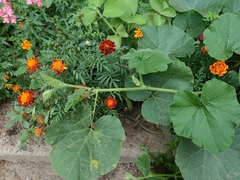 Cucurbita maximae0
- Outcome
- four clusterse0
- Value
- four clusterse0
- Qualifier
- RAPD markerse0
Not reportedMaterialGeneCompoundOrgan / stageInteractorInteractor roleSecond interactorSecond interactor roleTreatmentComparatorSettingDirection
Organisms pictured · Representative pictures of the matched species, not figures from the paper.

Verbatim
e0“morphological characteristics and RAPD markers grouped 44 accessions of C. maxima into four clusters, and the similarity coefficients ranged from 0.70 to 0.91 and from 0.40 to 0.98, respectively”
Title
Dan Zhao; Ling Wen; Hongwen Bi; et al. Acta Agriculturae Scandinavica Section B - Soil & Plant Science 2016. doi:10.1080/09064710.2016.1236981
Other claims from this paper (9)
- Observation Cucurbita maxima accessions showed large qualitative variation, especially in fruit traits.
- Method / resource Twenty-eight RAPD markers generated 128 bands.
- Method / resource Morphological characteristics grouped 44 accessions into four clusters.
- Observation Morphological similarity coefficients ranged from 0.70 to 0.91.
- Observation RAPD similarity coefficients ranged from 0.40 to 0.98.
- Association DNA polymorphisms were highly consistent with rootstock phenotypic traits.
- Method / resource Morphology and RAPD did not clearly resolve relationships among accessions from different origins.
- Observation Hybrid generations, parents and sister lines had little genetic distance under both methods.
- Method / resource Morphology and RAPD were consistent and revealed high diversity between landraces from different origins.