Claim · model-written summary
The authors interpreted Norwegian isolates as distinct from other S. homoeocarpa.
- Taxon
- S. homoeocarpa
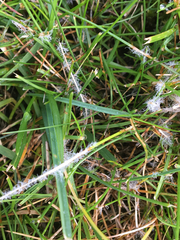 Clarireedia homoeocarpae0
- Outcome
- Norwegian isolates are distincte0
Not reportedMaterialGeneCompoundOrgan / stageInteractorInteractor roleSecond interactorSecond interactor roleTreatmentComparatorSettingDirectionValueQualifier
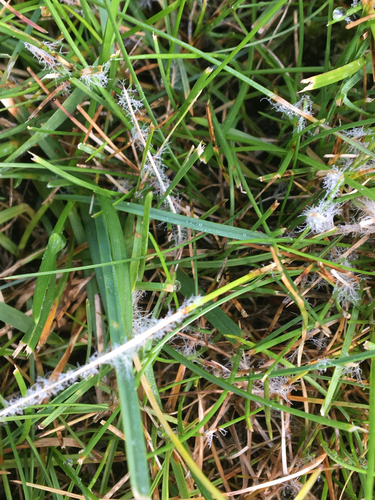
Organisms pictured · Representative pictures of the matched species, not figures from the paper.
Verbatim
e0“This similarity is considered quite low within a species and indicates that the Norwegian isolates are distinct from other S. homoeocarpa.”
Title
First Report of Dollar Spot, Caused by Sclerotinia homoeocarpa, of Creeping Bentgrass in Norway
T. Espevig; M. B. Brurberg; A. Kvalbein Plant Disease 2014. doi:10.1094/pdis-07-14-0775-pdn
Other claims from this paper (16)
- Observation Dollar spot-like symptoms occurred on creeping bentgrass fairways in Norway.
- Observation Affected turf had bleached patches and leaves with tan lesions and reddish-brown margins.
- Observation Diseased turf developed abundant aerial mycelium after moist incubation.
- Observation The fungus had septate mycelium with y-shaped branches and no observed spores.
- Observation The fungus colonized 9-cm PDA plates in six days.
- Observation Hyphal diameter ranged from 2.5 to 12.5 μm.
- Observation White floccose mycelium turned olive green after seven days.
- Observation Mycelium turned cinnamon brown after 21 days.
- Observation Cultures formed flat dark-brown stroma 0.5 to 5.0 mm in diameter.
- Observation The three isolates had identical sequences.
- Observation Isolates showed up to 97.6% sequence similarity to common-type S. homoeocarpa.
- Intervention effect Inoculated creeping bentgrass exhibited 30 to 90% dollar spot symptoms after 14 days while controls remained healthy.
- Observation The fungus was recovered from inoculated turf and identified morphologically.
- Observation This was the first dollar spot report on grass in Norway.
- Observation Dollar spot-like symptoms had occurred on over 15 Scandinavian golf courses with damage from low to severe.
- Observation The disease was given the Norwegian name myntflekk.