Claim · model-written summary
Fruit weight fell from 2.04 to 1.56 kg with increasing density in the 2016 dryland trial.
- Taxon
- Winter Squash
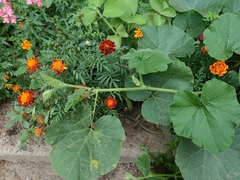 Cucurbita maximat0
- Treatment
- planting densitye0
- Outcome
- Average fruit weighte0
- Direction
- decreasede0
- Value
- 2.04 to 1.56 kge0
- Qualifier
- 2016 dryland triale0
Not reportedMaterialGeneCompoundOrgan / stageInteractorInteractor roleSecond interactorSecond interactor roleComparatorSetting
Organisms pictured · Representative pictures of the matched species, not figures from the paper.

Verbatim
e0“Average fruit weight decreased linearly from 1.89 to 1.30 kg for the irrigated trials, from 2.04 to 1.56 kg in the 2016 dryland trial, and from 1.42 to 0.93 kg in the 2017 dryland trial as planting density increased from 0.86 to 3.2, 0.38 to 1.4, and 0.57 to 2.2 plants/m 2 , respectively.”
t0“Winter Squash”
Title
Yield Response of Winter Squash to Irrigation Regime and Planting Density
Jennifer Wetzel; Alexandra Stone HortScience 2019. doi:10.21273/hortsci13690-18
Other claims from this paper (16)
- Observation Seven C. maxima types had statistically comparable yields under irrigated and dryland production.
- Observation Dryland yields were 76% of irrigated yields in 2016.
- Observation Dryland yields were 37% of irrigated yields in 2017.
- Observation Irrigated Tetsukabuto had the greatest yield, averaging 51.4 t·ha −1.
- Observation Irrigated Tetsukabuto had the greatest fruit number per hectare, averaging 12,080.
- Observation Irrigated Tetsukabuto had the greatest fruit number per plant, averaging 1.94.
- Observation Tetsukabuto yield was comparable with other varieties in dryland production.
- Association Planting density affected fruit weight, fruit number per hectare, and fruit number per plant.
- Association Planting density did not statistically affect yield in irrigated or dryland production.
- Association Irrigated fruit weight fell from 1.89 to 1.30 kg with increasing density.
- Association Fruit weight fell from 1.42 to 0.93 kg with increasing density in the 2017 dryland trial.
- Association Irrigated fruit number per hectare rose from 6660 to 10,590 as density increased.
- Observation Plants produced no more than two fruit per plant on average across varieties with irrigation, even at the lowest density.
- Recommendation Farmers can adjust squash fruit size by changing planting density.
- Mechanism The authors attribute very low 2017 dryland yields to unusually high summer temperatures in western Oregon.
- Recommendation The authors warn that increasingly hot summers may make dryland squash production unfeasible in western Oregon.