Claim · model-written summary
RT-PCR showed similarity between the lavender isolate and a Netherlands CMV subgroup II isolate.
- Taxon
- Lavandula angustifolia Mill.
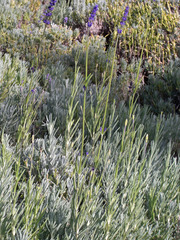 Lavandula angustifoliat0
- Interactor
- CMV
 cucumber mosaic cucumoviruse0pathogen
- Outcome
- similarity between the investigated isolate and the isolate of CMVe0
- Setting
- Netherlandse0
Not reportedMaterialGeneCompoundOrgan / stageSecond interactorSecond interactor roleTreatmentComparatorDirectionValueQualifier
Organisms pictured · Representative pictures of the matched species, not figures from the paper.

Verbatim
e0“RT-PCR reaction revealed similarity between the investigated isolate and the isolate of CMV from the Netherlands belonging to subgroup II.”
t0“Lavandula angustifolia Mill.”
Title
Lavandula angustifolia Mill. as a natural host of Cucumber mosaic virus (CMV)
Tadeusz Kobyłko; Piotr Dańda; Beata Hasiów; et al. Folia Horticulturae 2008. doi:10.2478/fhort-2013-0107
Other claims from this paper (7)
- Observation Lavandula plants showed yellow leaf mottling and distortion with an isolated virus.
- Intervention effect Mechanical inoculation of the virus induced symptoms characteristic of Cucumber mosaic virus in most test plants.
- Observation The lavender virus remained viable in vitro for 1-2 days.
- Observation The lavender virus had a thermal inactivation point of 55-60°C.
- Observation The lavender virus had a dilution endpoint of log10minus 3 - 4.
- Observation The lavender virus reacted positively with CMV antiserum in DAS-ELISA.
- Observation The authors identified the lavender pathogen as Cucumber mosaic virus and lavender as a natural host.