Claim · model-written summary
C. sativus caused seedling blight and root and crown discoloration and necrosis in test tubes and greenhouse.
- Taxon
- Soft Red Winter Wheatt0
- Organ / stage
- seminal roots and crownse0
- Treatment
- infected with isolates of C. sativuse0
- Interactor
- C. sativus
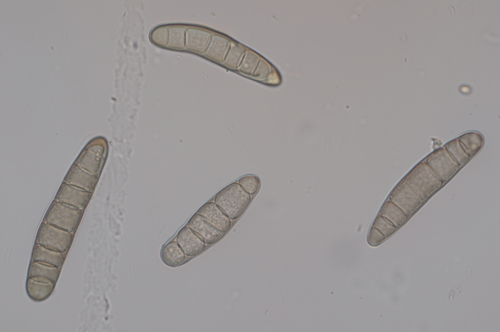
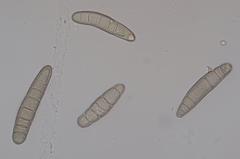 Bipolaris sorokinianae0pathogen
- Outcome
- seedling blight, discoloration and necrosise0
Not reportedMaterialGeneCompoundSecond interactorSecond interactor roleComparatorSettingDirectionValueQualifier
Organisms pictured · Representative pictures of the matched species, not figures from the paper.
Verbatim
e0“In test tubes and in the greenhouse, seedlings infected with isolates of C. sativus developed seedling blight, discoloration and necrosis, primarily in seminal roots and crowns”
t0“Soft Red Winter Wheat”
Title
M. S. Gonzalez; L. E. Trevathan Journal of Phytopathology 2000. doi:10.1046/j.1439-0434.2000.00477.x
Other claims from this paper (14)
- Observation Seedling stand fell by 40% each year in untreated seed plots.
- Observation Cochliobolus sativus was the most frequently isolated fungus from the wheat disease survey.
- Observation Fusarium acuminatum, Fusarium equiseti, and Fusarium solani were the most prevalent Fusarium species.
- Observation Seven additional Fusarium species and 23 other fungal species were isolated.
- Intervention effect In greenhouse tests, C. sativus caused lower leaf sheath lesions.
- Intervention effect In greenhouse tests, C. sativus reduced seedling height, emergence, and root and shoot weights.
- Intervention effect F. acuminatum caused slight to moderate crown and seminal-root discoloration in test tubes.
- Intervention effect C. spicifer caused black root discoloration and root pruning and reduced emergence and seedling weights.
- Intervention effect In greenhouse tests, F. acuminatum reduced seedling height, emergence, and root and shoot dry weights.
- Intervention effect M. bolleyi reduced root weights, emergence, and shoot dry weight.
- Intervention effect E. chlamydospora reduced root weights, emergence, and shoot dry weight.
- Intervention effect F. acuminatum reduced wheat seedling growth rate.
- Intervention effect C. spicifer reduced wheat seedling growth rate.
- Intervention effect All evaluated fungi increased disease severity versus untreated controls.