Claim · model-written summary
Inbreeding depression probably caused Sanctambrosia woody habit and gynodioecy.
- Taxon
- Sanctambrosia
 Sanctambrosiae1
- Outcome
- woody habit and gynodioecye0
- Qualifier
- inbreeding depressione0
Not reportedMaterialGeneCompoundOrgan / stageInteractorInteractor roleSecond interactorSecond interactor roleTreatmentComparatorSettingDirectionValue
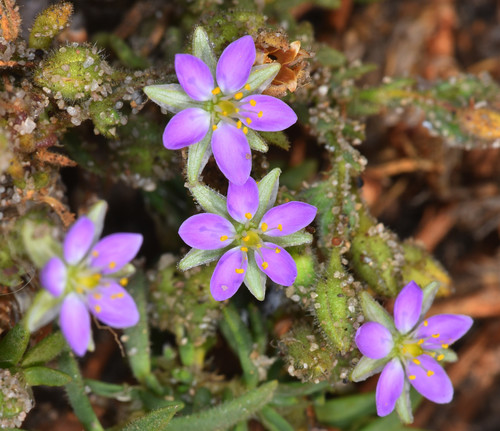
Organisms pictured · Representative pictures of the matched species, not figures from the paper.
Verbatim
e0“its woody habit and gynodioecy are probably caused by inbreeding depression”
e1“Sanctambrosia, the only tree-like plant in Caryophyllaceae”
Title
Desert Plants and Deserted Islands : Systematics and Ethnobotany in Caryophyllaceae
Anneleen Kool KTH Publication Database DiVA (KTH Royal Institute of Technology) 2012
Other claims from this paper (13)
- Observation Polycarpon is polyphyletic.
- Observation Sphaerocoma is sister to Pollichia and has intraspecific variation.
- Observation Sanctambrosia falls within Spergularia.
- Observation Spergula and Spergularia are monophyletic.
- Observation Preliminary data suggest Polycarpaea is polyphyletic.
- Observation Caryophyllaceae emerged during the Paleocene, according to preliminary data.
- Observation Major extant Caryophyllaceae lineages originated in the Oligocene and diversified later.
- Method / resource Molecular identification resolved around 50% of Moroccan medicinal roots to species level.
- Method / resource Molecular identification resolved an additional 30% of Moroccan medicinal roots to genus level.
- Observation Sphaerocoma species were merged into one species with two subspecies.
- Mechanism Sanctambrosia is probably due to long-distance dispersal.
- Observation Sanctambrosia manicata was transferred to Spergularia.
- Method / resource Molecular identification of traded medicinal roots had a lower success rate than theoretical studies.