Claim · model-written summary
Low water potential was associated with increased root to shoot ratio.
- Taxon
- PROSOPIS GLANDULOSA VAR. TORREYANA
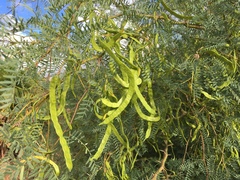 Neltuma odoratat0
- Outcome
- root to shoot ratioe0
- Direction
- increasede0
- Qualifier
- Low water potentiale0
Not reportedMaterialGeneCompoundOrgan / stageInteractorInteractor roleSecond interactorSecond interactor roleTreatmentComparatorSettingValue
Organisms pictured · Representative pictures of the matched species, not figures from the paper.

Verbatim
e0“Low water potential was also associated with reduced leaf size, reduced leaf area per plant and increased root to shoot ratio.”
t0“PROSOPIS GLANDULOSA VAR. TORREYANA”
Title
Erik T. Nilsen; R. A. Virginia; W. M. Jarrell American Journal of Botany 1986. doi:10.1002/j.1537-2197.1986.tb12056.x
Other claims from this paper (13)
- Intervention effect Increased groundwater salinity lowered plant water potentials.
- Intervention effect Increased groundwater salinity increased osmotic adjustment.
- Intervention effect Increased groundwater salinity did not significantly increase leaf sodium concentration.
- Intervention effect Leaf conductance was higher with higher salinity.
- Association Low water potential was associated with reduced leaf size.
- Association Low water potential was associated with reduced leaf area per plant.
- Intervention effect Specific leaf weight was unaffected by low water potential induced by salinity.
- Intervention effect transpiration ratio was unaffected by low water potential induced by salinity.
- Intervention effect Increasing nitrogen availability increased growth rates.
- Intervention effect Increasing nitrogen availability did not influence water use efficiency.
- Intervention effect Net assimilation rates increased with nitrogen availability.
- Association Relative growth rates depended more on plant size than treatment conditions.
- Observation Plant responses in the simulated phreatophytic environment were similar to field predictions.