Abstract
In the Republic of Cape Verde, an ambitious afforestation programme was begun after independence in 1975, making extensive use of Prosopis juliflora. In this study, the relative performance of P. juliflora and other Prosopis species introduced from Oman, India and Argentina, and from collections provided by P. Felker of Texas A&M University-Kingsville, was evaluated. In one preliminary trial P. juliflora exhibited a higher survival than P. cineraria and eight non-Prosopis droughttolerant species after 4.5 years under conditions of extreme aridity and heavy browsing. In another trial, Prosopis tamarugo suffered 100% mortality after 6 months, while 100% survival of P. juliflora was recorded after 4 years. In a trial planted in 1992, including five Prosopis species, Argentinean provenances of P. alba, P. chilensis, P. flexuosa and P. nigra showed high survival after 2.5 years. Survival of Indian P. cineraria provenances was only 20% to 44%. P. nigra 333 was the most promising provenance overall, with high branch length and stem-base diameter, high survival, an acceptable growth habit, and very small thorns. In a trial planted in 1993, at two sites in the arid agroecological zone, 20 provenances had survivals of at least 90%, including all four P. juliflora provenances tested, seven out of the nine P. sp. ‘Peru’, and one or more provenance of P. alba, P. articulata, P. caldenia, P. chilensis, P. glandulosa, and P. velutina. All of these species are in the section Algarobia. Provenances of species such as P. pubescens and P. cineraria from outside of section Algarobia showed poorer survival and P. tamarugo failed to survive. Overall, in terms of biomass production, P. juliflora and P. sp. 'Peru', likely to be P. juliflora or a P. juliflora hybrid, were the most promising. Further collection and evaluation of the Peruvian provenances is recommended. P. juliflora 737, from trees naturalised in Cape Verde and widely used in local afforestation programmes, ranked approximately third for biomass production and was the least thorny of the P. juliflora provenances. Reasonable success with vegetative propagation was obtained only with P. juliflora, and grafting was largely unsuccessful. Therefore, low-cost vegetative propagation does not appear promising and there is a need to consider conventional programmes of germ plasm collection, selection, breeding, and seed production.
Abstract from the paper’s OpenAlex record, shown for indexing and research. Copyright remains with the authors or the publisher. Read at the source ↗
The text the model read, with the source record’s inline markup (italics, sub- and superscripts) rendered and its character entities decoded; quote offsets refer to the raw text.
Claims 16
Claim · model-written summary
P. juliflora survived better than P. cineraria and eight other species after 4.5 years.
- Taxon
- P. juliflora
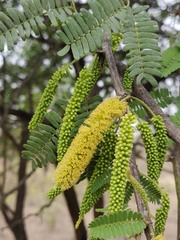 Neltuma juliflorae0
- Outcome
- survivale0
- Direction
- highere0
- Qualifier
- after 4.5 years under conditions of extreme aridity and heavy browsinge0
- Comparator
- P. cineraria and eight non-Prosopis droughttolerant speciese0
Organisms pictured · Representative pictures of the matched species, not figures from the paper.

Verbatim
e0“P. juliflora exhibited a higher survival than P. cineraria and eight non-Prosopis droughttolerant species after 4.5 years under conditions of extreme aridity and heavy browsing.”
Claim · model-written summary
Prosopis tamarugo had complete mortality after six months.
- Taxon
- Prosopis tamarugo
 Strombocarpa tamarugoe0
- Outcome
- mortalitye0
- Value
- 100%e0
- Qualifier
- after 6 monthse0
Organisms pictured · Representative pictures of the matched species, not figures from the paper.

Verbatim
e0“Prosopis tamarugo suffered 100% mortality after 6 months”
Claim · model-written summary
P. juliflora had complete survival after four years.
- Taxon
- P. julifloraNeltuma juliflorae0
- Outcome
- survivale0
- Value
- 100%e0
- Qualifier
- after 4 yearse0
Organisms pictured · Representative pictures of the matched species, not figures from the paper.
Verbatim
e0“100% survival of P. juliflora was recorded after 4 years”
Claim · model-written summary
Argentinean P. alba, P. chilensis, P. flexuosa and P. nigra provenances had high survival after 2.5 years.
- Taxon
- P. alba, P. chilensis, P. flexuosa and P. nigra
 Neltuma chilensis
 Neltuma alba
 Neltuma flexuosa
 Neltuma nigrae0
- Material
- Argentinean provenancese0
- Outcome
- survivale0
- Direction
- highe0
- Qualifier
- after 2.5 yearse0
Organisms pictured · Representative pictures of the matched species, not figures from the paper.


Verbatim
e0“Argentinean provenances of P. alba, P. chilensis, P. flexuosa and P. nigra showed high survival after 2.5 years.”
Claim · model-written summary
Indian P. cineraria provenances had 20% to 44% survival.
- Taxon
- P. cineraria
 Prosopis cinerariae0
- Material
- Indian P. cineraria provenancese0
- Outcome
- Survivale0
- Direction
- onlye0
- Value
- 20% to 44%e0
Organisms pictured · Representative pictures of the matched species, not figures from the paper.

Verbatim
e0“Survival of Indian P. cineraria provenances was only 20% to 44%.”
Claim · model-written summary
P. nigra 333 was the most promising provenance for growth, survival, habit and small thorns.
- Taxon
- P. nigraNeltuma nigrae0
- Material
- P. nigra 333e0
- Outcome
- most promising provenance overalle0
- Direction
- most promisinge0
Organisms pictured · Representative pictures of the matched species, not figures from the paper.
Verbatim
e0“P. nigra 333 was the most promising provenance overall, with high branch length and stem-base diameter, high survival, an acceptable growth habit, and very small thorns.”
Claim · model-written summary
Twenty provenances survived at least 90% at two arid sites.
 Prosopis
Organisms pictured · Representative pictures of the matched species, not figures from the paper.

Verbatim
e0“at two sites in the arid agroecological zone, 20 provenances had survivals of at least 90%”
t0“Prosopis”
Claim · model-written summary
P. pubescens and P. cineraria from outside Algarobia showed poorer survival.
- Taxon
- P. pubescens and P. cineraria
 Strombocarpa pubescensProsopis cinerariae0
- Outcome
- survivale0
- Direction
- poorere0
- Qualifier
- outside of section Algarobiae0
Organisms pictured · Representative pictures of the matched species, not figures from the paper.

Verbatim
e0“P. pubescens and P. cineraria from outside of section Algarobia showed poorer survival”
Claim · model-written summary
P. tamarugo failed to survive in the 1993 trial.
- Taxon
- P. tamarugoStrombocarpa tamarugoe0
- Outcome
- failed to survivee0
Not reportedDirection
Organisms pictured · Representative pictures of the matched species, not figures from the paper.
Verbatim
e0“P. tamarugo failed to survive.”
Claim · model-written summary
P. juliflora and P. sp. Peru were most promising for biomass production.
Verbatim
e0“in terms of biomass production, P. juliflora and P. sp. 'Peru', likely to be P. juliflora or a P. juliflora hybrid, were the most promising.”
Claim · model-written summary
P. juliflora 737 ranked approximately third for biomass production.
- Taxon
- P. julifloraNeltuma juliflorae0
- Material
- P. juliflora 737e0
- Outcome
- biomass productione0
- Direction
- ranked approximately thirde0
- Setting
- Cape Verdee0
Organisms pictured · Representative pictures of the matched species, not figures from the paper.
Verbatim
e0“P. juliflora 737, from trees naturalised in Cape Verde and widely used in local afforestation programmes, ranked approximately third for biomass production”
Claim · model-written summary
P. juliflora 737 was the least thorny P. juliflora provenance.
- Taxon
- P. julifloraNeltuma juliflorae0
- Outcome
- least thornye0
- Direction
- leaste0
Organisms pictured · Representative pictures of the matched species, not figures from the paper.
Verbatim
e0“was the least thorny of the P. juliflora provenances.”
Claim · model-written summary
Vegetative propagation had reasonable success only with P. juliflora.
- Taxon
- P. julifloraNeltuma juliflorae0
- Outcome
- Reasonable success with vegetative propagatione0
- Direction
- Reasonable successe0
Organisms pictured · Representative pictures of the matched species, not figures from the paper.
Verbatim
e0“Reasonable success with vegetative propagation was obtained only with P. juliflora”
Claim · model-written summary
Grafting was largely unsuccessful.
- Outcome
- grafting was largely unsuccessfule0
Not reportedDirection
Organisms pictured · Representative pictures of the matched species, not figures from the paper.
Verbatim
e0“grafting was largely unsuccessful.”
t0“Prosopis”
Claim · model-written summary
The authors recommend more collection and evaluation of Peruvian provenances.
- Outcome
- Further collection and evaluation of the Peruvian provenancese0
Organisms pictured · Representative pictures of the matched species, not figures from the paper.
Verbatim
e0“Further collection and evaluation of the Peruvian provenances is recommended.”
t0“Prosopis”
Claim · model-written summary
The authors recommend conventional germplasm collection, selection, breeding and seed production.
- Outcome
- conventional programmes of germ plasm collection, selection, breeding, and seed productione0
Organisms pictured · Representative pictures of the matched species, not figures from the paper.
Verbatim
e0“there is a need to consider conventional programmes of germ plasm collection, selection, breeding, and seed production.”
t0“Prosopis”