Claim · model-written summary
P. juliflora survived better than P. cineraria and eight other species after 4.5 years.
- Taxon
- P. juliflora
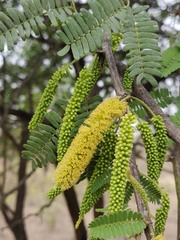 Neltuma juliflorae0
- Outcome
- survivale0
- Direction
- highere0
- Qualifier
- after 4.5 years under conditions of extreme aridity and heavy browsinge0
- Comparator
- P. cineraria and eight non-Prosopis droughttolerant speciese0
Not reportedMaterialGeneCompoundOrgan / stageInteractorInteractor roleSecond interactorSecond interactor roleTreatmentSettingValue
Organisms pictured · Representative pictures of the matched species, not figures from the paper.

Verbatim
e0“P. juliflora exhibited a higher survival than P. cineraria and eight non-Prosopis droughttolerant species after 4.5 years under conditions of extreme aridity and heavy browsing.”
Title
Prosopis genetic improvement trials in Cape Verde
Philip J. Harris; Nick Pasiecznik; M. T. Vera-Cruz; et al. 1997
Other claims from this paper (15)
- Observation Prosopis tamarugo had complete mortality after six months.
- Observation P. juliflora had complete survival after four years.
- Observation Argentinean P. alba, P. chilensis, P. flexuosa and P. nigra provenances had high survival after 2.5 years.
- Observation Indian P. cineraria provenances had 20% to 44% survival.
- Observation P. nigra 333 was the most promising provenance for growth, survival, habit and small thorns.
- Observation Twenty provenances survived at least 90% at two arid sites.
- Observation P. pubescens and P. cineraria from outside Algarobia showed poorer survival.
- Observation P. tamarugo failed to survive in the 1993 trial.
- Observation P. juliflora and P. sp. Peru were most promising for biomass production.
- Observation P. juliflora 737 ranked approximately third for biomass production.
- Observation P. juliflora 737 was the least thorny P. juliflora provenance.
- Observation Vegetative propagation had reasonable success only with P. juliflora.
- Observation Grafting was largely unsuccessful.
- Recommendation The authors recommend more collection and evaluation of Peruvian provenances.
- Recommendation The authors recommend conventional germplasm collection, selection, breeding and seed production.