Abstract
We explored the potential of the North European flora and some garden plants growing naturally outside Europe to support a reservoir of pine stem rusts. Live plants and detached leaves of 35 species in 16 families (Solanaceae, Verbenaceae, Grossulariaceae, Paeoniaceae, Balsaminaceae, Gentianaceae, Scrophulariaceae, Loasaceae, Tropaeolaceae, Acanthaceae, Myricaceae, Phrymaceae, Plantaginaceae, Orobanchaceae, Apocynaceae, and Fagaceae) were inoculated in the greenhouse and (or) laboratory with aeciospores of Cronartium ribicola J.C. Fisch. and Cronartium flaccidum (Alb. & Schwein) G. Winter in 2010. Cronartium flaccidum produced uredinia and (or) telia in 14 species in nine families, 11 of which represent new alternate hosts in Finland and nine also elsewhere (excluding Nemesia versicolor and Tropaeolum majus L.): Euphrasia stricta D. Wof. ex J.F. Lehm., N. versicolor E. Mey. ex Benth., Nemesia strumosa Benth., Verbena × hybrida Voss., Verbena officinalis L., Veronica longifolia L., Impatiens glandulifera Royle, T. majus, Loasa triphylla Juss., Asclepias incarnata L., and Bartsia alpina L. Cronartium ribicola formed fruitbodies in nine species and cultivars in five families, five of which are new alternate hosts for this species in Finland and also elsewhere: Mentzelia lindleyi Torr. & A. Gray, A. incarnata, B. alpina, L. triphylla, and T. majus. Both species of Cronartium infected four alternate hosts, each in its own family. The alternate host range of each Cronartium was wider than expected and wider than that previously described. In local natural forests, Euphrasia , Veronica , and Bartsia (in northern Finland) are potential hosts that are common and may be able to spread these rusts. The recently established ornamental I. glandulifera could provide the means to spread C. flaccidum to Scots pine ( Pinus sylvestris L.) in southern Finland, and species of Mentzelia may be important for the spread of C. ribicola.
Abstract from the paper’s OpenAlex record, shown for indexing and research. Copyright remains with the authors or the publisher. Read at the source ↗
The text the model read, with the source record’s inline markup (italics, sub- and superscripts) rendered and its character entities decoded; quote offsets refer to the raw text.
Claims 10
Claim · model-written summary
Cronartium flaccidum produced uredinia or telia in 14 species across nine families.
- Taxon
- plantsViridiplantaee1
- Interactor
- Cronartium flaccidum
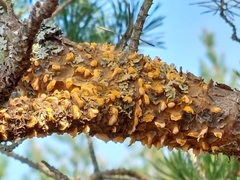 Cronartium flaccidume0pathogen
- Outcome
- Cronartium flaccidum produced uredinia and (or) teliae0
- Value
- 14 speciese0
Organisms pictured · Representative pictures of the matched species, not figures from the paper.
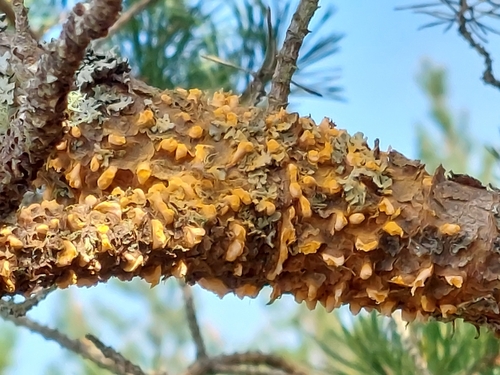
Verbatim
e0“Cronartium flaccidum produced uredinia and (or) telia in 14 species in nine families”
e1“Live plants and detached leaves of 35 species”
Claim · model-written summary
Eleven Cronartium flaccidum alternate hosts were new for Finland.
- Taxon
- plantsViridiplantaee2
- Interactor
- Cronartium flaccidumCronartium flaccidume1pathogen
- Outcome
- new alternate hostse0
- Value
- 11e0
- Setting
- Finlande0
Organisms pictured · Representative pictures of the matched species, not figures from the paper.
Verbatim
e0“11 of which represent new alternate hosts in Finland”
e1“Cronartium flaccidum produced uredinia and (or) telia in 14 species in nine families”
e2“Live plants and detached leaves of 35 species”
Claim · model-written summary
Nine Cronartium flaccidum alternate hosts were new elsewhere as well.
- Taxon
- plantsViridiplantaee2
- Interactor
- Cronartium flaccidumCronartium flaccidume1pathogen
- Outcome
- new alternate hostse3
- Value
- ninee0
Organisms pictured · Representative pictures of the matched species, not figures from the paper.
Verbatim
e0“and nine also elsewhere”
e1“Cronartium flaccidum produced uredinia and (or) telia in 14 species in nine families”
e2“Live plants and detached leaves of 35 species”
e3“11 of which represent new alternate hosts in Finland”
Claim · model-written summary
Cronartium ribicola formed fruitbodies in nine species and cultivars across five families.
- Taxon
- plantsViridiplantaee1
- Interactor
- Cronartium ribicola
 Cronartium ribicolae0pathogen
- Outcome
- Cronartium ribicola formed fruitbodiese0
- Value
- nine species and cultivarse0
Organisms pictured · Representative pictures of the matched species, not figures from the paper.

Verbatim
e0“Cronartium ribicola formed fruitbodies in nine species and cultivars in five families”
e1“Live plants and detached leaves of 35 species”
Claim · model-written summary
Five Cronartium ribicola alternate hosts were new in Finland and elsewhere.
- Taxon
- plantsViridiplantaee2
- Interactor
- Cronartium ribicolaCronartium ribicolae1pathogen
- Outcome
- new alternate hostse0
- Value
- fivee0
- Setting
- Finlande0
Organisms pictured · Representative pictures of the matched species, not figures from the paper.
Verbatim
e0“five of which are new alternate hosts for this species in Finland and also elsewhere”
e1“Cronartium ribicola formed fruitbodies in nine species and cultivars in five families”
e2“Live plants and detached leaves of 35 species”
Claim · model-written summary
Both rust species infected four alternate hosts, each in a distinct family.
- Taxon
- plantsViridiplantaee1
- Interactor
- CronartiumCronartiume0pathogen
- Outcome
- infected four alternate hostse0
- Value
- foure0
Organisms pictured · Representative pictures of the matched species, not figures from the paper.
Verbatim
e0“Both species of Cronartium infected four alternate hosts, each in its own family”
e1“Live plants and detached leaves of 35 species”
Claim · model-written summary
Each Cronartium species had a wider alternate host range than expected or previously described.
- Taxon
- plantsViridiplantaee1
- Interactor
- CronartiumCronartiume0pathogen
- Outcome
- alternate host rangee0
- Direction
- widere0
Organisms pictured · Representative pictures of the matched species, not figures from the paper.
Verbatim
e0“The alternate host range of each Cronartium was wider than expected and wider than that previously described”
e1“Live plants and detached leaves of 35 species”
Claim · model-written summary
Euphrasia, Veronica and Bartsia may act as common local natural forest hosts and spread the rusts.
- Outcome
- potential hosts that are common and may be able to spread these rustse0
- Setting
- northern Finlande0
 Veronica
 Bartsia
 Euphrasia
Organisms pictured · Representative pictures of the matched species, not figures from the paper.


Verbatim
e0“In local natural forests, Euphrasia , Veronica , and Bartsia (in northern Finland) are potential hosts that are common and may be able to spread these rusts”
Claim · model-written summary
Established ornamental Impatiens glandulifera could spread C. flaccidum to Scots pine in southern Finland.
- Taxon
- Scots pine
 Pinus sylvestrise0
- Interactor
- C. flaccidumCronartium flaccidume0pathogen
- Outcome
- spread C. flaccidum to Scots pinee0
- Setting
- southern Finlande0
Organisms pictured · Representative pictures of the matched species, not figures from the paper.

Verbatim
e0“The recently established ornamental I. glandulifera could provide the means to spread C. flaccidum to Scots pine ( Pinus sylvestris L.) in southern Finland”
Claim · model-written summary
Mentzelia species may aid the spread of C. ribicola.
- Interactor
- C. ribicolaCronartium ribicolae0pathogen
- Outcome
- spread of C. ribicolae0
 Mentzelia
Organisms pictured · Representative pictures of the matched species, not figures from the paper.

Verbatim
e0“species of Mentzelia may be important for the spread of C. ribicola”