Claim · model-written summary
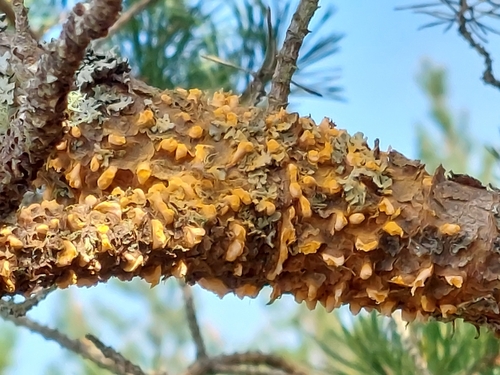
Pine blister rust prevalence reached 80% in some young Landes stands.
- Interactor
- Pine blister rust
 Cronartium flaccidume1pathogen
- Outcome
- prevalence levelse0
- Value
- up to 80%e0
- Setting
- Landes forest in South‐West Francee0
 Pinus
Verbatim
e0“A recent outbreak of this disease was observed on young pine stands in the Landes forest in South‐West France, with prevalence levels reaching up to 80% in some stands.”
e1“Pine blister rust is widely distributed across Eurasia”
Title
R. Ioos; C. Jeandel; S. Launes; et al. Forest Pathology 2025. doi:10.1111/efp.70028
Other claims from this paper (8)
- Observation The heteroecious form of C. pini predominated at Landes and more distant sampled sites.
- Observation C. pini populations on peonies were genetically indistinguishable from nearby pine populations.
- Mechanism Peonies were inferred to participate in the C. pini life cycle at the sampled sites.
- Observation Landes C. pini populations differed from more distant French populations.
- Mechanism Peony cultivation amid pine plantations was inferred to multiply heteroecious C. pini inoculum.
- Mechanism Peony cultivation was inferred to increase pine disease pressure.
- Mechanism Peony cultivation was inferred to increase damage severity to pine saplings.
- Recommendation The authors expect removal of peony plots to reduce future disease intensity.
 Odontites vernus
 Euphrasia nemorosa
 Euphrasia stricta
 Rhinanthus serotinus
 Melampyrum sylvaticum