Abstract
ABSTRACT Two‐needle pine blister rust is caused by Cronartium pini , a fungus that can have one of two forms. One requires an alternate host plant to achieve sexual reproduction and thus complete its life cycle (heteroecious), while the other is able to maintain itself clonally on pines (autoecious). Pine blister rust is widely distributed across Eurasia and may cause significant damage in infected natural forests and plantations. In France, the fungus may cause sporadic, local damage to plantations under certain environmental conditions, such as the presence of wild alternate hosts and particular weather conditions. A recent outbreak of this disease was observed on young pine stands in the Landes forest in South‐West France, with prevalence levels reaching up to 80% in some stands. This outbreak emerged contemporaneously with the planting of a large peony field in the middle of young pine plantations. Peonies being one of the many alternate hosts for C. pini , this work aimed to investigate whether the latter was present in its alternating or non‐alternating form and to study the relationship between the fungal populations attacking both pine trees and peonies. A total of 522 samples of aecia on pines and 108 samples of uredia on peonies were genotyped in 2021 and 2022 by studying seven microsatellite loci. The results showed that the heteroecious form of C. pini largely predominated in both the populations of the two sites sampled in the Landes forest and at the two more distant sites. In addition, the populations sampled from peonies did not differ genetically from those sampled in the pine plots surrounding them, which suggests that peonies participate in the completion of the biological cycle of C. pini on these sites. On the other hand, the populations in the Landes differ from the populations at the more distant sites in France. This study demonstrates that the establishment of natural hosts in the form of peony crops in the middle of pine plantations allowed the fungus inoculum to multiply in its heteroecious form, to increase the disease pressure and, consequently, the severity of damage to pine saplings. The complete removal of peony plots in late 2023 should help reduce the intensity of the disease in the years to come.
Abstract from the paper’s OpenAlex record, shown for indexing and research. Copyright remains with the authors or the publisher. Read at the source ↗
The text the model read, with the source record’s inline markup (italics, sub- and superscripts) rendered and its character entities decoded; quote offsets refer to the raw text.
Claims 9
Claim · model-written summary
Pine blister rust prevalence reached 80% in some young Landes stands.
- Interactor
- Pine blister rust
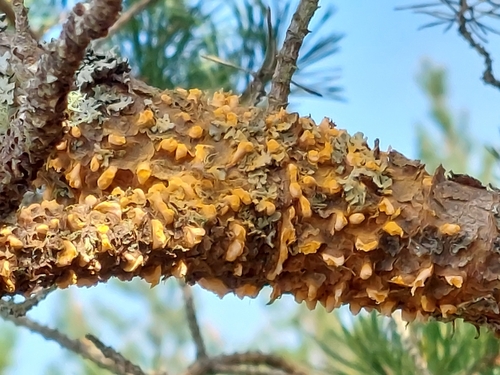
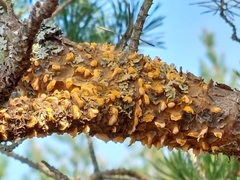 Cronartium flaccidume1pathogen
- Outcome
- prevalence levelse0
- Value
- up to 80%e0
- Setting
- Landes forest in South‐West Francee0
 Pinus
Organisms pictured · Representative pictures of the matched species, not figures from the paper.

Verbatim
e0“A recent outbreak of this disease was observed on young pine stands in the Landes forest in South‐West France, with prevalence levels reaching up to 80% in some stands.”
e1“Pine blister rust is widely distributed across Eurasia”
Claim · model-written summary
The heteroecious form of C. pini predominated at Landes and more distant sampled sites.
- Interactor
- C. piniCronartium pinie0pathogen
- Outcome
- heteroecious form of C. pinie0
- Direction
- predominatede0
- Setting
- Landes foreste0
Organisms pictured · Representative pictures of the matched species, not figures from the paper.
Verbatim
e0“the heteroecious form of C. pini largely predominated in both the populations of the two sites sampled in the Landes forest and at the two more distant sites.”
e1“aecia on pines”
Claim · model-written summary
C. pini populations on peonies were genetically indistinguishable from nearby pine populations.
- Interactor
- C. piniCronartium pinie1pathogen
- Outcome
- populations sampled from peonies did not differ geneticallye0
- Comparator
- pine plots surrounding theme0
 Paeonia
Organisms pictured · Representative pictures of the matched species, not figures from the paper.

Verbatim
e0“the populations sampled from peonies did not differ genetically from those sampled in the pine plots surrounding them”
e1“Peonies being one of the many alternate hosts for C. pini”
Claim · model-written summary
Peonies were inferred to participate in the C. pini life cycle at the sampled sites.
- Interactor
- C. piniCronartium pinie0pathogen
- Outcome
- completion of the biological cycle of C. pinie0
Organisms pictured · Representative pictures of the matched species, not figures from the paper.
Verbatim
e0“which suggests that peonies participate in the completion of the biological cycle of C. pini on these sites”
Claim · model-written summary
Landes C. pini populations differed from more distant French populations.
- Interactor
- C. piniCronartium pinie2pathogen
- Outcome
- populations in the Landes differe0
- Comparator
- populations at the more distant sites in Francee0
Organisms pictured · Representative pictures of the matched species, not figures from the paper.
Verbatim
e0“the populations in the Landes differ from the populations at the more distant sites in France”
e1“aecia on pines”
e2“Peonies being one of the many alternate hosts for C. pini”
Claim · model-written summary
Peony cultivation amid pine plantations was inferred to multiply heteroecious C. pini inoculum.
- Interactor
- C. piniCronartium pinie1pathogen
- Outcome
- fungus inoculum to multiply in its heteroecious forme0
- Qualifier
- peony crops in the middle of pine plantationse0
Organisms pictured · Representative pictures of the matched species, not figures from the paper.
Verbatim
e0“the establishment of natural hosts in the form of peony crops in the middle of pine plantations allowed the fungus inoculum to multiply in its heteroecious form”
e1“Peonies being one of the many alternate hosts for C. pini”
Claim · model-written summary
Peony cultivation was inferred to increase pine disease pressure.
- Interactor
- C. piniCronartium pinie1pathogen
- Outcome
- disease pressuree0
- Direction
- increasee0
- Qualifier
- peony crops in the middle of pine plantationse0
Organisms pictured · Representative pictures of the matched species, not figures from the paper.
Verbatim
e0“the establishment of natural hosts in the form of peony crops in the middle of pine plantations allowed the fungus inoculum to multiply in its heteroecious form, to increase the disease pressure”
e1“Peonies being one of the many alternate hosts for C. pini”
Claim · model-written summary
Peony cultivation was inferred to increase damage severity to pine saplings.
- Interactor
- C. piniCronartium pinie1pathogen
- Outcome
- severity of damage to pine saplingse0
- Qualifier
- peony crops in the middle of pine plantationse0
Organisms pictured · Representative pictures of the matched species, not figures from the paper.
Verbatim
e0“the establishment of natural hosts in the form of peony crops in the middle of pine plantations allowed the fungus inoculum to multiply in its heteroecious form, to increase the disease pressure and, consequently, the severity of damage to pine saplings”
e1“Peonies being one of the many alternate hosts for C. pini”
Claim · model-written summary
The authors expect removal of peony plots to reduce future disease intensity.
- Interactor
- C. piniCronartium pinie2pathogen
- Outcome
- complete removal of peony plotse0
- Qualifier
- should help reduce the intensity of the disease in the years to comee0
Organisms pictured · Representative pictures of the matched species, not figures from the paper.
Verbatim
e0“The complete removal of peony plots in late 2023 should help reduce the intensity of the disease in the years to come.”
e1“young pine plantations”
e2“Peonies being one of the many alternate hosts for C. pini”