Abstract
Attached and detached leaves of 60 potential host species were inoculated in the greenhouse and laboratory with aeciospores of Cronartium ribicola J.C. Fisch. from six Finnish locations and of Cronartium flaccidum (Alb. & Schw.) Wint. from 20 locations in Finland and Sweden in 2011. Candidate hosts represented 16 plant families: Solanaceae, Verbenaceae, Asclepiadaceae, Grossulariaceae, Paeoniaceae, Balsaminaceae, Gentianaceae, Scrophulariaceae, Loasaceae, Tropaeolaceae, Acanthaceae, Myricaceae, Phrymaceae, Plantaginaceae, Orobanchaceae, and Apocynaceae. Inoculations of C. flaccidum produced uredinia after 2 weeks and (or) telia after 4 weeks of incubation on 25 hosts. Inoculation trials identified several new hosts for C. flaccidum in Fennoscandia, namely Impatiens balsamina, Swertia fedtschenkoana, Loasa tricolor, Myrica gale, Verbena canadensis, Saxifraga spp., Paeonia obovata, and Veronica daurica. Myricaceae and Saxifragaceae represent new host families for these rusts. Cronartium ribicola formed uredinia or telia on 10 species: Ribes spp. (7 species/cultivars), Pedicularis palustris subsp. palustris, Bartsia alpina, and Loasa triphylla. Results suggest wider alternate host ranges for both C. flaccidum and C. ribicola than previously recognized. Spores were virulent regardless of their source location, suggesting a lack of host-specificity among Fennoscandian populations of Cronartium.
Abstract from the paper’s OpenAlex record, shown for indexing and research. Copyright remains with the authors or the publisher. Read at the source ↗
The text the model read, with the source record’s inline markup (italics, sub- and superscripts) rendered and its character entities decoded; quote offsets refer to the raw text.
Claims 8
Claim · model-written summary
Inoculation identified Impatiens balsamina, Swertia fedtschenkoana and Loasa tricolor as new hosts for C. flaccidum.
- Taxon
- Impatiens balsamina, Swertia fedtschenkoana, Loasa tricolor
 Impatiens balsaminaLoasa tricolorSwertia fedtschenkoanae1
- Interactor
- C. flaccidum
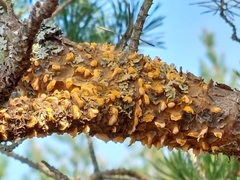 Cronartium flaccidume1pathogen
- Outcome
- new hostse1
Organisms pictured · Representative pictures of the matched species, not figures from the paper.

Verbatim
e1“Inoculation trials identified several new hosts for C. flaccidum in Fennoscandia, namely Impatiens balsamina, Swertia fedtschenkoana, Loasa tricolor, Myrica gale, Verbena canadensis, Saxifraga spp., Paeonia obovata, and Veronica daurica”
Claim · model-written summary
Inoculation identified Myrica gale, Verbena canadensis and Saxifraga spp. as new hosts for C. flaccidum.
- Taxon
- Myrica gale, Verbena canadensis, Saxifraga spp.
 Saxifraga
 Myrica gale
 Glandularia canadensise1
- Interactor
- C. flaccidumCronartium flaccidume1pathogen
- Outcome
- new hostse1
Organisms pictured · Representative pictures of the matched species, not figures from the paper.


Verbatim
e1“Inoculation trials identified several new hosts for C. flaccidum in Fennoscandia, namely Impatiens balsamina, Swertia fedtschenkoana, Loasa tricolor, Myrica gale, Verbena canadensis, Saxifraga spp., Paeonia obovata, and Veronica daurica”
Claim · model-written summary
Inoculation identified Paeonia obovata and Veronica daurica as new hosts for C. flaccidum.
- Taxon
- Paeonia obovata, and Veronica daurica
 Paeonia obovata
 Veronica dauricae1
- Interactor
- C. flaccidumCronartium flaccidume1pathogen
- Outcome
- new hostse1
Organisms pictured · Representative pictures of the matched species, not figures from the paper.


Verbatim
e1“Inoculation trials identified several new hosts for C. flaccidum in Fennoscandia, namely Impatiens balsamina, Swertia fedtschenkoana, Loasa tricolor, Myrica gale, Verbena canadensis, Saxifraga spp., Paeonia obovata, and Veronica daurica”
Claim · model-written summary
Myricaceae and Saxifragaceae are new host families for the rusts.
- Taxon
- Myricaceae and SaxifragaceaeSaxifragaceaeMyricaceaee1
- Interactor
- rustsPuccinialese1pathogen
- Outcome
- new host familiese1
Verbatim
e1“Myricaceae and Saxifragaceae represent new host families for these rusts”
Claim · model-written summary
Cronartium ribicola formed uredinia or telia on Ribes spp. (7 species/cultivars).
- Interactor
- Cronartium ribicola
 Cronartium ribicolae1pathogen
- Outcome
- uredinia or teliae1
 Ribes
Organisms pictured · Representative pictures of the matched species, not figures from the paper.


Verbatim
e1“Cronartium ribicola formed uredinia or telia on 10 species: Ribes spp. (7 species/cultivars), Pedicularis palustris subsp. palustris, Bartsia alpina, and Loasa triphylla”
Claim · model-written summary
Cronartium ribicola formed uredinia or telia on Pedicularis palustris subsp. palustris and Bartsia alpina.
- Taxon
- Pedicularis palustris subsp. palustris, Bartsia alpina
 Bartsia alpina
 Pedicularis palustris subsp. palustrise1
- Interactor
- Cronartium ribicolaCronartium ribicolae1pathogen
- Outcome
- uredinia or teliae1
Organisms pictured · Representative pictures of the matched species, not figures from the paper.


Verbatim
e1“Cronartium ribicola formed uredinia or telia on 10 species: Ribes spp. (7 species/cultivars), Pedicularis palustris subsp. palustris, Bartsia alpina, and Loasa triphylla”
Claim · model-written summary
Cronartium ribicola formed uredinia or telia on Loasa triphylla.
- Taxon
- Loasa triphylla
 Nasa triphyllae1
- Interactor
- Cronartium ribicolaCronartium ribicolae1pathogen
- Outcome
- uredinia or teliae1
Organisms pictured · Representative pictures of the matched species, not figures from the paper.

Verbatim
e1“Cronartium ribicola formed uredinia or telia on 10 species: Ribes spp. (7 species/cultivars), Pedicularis palustris subsp. palustris, Bartsia alpina, and Loasa triphylla”
Claim · model-written summary
Spores of Cronartium were virulent regardless of their source location, suggesting no host-specificity among Fennoscandian populations.
- Taxon
- potential host speciese1
- Interactor
- CronartiumCronartiume2pathogen
- Outcome
- virulente2
- Qualifier
- regardless of their source locatione2
Organisms pictured · Representative pictures of the matched species, not figures from the paper.
Verbatim
e1“Attached and detached leaves of 60 potential host species were inoculated in the greenhouse and laboratory”
e2“Spores were virulent regardless of their source location, suggesting a lack of host-specificity among Fennoscandian populations of Cronartium”