Abstract
Monttea aphylla is an aphyllus shrub abundant in the Monte Desert, Argentina. This species presents particular floral syndromes including violet, tubular flowers with trichome elaiophores that produce oil. Oil flowers are associated with specialised bees with an oil-collecting apparatus. To better understand the reproductive biology of M. aphylla, the mating system, flowering phenology, the associated pollinator assemblage and foraging behaviour was determined at the southern-most part of its distributional range. Results were compared with those of previous studies and discussed. At this southern location M. aphylla is a self-incompatible species; it relies on pollinators for fruit production and presented a low fruit set. Flowering occurred during the spring, from October to December. M. aphylla was pollinated by three species of bees (Apidae); two generalist species (Centris brethesi and Mesonychium jenseni) and one specialist to M. aphylla (Centris vardyorum). M. jenseni is a cleptoparasite of Centris species. Centris species are oil-collecting bees and showed territorial behaviour (i.e. they always visited a restricted group of plants which they protected from other visitors), they visited several flowers/plants, which enhanced geitonogamous self-pollination and reduced pollination efficiency, and which might explain the low natural fruit set observed in M. aphylla. C. vardyorum was the most important pollinator of M. aphylla in the study area. The reproductive biology of M. aphylla differs along its distributional range. Apparently, southern populations of M. aphylla are more specialised than the northern populations, the former being pollinated by a few related pollinator species whereas at the northern location a variety of visitors were observed.
Abstract from the paper’s OpenAlex record, shown for indexing and research. Copyright remains with the authors or the publisher. Read at the source ↗
The text the model read, with the source record’s inline markup (italics, sub- and superscripts) rendered and its character entities decoded; quote offsets refer to the raw text.
Claims 8
Claim · model-written summary
Southern Monttea aphylla was self-incompatible and relied on pollinators for fruit production.
- Taxon
- Monttea aphylla
 Monttea aphyllat0
- Outcome
- self-incompatible speciese0
- Setting
- southern locatione0
Organisms pictured · Representative pictures of the matched species, not figures from the paper.

Verbatim
e0“At this southern location M. aphylla is a self-incompatible species; it relies on pollinators for fruit production”
t0“Monttea aphylla”
Claim · model-written summary
Fruit set was low at the southern site.
- Taxon
- Monttea aphyllaMonttea aphyllat0
- Outcome
- fruit sete0
- Direction
- lowe0
Organisms pictured · Representative pictures of the matched species, not figures from the paper.
Verbatim
e0“presented a low fruit set”
t0“Monttea aphylla”
Claim · model-written summary
Flowering occurred from October to December.
- Taxon
- Monttea aphyllaMonttea aphyllat0
- Outcome
- Floweringe0
- Value
- October to Decembere0
Organisms pictured · Representative pictures of the matched species, not figures from the paper.
Verbatim
e0“Flowering occurred during the spring, from October to December”
t0“Monttea aphylla”
Claim · model-written summary
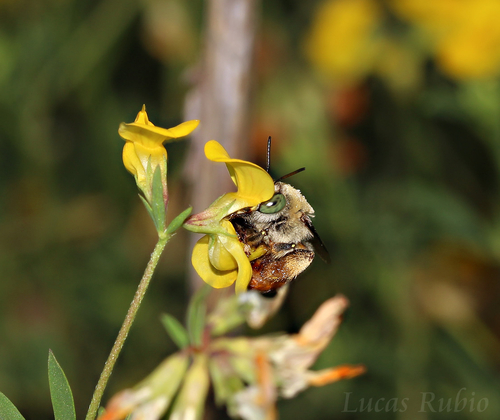
Centris brethesi pollinated the shrub as a generalist bee.
- Taxon
- Monttea aphyllaMonttea aphyllat0
- Interactor
- Centris brethesi
 Centris brethesie0pollinator
- Outcome
- pollinatede0
Organisms pictured · Representative pictures of the matched species, not figures from the paper.
Verbatim
e0“M. aphylla was pollinated by three species of bees (Apidae); two generalist species (Centris brethesi and Mesonychium jenseni) and one specialist to M. aphylla (Centris vardyorum)”
t0“Monttea aphylla”
Claim · model-written summary
Mesonychium jenseni pollinated the shrub as a generalist bee.
- Taxon
- Monttea aphyllaMonttea aphyllat0
- Interactor
- Mesonychium jenseniMesonychium jensenie0pollinator
- Outcome
- pollinatede0
Organisms pictured · Representative pictures of the matched species, not figures from the paper.
Verbatim
e0“M. aphylla was pollinated by three species of bees (Apidae); two generalist species (Centris brethesi and Mesonychium jenseni) and one specialist to M. aphylla (Centris vardyorum)”
t0“Monttea aphylla”
Claim · model-written summary
Centris vardyorum pollinated the shrub as a specialist and was the most important pollinator locally.
- Taxon
- Monttea aphyllaMonttea aphyllat0
- Interactor
- Centris vardyorumCentris vardyorume1pollinator
- Outcome
- most important pollinatore0
Organisms pictured · Representative pictures of the matched species, not figures from the paper.
Verbatim
e0“C. vardyorum was the most important pollinator of M. aphylla in the study area”
e1“one specialist to M. aphylla (Centris vardyorum)”
t0“Monttea aphylla”
Claim · model-written summary
Centris territorial visits enhanced geitonogamous self-pollination and reduced pollination efficiency.
- Taxon
- Monttea aphyllaMonttea aphyllat0
- Outcome
- reduced pollination efficiencye0
- Qualifier
- territorial behavioure0
 Centris
Organisms pictured · Representative pictures of the matched species, not figures from the paper.

Verbatim
e0“Centris species are oil-collecting bees and showed territorial behaviour (i.e. they always visited a restricted group of plants which they protected from other visitors), they visited several flowers/plants, which enhanced geitonogamous self-pollination and reduced pollination efficiency”
t0“Monttea aphylla”
Claim · model-written summary
Southern populations appeared more specialized than northern populations in pollinators.
- Taxon
- Monttea aphyllaMonttea aphyllat0
- Outcome
- more specialisede0
- Comparator
- northern populationse0
Organisms pictured · Representative pictures of the matched species, not figures from the paper.
Verbatim
e0“southern populations of M. aphylla are more specialised than the northern populations”
t0“Monttea aphylla”