Abstract
Summary The stem end rot pathogens of mango ( Mangifera indica ), ( Dothiorella dominicana, Dothiorella mangiferae, Lasiodiplodia theobromae (Syn. Diplodia natalensis Phomopsis mangiferae, Cytosphaera mangiferae, Pestalotiopsis sp. and Dothiorella ‘long’), as well as other fungi (including Alternaria alternata ), were found to occur endophytically in the stem tissue of mango trees prior to inflorescence emergence. On samples from trees with a record of low stem end rot levels, colonisation did not extend into the most recently produced flush of stem tissue. At a site with a history of high stem end rot levels, sequential monitoring of inflorescence tissue between flowering and harvest by plating out small ( c . 8 mm 3 ) tissue pieces revealed, that at least some of the pathogens ‐ Dothiorella spp., P. mangiferae, Pestalotiopsis sp. and C. mangiferae gradually colonised the inflorescence, reaching the pedicel tissue of young fruit ‐ 8 wk after flowering. Subsequently, detection frequency of the pathogens in inflorescence tissue declined, possibly because of interference from copper residues (from field sprays) accumulating on tissue samples. The detection frequency of A. alternata also increased as Dothiorella spp. declined, however these changes could not be attributed to antagonistic interactions between the two fungi. Using larger tissue pieces (1–2 mm thick transverse sections, or a square of tissue 25 mm 2 × 3 mm thick) in isolations, endophytic colonisation by Dothiorella spp. and P. mangiferae was detected in stem, inflorescence and pedicel tissues of mature‐fruit‐specimens from two different sites, one unsprayed, and the other regularly sprayed with copper. The fungi were detected more frequently in the samples from unsprayed trees. Fruit from the sprayed orchard subsequently developed a high level of stem end rot caused by D. dominicana , while a lower level of stem end rot developed in unsprayed fruit, possibly because the latter fruit were also extensively diseased by anthracnose ( Colletotrichum gloeosporioides Penz.). Endophytic colonisation of inflorescence and pedicel tissue was found to be a primary route of infection for fruit which develop stem end rot during ripening.
Abstract from the paper’s OpenAlex record, shown for indexing and research. Copyright remains with the authors or the publisher. Read at the source ↗
The text the model read, with the source record’s inline markup (italics, sub- and superscripts) rendered and its character entities decoded; quote offsets refer to the raw text.
Claims 10
Claim · model-written summary
Stem end rot pathogens of mango were found endophytically in mango stem tissue before inflorescence emergence.
- Taxon
- mango
 Mangifera indicae1
- Organ / stage
- stem tissuee1
- Interactor
- stem end rot pathogense0pathogen
- Outcome
- found to occur endophytically in the stem tissuee1
Organisms pictured · Representative pictures of the matched species, not figures from the paper.

Verbatim
e0“stem end rot pathogens of mango”
e1“were found to occur endophytically in the stem tissue of mango trees prior to inflorescence emergence”
Claim · model-written summary
In samples from trees with a record of low stem end rot, colonisation did not extend into the most recently produced flush of stem tissue.
- Taxon
- MangoMangifera indicat0
- Organ / stage
- stem tissuee0
- Outcome
- colonisation did not extend into the most recently produced flushe0
Organisms pictured · Representative pictures of the matched species, not figures from the paper.
Verbatim
t0“Mango”
e0“colonisation did not extend into the most recently produced flush of stem tissue”
Claim · model-written summary
At a high stem end rot site, Dothiorella spp., P. mangiferae, Pestalotiopsis sp. and C. mangiferae gradually colonised the inflorescence, reaching the pedicel tissue of young fruit 8 weeks after flowering.
- Taxon
- MangoMangifera indicat0
- Interactor
- Dothiorella spp.
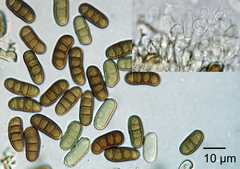 Dothiorellae0pathogen
- Second interactor
- P. mangiferaee0pathogen
- Outcome
- gradually colonised the inflorescence, reaching the pedicel tissue of young fruite0
- Qualifier
- 8 wk after floweringe0
Organisms pictured · Representative pictures of the matched species, not figures from the paper.

Verbatim
t0“Mango”
e0“at least some of the pathogens ‐ Dothiorella spp., P. mangiferae, Pestalotiopsis sp. and C. mangiferae gradually colonised the inflorescence, reaching the pedicel tissue of young fruit ‐ 8 wk after flowering”
Claim · model-written summary
Detection frequency of the pathogens in inflorescence tissue subsequently declined, possibly because of interference from copper residues accumulating on samples.
- Taxon
- MangoMangifera indicat0
- Organ / stage
- inflorescence tissuee0
- Interactor
- pathogense0pathogen
- Outcome
- detection frequency of the pathogense0
- Direction
- declinede0
- Qualifier
- possibly because of interference from copper residuese0
Organisms pictured · Representative pictures of the matched species, not figures from the paper.
Verbatim
t0“Mango”
e0“Subsequently, detection frequency of the pathogens in inflorescence tissue declined, possibly because of interference from copper residues (from field sprays) accumulating on tissue samples”
Claim · model-written summary
The detection frequency of Alternaria alternata increased as Dothiorella spp. declined.
- Taxon
- MangoMangifera indicat0
- Interactor
- A. alternata
 Alternaria alternatae0other
- Second interactor
- Dothiorella spp.Dothiorellae0pathogen
- Outcome
- detection frequency of A. alternatae0
- Direction
- increasede0
Organisms pictured · Representative pictures of the matched species, not figures from the paper.

Verbatim
t0“Mango”
e0“The detection frequency of A. alternata also increased as Dothiorella spp. declined”
Claim · model-written summary
The changes in detection of A. alternata and Dothiorella spp. could not be attributed to antagonistic interactions between the two fungi.
- Taxon
- MangoMangifera indicat0
- Outcome
- could not be attributed to antagonistic interactions between the two fungie0
Organisms pictured · Representative pictures of the matched species, not figures from the paper.
Verbatim
t0“Mango”
e0“these changes could not be attributed to antagonistic interactions between the two fungi”
Claim · model-written summary
With larger tissue pieces, endophytic colonisation by Dothiorella spp. and P. mangiferae was detected in stem, inflorescence and pedicel tissues of mature-fruit specimens from two sites.
- Taxon
- MangoMangifera indicat0
- Organ / stage
- stem, inflorescence and pedicel tissuese0
- Interactor
- Dothiorella spp.Dothiorellae0pathogen
- Second interactor
- P. mangiferaee0pathogen
- Outcome
- endophytic colonisation by Dothiorella spp. and P. mangiferae was detectede0
- Setting
- two different sitese0
Organisms pictured · Representative pictures of the matched species, not figures from the paper.
Verbatim
t0“Mango”
e0“endophytic colonisation by Dothiorella spp. and P. mangiferae was detected in stem, inflorescence and pedicel tissues of mature‐fruit‐specimens from two different sites”
Claim · model-written summary
The endophytic fungi were detected more frequently in samples from unsprayed trees than from copper-sprayed trees.
- Taxon
- MangoMangifera indicat0
- Treatment
- unsprayed treese0
- Outcome
- fungi were detectede0
- Direction
- more frequentlye0
Organisms pictured · Representative pictures of the matched species, not figures from the paper.
Verbatim
t0“Mango”
e0“The fungi were detected more frequently in the samples from unsprayed trees”
Claim · model-written summary
Fruit from the copper-sprayed orchard developed a high level of stem end rot caused by D. dominicana, while a lower level developed in unsprayed fruit.
- Taxon
- MangoMangifera indicat0
- Treatment
- regularly sprayed with coppere1
- Interactor
- D. dominicanae0pathogen
- Outcome
- stem end rote0
- Direction
- high levele0
- Comparator
- unsprayed fruite0
Organisms pictured · Representative pictures of the matched species, not figures from the paper.
Verbatim
t0“Mango”
e0“Fruit from the sprayed orchard subsequently developed a high level of stem end rot caused by D. dominicana , while a lower level of stem end rot developed in unsprayed fruit”
e1“the other regularly sprayed with copper”
Claim · model-written summary
Endophytic colonisation of inflorescence and pedicel tissue was found to be a primary route of infection for fruit that develop stem end rot during ripening.
- Taxon
- MangoMangifera indicat0
- Organ / stage
- inflorescence and pedicel tissuee0
- Outcome
- primary route of infection for fruit which develop stem end rot during ripeninge0
Organisms pictured · Representative pictures of the matched species, not figures from the paper.
Verbatim
t0“Mango”
e0“Endophytic colonisation of inflorescence and pedicel tissue was found to be a primary route of infection for fruit which develop stem end rot during ripening”
The same questions in other papers
copper atom · disease · Mangifera indica (mango)Positive and negative results
3 in the opposite direction
- positive
- positive
- positive
application · disease · Mangifera indica (mango)Positive and negative results
2 papers in the same direction as this paper · 39 in the opposite direction
- positive
- positive
- positive
38 papers more in this group
See all 42 papers →Claims are grouped by organism, treatment and what was measured or targeted. A paper counts as positive when any of its claims in the group is positive.