Abstract
The essential oils of 23 species of Austromyrtus sens. lat. have been examined. Austromyrtus gonoclada contains 2-hydroxy-4,6-dimethoxy-3,5-dimethylacetophenone as its principal component. The remaining 22 species fall into two groups in which the leaf essential oils are either dominated by sesquiterpenes or have monoterpenes accounting for 50% or more of the oil. Into the first group fall both chemotypes of A. floribunda, one chemotype of A. hillii, A. inophloia, A. minutiflora, A. pubiflora, A. shepherdii, A. sp. (Bamaga, B. P. Hyland 10235), A. sp. (Brookfield, L. W. Jessup 155), A. sp. (McIlwraith Range, B. P. Hyland 11148), A. sp. (Pinnacle Track, P.I. Forster PIF15535). The second group, which has monoterpenes accounting for 50% or more of the oil, comprises Austromyrtus acmenoides, A. bidwillii, A. dallachiana, A. fragrantissima, one chemotype of A. hillii, A. racemulosa, A. sp. (Byerstown Range, G. P. Guymer 2037), A. sp. (Forty Mile Scrub, G. C. Stocker 1758), A. sp. (Mt. Beatrice, P. I. Forster PIF14662), A. sp. (Mt. Lewis, P.I. Forster PIF15613), A. sp. (Mt. White, P.I. Forster PIF13461), A. sp (Danbulla, L. S. Smith 10123), and A. sp. (Spencer Creek, P. I. Forster PIF13701).
Abstract from the paper’s OpenAlex record, shown for indexing and research. Copyright remains with the authors or the publisher. Read at the source ↗
The text the model read, with the source record’s inline markup (italics, sub- and superscripts) rendered and its character entities decoded; quote offsets refer to the raw text.
Claims 5
Claim · model-written summary
Austromyrtus gonoclada oil had 2-hydroxy-4,6-dimethoxy-3,5-dimethylacetophenone as its principal component.
Verbatim
e0“Austromyrtus gonoclada contains 2-hydroxy-4,6-dimethoxy-3,5-dimethylacetophenone as its principal component”
Claim · model-written summary
One oil composition group among the other species was dominated by sesquiterpenes.
- Taxon
- Austromyrtus
 Austromyrtust0
- Organ / stage
- leafe0
- Outcome
- leaf essential oils are either dominated by sesquiterpenese0
Organisms pictured · Representative pictures of the matched species, not figures from the paper.

Verbatim
e0“The remaining 22 species fall into two groups in which the leaf essential oils are either dominated by sesquiterpenes or have monoterpenes accounting for 50% or more of the oil”
t0“Australian Austromyrtus sens. lat.”
Claim · model-written summary
Another oil composition group had monoterpenes accounting for at least half of the oil.
- Taxon
- AustromyrtusAustromyrtust0
- Outcome
- monoterpenes accounting for 50% or more of the oile0
- Value
- 50% or moree0
Organisms pictured · Representative pictures of the matched species, not figures from the paper.
Verbatim
e0“The second group, which has monoterpenes accounting for 50% or more of the oil”
t0“Australian Austromyrtus sens. lat.”
Claim · model-written summary
Both chemotypes of A. floribunda and one of A. hillii belonged to the sesquiterpene-dominated group.
Verbatim
e0“Into the first group fall both chemotypes of A. floribunda, one chemotype of A. hillii”
e1“leaf essential oils are either dominated by sesquiterpenes”
Claim · model-written summary
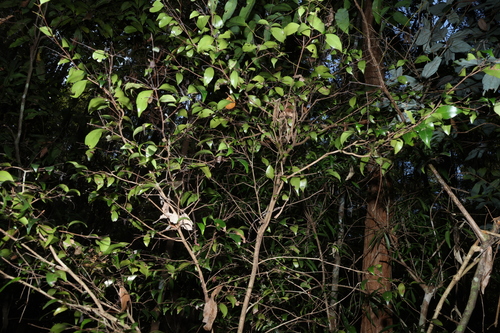
A. hillii also had a chemotype in the monoterpene-rich group.
- Taxon
- A. hillii
 Gossia hilliie0
- Material
- one chemotype of A. hilliie0
- Outcome
- monoterpenes accounting for 50% or more of the oile1
- Value
- 50% or moree1
Organisms pictured · Representative pictures of the matched species, not figures from the paper.
Verbatim
e0“one chemotype of A. hillii, A. racemulosa”
e1“The second group, which has monoterpenes accounting for 50% or more of the oil”