Abstract
Dothiorella gummosis and canker on citrus is generally viewed as a minor disease but can result in serious decline of trees. Symptoms, mostly found on branches, include grayish-to-brown cast on cankered bark, which can extend into the xylem. Dothiorella gummosis was earlier believed to be caused by Dothiorella gregaria (2). In a continuing survey on citrus in six California counties (Fresno, Riverside, San Diego, San Luis Obispo, Tulare, and Ventura) in 2010, branch cankers were collected. Small pieces of symptomatic tissues were plated onto potato dextrose agar amended with 0.01% tetracycline (PDA-tet) and incubated at 25°C for 4 days. Fungi most frequently isolated were initially identified as Botryosphaeriaceae based on morphological characters (1,3). Total genomic DNA was PCR amplified with primers Bt2a/2b for the β-tubulin (BT); EF1-728F/986R for the elongation factor α-1 (EF); and ITS4/5 for the internal transcribed spacer ITS1-5.8S-ITS2 regions (3). Sequences were compared in a BLAST search. Spencermartinsia viticola UCP105 was isolated from cv. Parent Washington on Sour Orange rootstock in Tulare County, Neofusicoccum australe UCR1110 from cv. Satsuma in Riverside County, and N. parvum UCR1166 from cv. Meyer Lemon on Volkameriana rootstock in Ventura County. Sequences of UCP105, UCR1110, and UCR1166 have been deposited in GenBank under Accession Nos. JF271766, JF271776, and JF271780 for BT; JF271784, JF271793, and JF271796 for EF; and JF271748, JF271758, and JF271762 for the ITS regions. The sequences matched with isolates in GenBank as follows: ITS region of strain UCP105-98% match with Accession Nos. AY905556-8; BT of strain UCR1110-99% with GU251879-80; and EF of strain UCR1166-98% with GU251238. Pathogenicity tests were conducted by inoculating green shoots of healthy citrus trees similar to cultivar/rootstock from which each isolate was obtained. Fresh wounds were made on 1-year-old citrus shoots with a 3-mm cork borer, and the freshly wounded surfaces were inoculated with 3-mm mycelial plugs from 5-day-old cultures on PDA-tet. Control shoots were inoculated with sterile agar plugs and each treatment had 10 replicates. Inoculated wounds and shoot ends were covered with petroleum jelly and wrapped with Parafilm to prevent desiccation. Shoots were incubated at 25°C in moist chambers for 4 weeks. Lesions were observed on all inoculated shoots except for the control. Mean lesion lengths were 6.4, 7.0, and 6.9 cm for UCP105, UCR1110, and UCR1166, respectively, which were significantly (P = 0.05) different from the control (0.8 cm). The three isolates were reisolated from symptomatic tissues of inoculated shoots to confirm their pathogenicity. This test was repeated and similar results were obtained. Results indicate that there are multiple species in the Botryosphaeriaceae family causing symptoms on citrus that were previously believed to be caused by D. gregaria. To our knowledge, this is the first report of S. viticola, N. australe, and N. parvum on citrus in California. References: (1) P. W. Crous et al. Stud. Mycol. 55:235, 2006. (2) V. McDonald et al. Plant Dis. 93:967, 2009. (3) B. Slippers et al. Mycologia 96:83, 2004.
Abstract from the paper’s OpenAlex record, shown for indexing and research. Copyright remains with the authors or the publisher. Read at the source ↗
The text the model read, with the source record’s inline markup (italics, sub- and superscripts) rendered and its character entities decoded; quote offsets refer to the raw text.
Claims 9
Claim · model-written summary
Spencermartinsia viticola UCP105 was isolated from Parent Washington on Sour Orange rootstock in Tulare County.
- Material
- Parent Washingtone0
- Interactor
- Spencermartinsia viticolaDothiorella viticolae0pathogen
- Outcome
- Spencermartinsia viticola UCP105 was isolatede0
- Setting
- Tulare Countye0
 Citrus
Organisms pictured · Representative pictures of the matched species, not figures from the paper.

Verbatim
e0“Spencermartinsia viticola UCP105 was isolated from cv. Parent Washington on Sour Orange rootstock in Tulare County”
t0“Citrus”
Claim · model-written summary
Neofusicoccum australe UCR1110 was isolated from Satsuma in Riverside County.
- Material
- Satsumae0
- Interactor
- Neofusicoccum australe
 Neofusicoccum australee0pathogen
- Outcome
- Neofusicoccum australe UCR1110e0
- Setting
- Riverside Countye0
Organisms pictured · Representative pictures of the matched species, not figures from the paper.
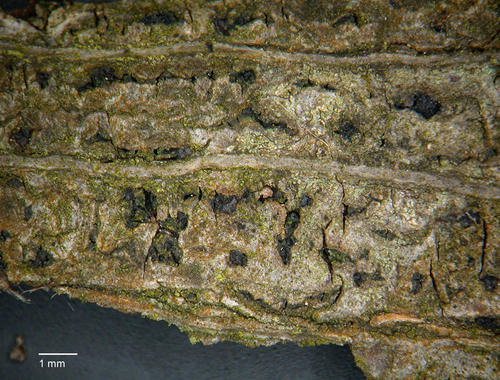
Verbatim
e0“Neofusicoccum australe UCR1110 from cv. Satsuma in Riverside County”
t0“Citrus”
Claim · model-written summary
N. parvum UCR1166 was isolated from Meyer Lemon on Volkameriana rootstock in Ventura County.
- Material
- Meyer Lemone0
- Interactor
- N. parvumNeofusicoccum parvume0pathogen
- Outcome
- N. parvum UCR1166e0
- Setting
- Ventura Countye0
Organisms pictured · Representative pictures of the matched species, not figures from the paper.
Verbatim
e0“N. parvum UCR1166 from cv. Meyer Lemon on Volkameriana rootstock in Ventura County”
t0“Citrus”
Claim · model-written summary
Spencermartinsia viticola UCP105 produced a 6.4 cm mean lesion, significantly different from the 0.8 cm control.
- Treatment
- UCP105e0
- Interactor
- UCP105e0pathogen
- Outcome
- lesion lengthse0
- Value
- 6.4e0
- Qualifier
- 0.8 cme0
- Comparator
- controle0
Not reportedDirection
Organisms pictured · Representative pictures of the matched species, not figures from the paper.
Verbatim
e0“Mean lesion lengths were 6.4, 7.0, and 6.9 cm for UCP105, UCR1110, and UCR1166, respectively, which were significantly (P = 0.05) different from the control (0.8 cm)”
t0“Citrus”
Claim · model-written summary
Neofusicoccum australe UCR1110 produced a 7.0 cm mean lesion, significantly different from the 0.8 cm control.
- Treatment
- UCR1110e0
- Interactor
- UCR1110e0pathogen
- Outcome
- lesion lengthse0
- Value
- 7.0e0
- Qualifier
- 0.8 cme0
- Comparator
- controle0
Not reportedDirection
Organisms pictured · Representative pictures of the matched species, not figures from the paper.
Verbatim
e0“Mean lesion lengths were 6.4, 7.0, and 6.9 cm for UCP105, UCR1110, and UCR1166, respectively, which were significantly (P = 0.05) different from the control (0.8 cm)”
t0“Citrus”
Claim · model-written summary
N. parvum UCR1166 produced a 6.9 cm mean lesion, significantly different from the 0.8 cm control.
- Treatment
- UCR1166e0
- Interactor
- UCR1166e0pathogen
- Outcome
- lesion lengthse0
- Value
- 6.9 cme0
- Qualifier
- 0.8 cme0
- Comparator
- controle0
Not reportedDirection
Organisms pictured · Representative pictures of the matched species, not figures from the paper.
Verbatim
e0“Mean lesion lengths were 6.4, 7.0, and 6.9 cm for UCP105, UCR1110, and UCR1166, respectively, which were significantly (P = 0.05) different from the control (0.8 cm)”
t0“Citrus”
Claim · model-written summary
Lesions occurred on all fungus-inoculated shoots but not controls.
Not reportedDirection
Organisms pictured · Representative pictures of the matched species, not figures from the paper.
Verbatim
e0“Lesions were observed on all inoculated shoots except for the control”
t0“Citrus”
Claim · model-written summary
All three isolates were reisolated from symptomatic inoculated shoots.
Organisms pictured · Representative pictures of the matched species, not figures from the paper.
Verbatim
e0“The three isolates were reisolated from symptomatic tissues of inoculated shoots to confirm their pathogenicity”
t0“Citrus”
Claim · model-written summary
Multiple Botryosphaeriaceae species cause citrus symptoms previously attributed to D. gregaria.
- Interactor
- BotryosphaeriaceaeBotryosphaeriaceaee0pathogen
- Outcome
- causing symptoms on citruse0
Organisms pictured · Representative pictures of the matched species, not figures from the paper.
Verbatim
e0“there are multiple species in the Botryosphaeriaceae family causing symptoms on citrus that were previously believed to be caused by D. gregaria”
The same questions in other papers
inoculation · disease · CitrusPositive and negative results
11 papers in the same direction as this paper · 11 in the opposite direction
- positive
- positive
- positive
19 papers more in this group
See all 23 papers →Claims are grouped by organism, treatment and what was measured or targeted. A paper counts as positive when any of its claims in the group is positive.