Abstract
Rural afforestation in Zimbabwe has been heavily reliant on the genus Eucalyptus. Limited success has been achieved with these species in semi-arid areas. To broaden the species range and provide a wider product range, the Forestry Commission of Zimbabwe has been conducting on-station screening of African and Australian acacias. Of the African acacias, Faidherbia albida and Acacia tortilis exhibited high survival rates within the first year. Of the Australian acacias, Acacia auriculiformis succumbed to termite attacks except at Chesa and Acacia holosericea and Acacia colei appeared to be less susceptible to termite attack. Eucalyptus camaldulensis, Eucalyptus leptophleba and Eucalyptus tereticornis had better survival percentages than the acacia species tested. There are some indications that some acacia species, given more testing, can be selected for afforestation purposes in areas where eucalypts have been traditionally used. In Shurugwi, an evaluation of the performance of some multipurpose tree species planted out by farmers was carried out at eight years. The mortality of the tree species on-farm was variable, ranging from 39 to 64% in 1991 and 2 to 54% in 1996. Leucaena leucocephala, A. holosericea, Melia azedarach and Senna atomaria had the greatest growth and biomass production. Farmers preferred L. leucocephala and Casuarina cunninghamiana, which was correlated to their ability to produce useful poles. It is recommended that research that develops cost-effective strategies to improve survival levels of planted trees should be supported and alternative pole producing species should be made available to small holder farmers. Transactions of the Zimbabwe Scientific Association Volume 72 (Supplement) 1998, pp. 10-14
Abstract from the paper’s OpenAlex record, shown for indexing and research. Copyright remains with the authors or the publisher. Read at the source ↗
The text the model read, with the source record’s inline markup (italics, sub- and superscripts) rendered and its character entities decoded; quote offsets refer to the raw text.
Claims 17
Claim · model-written summary
Faidherbia albida showed high survival rates within the first year of on-station screening.
- Taxon
- Faidherbia albida
 Faidherbia albidae1
- Outcome
- survival ratese1
- Qualifier
- within the first yeare1
Organisms pictured · Representative pictures of the matched species, not figures from the paper.

Verbatim
e1“Of the African acacias, Faidherbia albida and Acacia tortilis exhibited high survival rates within the first year”
Claim · model-written summary
Acacia tortilis showed high survival rates within the first year of on-station screening.
- Taxon
- Acacia tortilis
 Vachellia tortilise1
- Outcome
- survival ratese1
- Qualifier
- within the first yeare1
Organisms pictured · Representative pictures of the matched species, not figures from the paper.

Verbatim
e1“Of the African acacias, Faidherbia albida and Acacia tortilis exhibited high survival rates within the first year”
Claim · model-written summary
Acacia auriculiformis succumbed to termite attacks, except at Chesa.
- Taxon
- Acacia auriculiformis
 Acacia auriculiformise2
- Interactor
- termitee2pest
- Outcome
- succumbede2
- Setting
- Chesae2
Organisms pictured · Representative pictures of the matched species, not figures from the paper.

Verbatim
e2“Of the Australian acacias, Acacia auriculiformis succumbed to termite attacks except at Chesa”
Claim · model-written summary
Acacia holosericea appeared less susceptible to termite attack than other tested acacias.
- Taxon
- Acacia holosericea
 Acacia holosericeae3
- Interactor
- termitee3pest
- Outcome
- susceptible to termite attacke3
- Direction
- lesse3
Organisms pictured · Representative pictures of the matched species, not figures from the paper.

Verbatim
e3“Acacia holosericea and Acacia colei appeared to be less susceptible to termite attack”
Claim · model-written summary
Acacia colei appeared less susceptible to termite attack than other tested acacias.
- Taxon
- Acacia colei
 Acacia coleie3
- Interactor
- termitee3pest
- Outcome
- susceptible to termite attacke3
- Direction
- lesse3
Organisms pictured · Representative pictures of the matched species, not figures from the paper.

Verbatim
e3“Acacia holosericea and Acacia colei appeared to be less susceptible to termite attack”
Claim · model-written summary
Eucalyptus camaldulensis, E. leptophleba and E. tereticornis had better survival percentages than the acacia species tested.
- Taxon
- Eucalyptus
 Eucalyptuse4
- Outcome
- survival percentagese4
- Direction
- bettere4
- Comparator
- acacia species testede4
Organisms pictured · Representative pictures of the matched species, not figures from the paper.

Verbatim
e4“Eucalyptus camaldulensis, Eucalyptus leptophleba and Eucalyptus tereticornis had better survival percentages than the acacia species tested”
Claim · model-written summary
Some acacia species may be selected for afforestation purposes after more testing.
- Outcome
- selected for afforestation purposese5
 Acacia
Organisms pictured · Representative pictures of the matched species, not figures from the paper.

Verbatim
e5“There are some indications that some acacia species, given more testing, can be selected for afforestation purposes”
Claim · model-written summary
On-farm mortality of the tree species was 39 to 64% in 1991.
Verbatim
e6“The mortality of the tree species on-farm was variable, ranging from 39 to 64% in 1991 and 2 to 54% in 1996”
Claim · model-written summary
On-farm mortality of the tree species was 2 to 54% in 1996.
Verbatim
e6“The mortality of the tree species on-farm was variable, ranging from 39 to 64% in 1991 and 2 to 54% in 1996”
Claim · model-written summary
Leucaena leucocephala had the greatest growth and biomass production among the species listed.
- Taxon
- Leucaena leucocephala
 Leucaena leucocephalae7
- Outcome
- growth and biomass productione7
- Direction
- greateste7
Organisms pictured · Representative pictures of the matched species, not figures from the paper.

Verbatim
e7“Leucaena leucocephala, A. holosericea, Melia azedarach and Senna atomaria had the greatest growth and biomass production”
Claim · model-written summary
Acacia holosericea had the greatest growth and biomass production among the species listed.
- Taxon
- A. holosericeaAcacia holosericeae7
- Outcome
- growth and biomass productione7
- Direction
- greateste7
Organisms pictured · Representative pictures of the matched species, not figures from the paper.
Verbatim
e7“Leucaena leucocephala, A. holosericea, Melia azedarach and Senna atomaria had the greatest growth and biomass production”
Claim · model-written summary
Melia azedarach had the greatest growth and biomass production among the species listed.
- Taxon
- Melia azedarach
 Melia azedarache7
- Outcome
- growth and biomass productione7
- Direction
- greateste7
Organisms pictured · Representative pictures of the matched species, not figures from the paper.

Verbatim
e7“Leucaena leucocephala, A. holosericea, Melia azedarach and Senna atomaria had the greatest growth and biomass production”
Claim · model-written summary
Senna atomaria had the greatest growth and biomass production among the species listed.
- Taxon
- Senna atomaria
 Senna atomariae7
- Outcome
- growth and biomass productione7
- Direction
- greateste7
Organisms pictured · Representative pictures of the matched species, not figures from the paper.
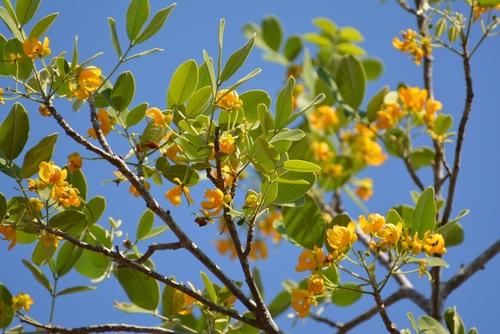
Verbatim
e7“Leucaena leucocephala, A. holosericea, Melia azedarach and Senna atomaria had the greatest growth and biomass production”
Claim · model-written summary
Farmers preferred Leucaena leucocephala.
- Taxon
- L. leucocephalaLeucaena leucocephalae0
- Outcome
- preferrede0
Organisms pictured · Representative pictures of the matched species, not figures from the paper.
Verbatim
e0“Farmers preferred L. leucocephala and Casuarina cunninghamiana, which was correlated to their ability to produce useful poles”
Claim · model-written summary
Farmers preferred Casuarina cunninghamiana, a preference correlated with its ability to produce useful poles.
- Taxon
- Casuarina cunninghamiana
 Casuarina cunninghamianae0
- Outcome
- preferrede0
- Qualifier
- correlated to their ability to produce useful polese0
Organisms pictured · Representative pictures of the matched species, not figures from the paper.

Verbatim
e0“Farmers preferred L. leucocephala and Casuarina cunninghamiana, which was correlated to their ability to produce useful poles”
Claim · model-written summary
Research on cost-effective strategies to improve survival levels of planted trees should be supported.
Verbatim
e1“research that develops cost-effective strategies to improve survival levels of planted trees should be supported”
Claim · model-written summary
Alternative pole producing species should be made available to smallholder farmers.
Verbatim
e2“alternative pole producing species should be made available to small holder farmers”