Abstract
1. Darkly staining granules are present among the bivalent chromosomes in late diakinesis in all members of Cucurbita, but are absent in Citrullus, Luffa, and Cucumis. 2. Cucurbita pepo and C. maxima each has twenty bivalent chromosomes. 3. Citrullus vulgaris has eleven bivalent chromosomes; Luffa cylindrica, eleven; Cucumis melo, twelve. Cucumis sativus has four-teen chromosomes in the diploid cells. 4. The homologous chromosomes pass to the poles at anaphase with no evidence of lagging in Cucurbita pepo, C. maxima, Citrullus vulgaris, Luffa cylindrica, and Cucumis melo. 5. Chromosomes are distributed irregularly on the spindle at anaphase in Cucumis sativus. 6. The nucleolus shows a tendency to bud in both Luffa cylindrica and Cucumis sativus, and is often present after the spindle fibers appear in these species.
Abstract from the paper’s OpenAlex record, shown for indexing and research. Copyright remains with the authors or the publisher. Read at the source ↗
The text the model read, with the source record’s inline markup (italics, sub- and superscripts) rendered and its character entities decoded; quote offsets refer to the raw text.
Claims 11
Claim · model-written summary
Darkly staining granules are present among the bivalent chromosomes in late diakinesis in all members of Cucurbita.
 Cucurbita
Not reportedDirection
Organisms pictured · Representative pictures of the matched species, not figures from the paper.

Verbatim
e0“Darkly staining granules are present among the bivalent chromosomes in late diakinesis in all members of Cucurbita, but are absent in Citrullus, Luffa, and Cucumis”
Claim · model-written summary
Darkly staining granules among the bivalent chromosomes in late diakinesis are absent in Citrullus, Luffa and Cucumis.
 Citrullus
 Cucumis
 Luffa
Not reportedDirection
Organisms pictured · Representative pictures of the matched species, not figures from the paper.


Verbatim
e0“Darkly staining granules are present among the bivalent chromosomes in late diakinesis in all members of Cucurbita, but are absent in Citrullus, Luffa, and Cucumis”
Claim · model-written summary
Cucurbita pepo has twenty bivalent chromosomes.
- Taxon
- Cucurbita pepo
 Cucurbita pepoe0
- Outcome
- bivalent chromosomese0
- Value
- twentye0
Organisms pictured · Representative pictures of the matched species, not figures from the paper.

Verbatim
e0“Cucurbita pepo and C. maxima each has twenty bivalent chromosomes”
Claim · model-written summary
Cucurbita maxima has twenty bivalent chromosomes.
- Taxon
- C. maxima
 Cucurbita maximae0
- Outcome
- bivalent chromosomese0
- Value
- twentye0
Organisms pictured · Representative pictures of the matched species, not figures from the paper.
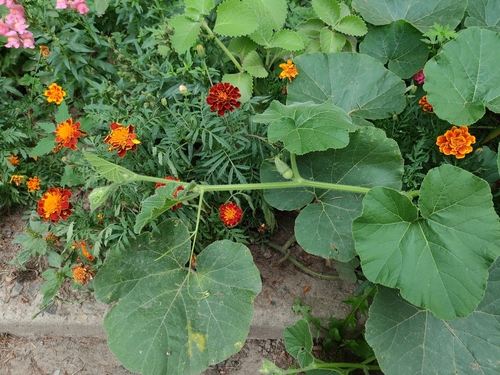
Verbatim
e0“Cucurbita pepo and C. maxima each has twenty bivalent chromosomes”
Claim · model-written summary
Citrullus vulgaris has eleven bivalent chromosomes.
- Taxon
- Citrullus vulgaris
 Citrullus lanatuse0
- Outcome
- bivalent chromosomese0
- Value
- elevene0
Organisms pictured · Representative pictures of the matched species, not figures from the paper.

Verbatim
e0“Citrullus vulgaris has eleven bivalent chromosomes”
Claim · model-written summary
Luffa cylindrica has eleven bivalent chromosomes.
Verbatim
e0“Luffa cylindrica, eleven”
Claim · model-written summary
Cucumis melo has twelve bivalent chromosomes.
- Taxon
- Cucumis melo
 Cucumis meloe0
- Outcome
- twelvee0
- Value
- twelvee0
Organisms pictured · Representative pictures of the matched species, not figures from the paper.

Verbatim
e0“Cucumis melo, twelve”
Claim · model-written summary
Cucumis sativus has fourteen chromosomes in the diploid cells.
- Taxon
- Cucumis sativus
 Cucumis sativuse0
- Organ / stage
- diploid cellse0
- Outcome
- chromosomese0
- Value
- four-teene0
Organisms pictured · Representative pictures of the matched species, not figures from the paper.

Verbatim
e0“Cucumis sativus has four-teen chromosomes in the diploid cells”
Claim · model-written summary
Homologous chromosomes pass to the poles at anaphase with no evidence of lagging in Cucurbita pepo, C. maxima, Citrullus vulgaris, Luffa cylindrica and Cucumis melo.
Verbatim
e0“The homologous chromosomes pass to the poles at anaphase with no evidence of lagging in Cucurbita pepo, C. maxima, Citrullus vulgaris, Luffa cylindrica, and Cucumis melo”
Claim · model-written summary
Chromosomes are distributed irregularly on the spindle at anaphase in Cucumis sativus.
- Taxon
- Cucumis sativusCucumis sativuse0
- Organ / stage
- anaphasee0
- Outcome
- Chromosomes are distributed irregularly on the spindlee0
Organisms pictured · Representative pictures of the matched species, not figures from the paper.
Verbatim
e0“Chromosomes are distributed irregularly on the spindle at anaphase in Cucumis sativus”
Claim · model-written summary
The nucleolus tends to bud in both Luffa cylindrica and Cucumis sativus, and is often present after the spindle fibers appear in these species.
Verbatim
e0“The nucleolus shows a tendency to bud in both Luffa cylindrica and Cucumis sativus”