Abstract
Bauhinia malabarica and B. divaricata have both been reported to have dimorphic flowers; floral development of these species has been investigated and compared using SEM. B. malabarica is subdioecious, with three types of flowers: perfect, staminate, and carpellate. Individual trees usually have only one type of flower. Perfect and carpellate flowers have similar initiation of floral organs; each has five sepals, five petals, two whorls of five stamen primordia and a carpel primordium. The carpels of carpellate flowers do not differ from those of perfect flowers throughout development. Both have a gynophore or stipe and a cuplike hypanthium. Stamen development diverges markedly after mid‐development: the perfect flowers have ten stamens in two whorls, the outer with longer filaments than the inner. All stamens have anthers, which are covered abaxially with abundant inflated trichomes. Carpellate flowers have a circle of short cylindrical staminodia, each bearing a few hairs, about the base of the carpel on the rim of the hypanthium. Heteromorphy in B. malabarica is effected by suppression of stamen development, even though the usual number of stamen primordia is initiated. Suppression of stamens occurs at midstage in development in carpellate flowers of B. malabarica, and is complete. In B. divaricata nine stamen primordia are released from suppression in late stage, undergo intercalary growth and form a staminodial tube around the carpel stipe. The dimorphy in B. divaricata is expressed late in bud enlargement as divergent rates of growth in the carpel in the two morphs.
Abstract from the paper’s OpenAlex record, shown for indexing and research. Copyright remains with the authors or the publisher. Read at the source ↗
The text the model read, with the source record’s inline markup (italics, sub- and superscripts) rendered and its character entities decoded; quote offsets refer to the raw text.
Claims 9
Claim · model-written summary
B. malabarica has perfect, staminate and carpellate flowers.
- Taxon
- B. malabarica
 Piliostigma malabaricume0
- Outcome
- three types of flowers: perfect, staminate, and carpellatee0
Organisms pictured · Representative pictures of the matched species, not figures from the paper.

Verbatim
e0“B. malabarica is subdioecious, with three types of flowers: perfect, staminate, and carpellate.”
Claim · model-written summary
Individual trees usually have one flower type.
- Outcome
- one type of flowere0
 Bauhinia
Organisms pictured · Representative pictures of the matched species, not figures from the paper.

Verbatim
e0“Individual trees usually have only one type of flower.”
t0“BAUHINIA”
Claim · model-written summary
Perfect and carpellate flowers initiate similar organs.
- Taxon
- B. malabaricaPiliostigma malabaricume1
- Outcome
- similar initiation of floral organse0
Organisms pictured · Representative pictures of the matched species, not figures from the paper.
Verbatim
e0“Perfect and carpellate flowers have similar initiation of floral organs; each has five sepals, five petals, two whorls of five stamen primordia and a carpel primordium.”
e1“B. malabarica is subdioecious”
Claim · model-written summary
Carpels of carpellate and perfect flowers did not differ during development.
- Outcome
- carpels of carpellate flowerse0
Organisms pictured · Representative pictures of the matched species, not figures from the paper.
Verbatim
e0“The carpels of carpellate flowers do not differ from those of perfect flowers throughout development.”
t0“BAUHINIA”
Claim · model-written summary
Stamen development diverged after mid-development.
- Outcome
- Stamen developmente0
Organisms pictured · Representative pictures of the matched species, not figures from the paper.
Verbatim
e0“Stamen development diverges markedly after mid‐development”
t0“BAUHINIA”
Claim · model-written summary
Carpellate flowers had short cylindrical staminodia.
- Outcome
- circle of short cylindrical staminodiae0
Organisms pictured · Representative pictures of the matched species, not figures from the paper.
Verbatim
e0“Carpellate flowers have a circle of short cylindrical staminodia, each bearing a few hairs, about the base of the carpel on the rim of the hypanthium.”
t0“BAUHINIA”
Claim · model-written summary
B. malabarica heteromorphy resulted from suppressed stamen development.
- Taxon
- B. malabaricaPiliostigma malabaricume0
- Outcome
- Heteromorphye0
- Qualifier
- suppression of stamen developmente0
Organisms pictured · Representative pictures of the matched species, not figures from the paper.
Verbatim
e0“Heteromorphy in B. malabarica is effected by suppression of stamen development, even though the usual number of stamen primordia is initiated.”
Claim · model-written summary
In B. divaricata nine stamen primordia formed a staminodial tube.
- Taxon
- B. divaricata
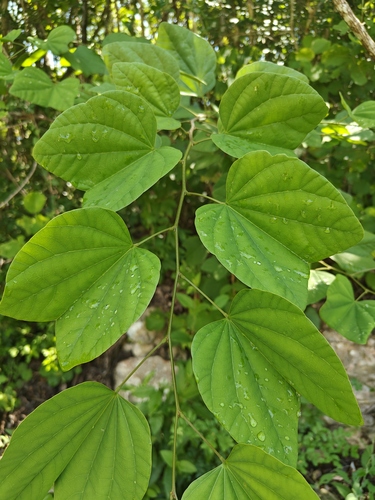
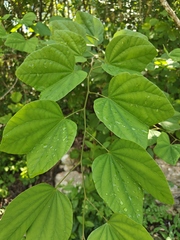 Bauhinia divaricatae0
- Outcome
- staminodial tubee0
Organisms pictured · Representative pictures of the matched species, not figures from the paper.
Verbatim
e0“In B. divaricata nine stamen primordia are released from suppression in late stage, undergo intercalary growth and form a staminodial tube around the carpel stipe.”
Claim · model-written summary
B. divaricata dimorphy appeared late through different carpel growth rates.
- Taxon
- B. divaricataBauhinia divaricatae0
- Outcome
- dimorphye0
- Qualifier
- divergent rates of growth in the carpele0
Organisms pictured · Representative pictures of the matched species, not figures from the paper.
Verbatim
e0“The dimorphy in B. divaricata is expressed late in bud enlargement as divergent rates of growth in the carpel in the two morphs.”