Abstract
ABSTRACT Bioassays were conducted under greenhouse conditions to test the efficacy of selected bacterial and fungal antagonists applied to wheat seeds for protection against seedling blight caused by Bipolaris sorokiniana. Initially, 120 wheat rhizobacteria from soils collected at five wheat fields in Argentina were screened by two different paired culture methods. Seven isolates of Trichoderma spp. that previously showed biocontrol activity against necrotrophic pathogens of wheat were also evaluated. The in vitro tests, based on the ability of the antagonists to inhibit mycelial growth of the pathogen, were used to select the most effective isolates for further testing in a plant bioassay conducted on wheat seedlings. Disease severity, disease incidence and dry weight were estimated in the greenhouse 3 weeks after sowing. Out of 120 bacteria, 33 showed moderate to strong inhibition to the mycelial growth of B. sorokiniana on potato dextrose agar in Petri dishes. Thereafter, dual cultures in flasks containing nutrient broth showed that four strains of Bacillus cereus and one isolate of Stenotrophomonas maltophilia exhibited the greatest inhibition (> 77%) to the fungal biomass. All Trichoderma spp. inhibited the mycelial growth of the pathogen by between 51 and 71%. Seed microbiolization failed to supress seedling blight under greenhouse conditions. Nevertheless, Trichoderma isolate Th2 as well as guazatine, significantly (p = 0.05) increased plant dry weight compared with untreated pathogen-infested seeds. Suitability of in vitro methods to evaluate potential efficacy of antagonists as biocontrol agents is discussed.
Abstract from the paper’s OpenAlex record, shown for indexing and research. Copyright remains with the authors or the publisher. Read at the source ↗
The text the model read, with the source record’s inline markup (italics, sub- and superscripts) rendered and its character entities decoded; quote offsets refer to the raw text.
Claims 7
Claim · model-written summary
Thirty-three wheat rhizobacteria moderately to strongly inhibited B. sorokiniana mycelial growth in vitro.
- Taxon
- Wheat
 Triticum aestivumt0
- Interactor
- B. sorokiniana
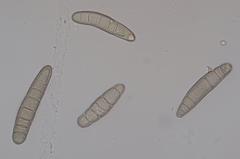 Bipolaris sorokinianae0pathogen
- Outcome
- inhibition to the mycelial growth of B. sorokinianae0
- Value
- 33e0
Organisms pictured · Representative pictures of the matched species, not figures from the paper.

Verbatim
t0“Wheat”
e0“Out of 120 bacteria, 33 showed moderate to strong inhibition to the mycelial growth of B. sorokiniana on potato dextrose agar in Petri dishes.”
Claim · model-written summary
Four Bacillus cereus strains had the greatest fungal biomass inhibition, exceeding 77%.
- Taxon
- WheatTriticum aestivumt0
- Interactor
- Bacillus cereus
 Bacillus cereuse0biocontrol_agent
- Outcome
- inhibition (> 77%) to the fungal biomasse0
- Value
- > 77%e0
Organisms pictured · Representative pictures of the matched species, not figures from the paper.

Verbatim
t0“Wheat”
e0“four strains of Bacillus cereus and one isolate of Stenotrophomonas maltophilia exhibited the greatest inhibition (> 77%) to the fungal biomass”
Claim · model-written summary
One Stenotrophomonas maltophilia isolate had the greatest fungal biomass inhibition, exceeding 77%.
- Taxon
- WheatTriticum aestivumt0
- Interactor
- Stenotrophomonas maltophilia
 Stenotrophomonas maltophiliae0biocontrol_agent
- Outcome
- inhibition (> 77%) to the fungal biomasse0
- Value
- > 77%e0
Organisms pictured · Representative pictures of the matched species, not figures from the paper.

Verbatim
t0“Wheat”
e0“four strains of Bacillus cereus and one isolate of Stenotrophomonas maltophilia exhibited the greatest inhibition (> 77%) to the fungal biomass”
Claim · model-written summary
All tested Trichoderma isolates inhibited pathogen mycelial growth by 51 to 71%.
- Taxon
- WheatTriticum aestivumt0
- Interactor
- Trichoderma spp.
 Trichodermae0biocontrol_agent
- Outcome
- mycelial growth of the pathogene0
- Direction
- inhibitede0
- Value
- between 51 and 71%e0
Organisms pictured · Representative pictures of the matched species, not figures from the paper.

Verbatim
t0“Wheat”
e0“All Trichoderma spp. inhibited the mycelial growth of the pathogen by between 51 and 71%.”
Claim · model-written summary
Seed microbiolization failed to suppress wheat seedling blight in the greenhouse.
- Taxon
- WheatTriticum aestivumt0
- Treatment
- Seed microbiolizatione0
- Outcome
- seedling blighte0
- Direction
- failed to supresse0
- Setting
- greenhouse conditionse0
Not reportedComparator
Organisms pictured · Representative pictures of the matched species, not figures from the paper.
Verbatim
t0“Wheat”
e0“Seed microbiolization failed to supress seedling blight under greenhouse conditions.”
Claim · model-written summary
Trichoderma isolate Th2 significantly increased plant dry weight relative to untreated pathogen-infested seeds.
- Taxon
- WheatTriticum aestivumt0
- Treatment
- Trichoderma isolate Th2e0
- Interactor
- Trichoderma isolate Th2e0biocontrol_agent
- Outcome
- plant dry weighte0
- Direction
- increasede0
- Comparator
- untreated pathogen-infested seedse0
Organisms pictured · Representative pictures of the matched species, not figures from the paper.
Verbatim
t0“Wheat”
e0“Trichoderma isolate Th2 as well as guazatine, significantly (p = 0.05) increased plant dry weight compared with untreated pathogen-infested seeds.”
Claim · model-written summary
Guazatine significantly increased plant dry weight relative to untreated pathogen-infested seeds.
- Taxon
- WheatTriticum aestivumt0
- Treatment
- guazatinee0
- Outcome
- plant dry weighte0
- Direction
- increasede0
- Comparator
- untreated pathogen-infested seedse0
Organisms pictured · Representative pictures of the matched species, not figures from the paper.
Verbatim
t0“Wheat”
e0“Trichoderma isolate Th2 as well as guazatine, significantly (p = 0.05) increased plant dry weight compared with untreated pathogen-infested seeds.”
The same questions in other papers
Trichoderma · growth · Triticum aestivum (wheat)Positive and negative results
11 papers in the same direction as this paper · 3 in the opposite direction
- negative
- no effect
- negative
11 papers more in this group
See all 15 papers →guazatine · growth · Triticum aestivum (wheat)Results agree
1 paper in the same direction as this paper
- positive
Claims are grouped by organism, treatment and what was measured or targeted. A paper counts as positive when any of its claims in the group is positive.