Abstract
Tissue cultures were isolated from healthy tissues of snapdragon and sunflower. Several unsuccessful attempts were made to infect tissue cultures with urediospores of the appropriate rust fungi. Snapdragon tissue cultures produced an extracellular material which inhibited urediospore germination. The inhibitory material could be leached out in agar or in water. It was heat stable, dialysable, non-ionic, and ether and ethanol insoluble. Rust-infected sunflower cotyledons and red-cedar galls induced by cedar-apple rust were cultured. Although the host tissue proliferated, the rust mycelium did not invade the newly formed tissues. Some sunflower hypocotyl explants proliferated on a chemically defined medium and produced roots, leaves, and flowers. Leaf callus was isolated from shoots that developed in vitro. Attempts to infect sunflower leaf tissue cultures and shoots in vitro with urediospores of Puccinia helianthi were not successful. Development of aerial mycelium of P. antirrhini was induced in infected snapdragon leaf tissue cultured on a defined medium. Aerial mycelium developed as white tufts, 1-3 mm long. This mycelium did not continue growth when transferred to a nutrient medium. It was not capable of infecting host tissue cultures. Inoculation of snapdragon tissue cultures covered by host leaf epidermis with urediospores did not produce infection. Attempts to infect callus tissue by placing in contact urediospores germinated on collodion membranes also failed.
Abstract from the paper’s OpenAlex record, shown for indexing and research. Copyright remains with the authors or the publisher. Read at the source ↗
The text the model read, with the source record’s inline markup (italics, sub- and superscripts) rendered and its character entities decoded; quote offsets refer to the raw text.
Claims 14
Claim · model-written summary
Attempts to infect host tissue cultures with urediospores failed.
- Taxon
- snapdragon and sunflower
 Antirrhinum majus
 Helianthus annuuse1
- Interactor
- rust fungie0pathogen
- Outcome
- infect tissue culturese0
Not reportedDirection
Organisms pictured · Representative pictures of the matched species, not figures from the paper.


Verbatim
e0“Several unsuccessful attempts were made to infect tissue cultures with urediospores of the appropriate rust fungi”
e1“Tissue cultures were isolated from healthy tissues of snapdragon and sunflower.”
Claim · model-written summary
Snapdragon cultures produced extracellular material inhibiting urediospore germination.
- Taxon
- SnapdragonAntirrhinum majuse0
- Interactor
- urediosporee0pathogen
- Outcome
- urediospore germinatione0
- Direction
- inhibitede0
Organisms pictured · Representative pictures of the matched species, not figures from the paper.
Verbatim
e0“Snapdragon tissue cultures produced an extracellular material which inhibited urediospore germination”
Claim · model-written summary
The inhibitory material could be leached in agar or water.
- Taxon
- SnapdragonAntirrhinum majuse1
- Outcome
- inhibitory material could be leached oute0
Not reportedDirection
Organisms pictured · Representative pictures of the matched species, not figures from the paper.
Verbatim
e0“The inhibitory material could be leached out in agar or in water”
e1“Tissue cultures were isolated from healthy tissues of snapdragon and sunflower.”
Claim · model-written summary
The inhibitory material was heat stable, dialysable, non-ionic, and insoluble in ether and ethanol.
- Taxon
- SnapdragonAntirrhinum majuse1
- Outcome
- heat stable, dialysable, non-ionic, and ether and ethanol insolublee0
Not reportedDirection
Organisms pictured · Representative pictures of the matched species, not figures from the paper.
Verbatim
e0“It was heat stable, dialysable, non-ionic, and ether and ethanol insoluble”
e1“Tissue cultures were isolated from healthy tissues of snapdragon and sunflower.”
Claim · model-written summary
Rust mycelium failed to invade proliferating sunflower and red-cedar host tissues.
- Taxon
- sunflowerHelianthus annuuse1
- Interactor
- rust myceliume0pathogen
- Outcome
- rust mycelium did not invade the newly formed tissuese0
Not reportedDirection
Organisms pictured · Representative pictures of the matched species, not figures from the paper.
Verbatim
e0“Although the host tissue proliferated, the rust mycelium did not invade the newly formed tissues”
e1“Tissue cultures were isolated from healthy tissues of snapdragon and sunflower.”
Claim · model-written summary
Some sunflower hypocotyl explants proliferated and produced roots, leaves and flowers on defined medium.
- Taxon
- sunflowerHelianthus annuuse0
- Organ / stage
- hypocotyl explantse0
- Treatment
- chemically defined mediume0
- Outcome
- produced roots, leaves, and flowerse0
Not reportedDirection
Organisms pictured · Representative pictures of the matched species, not figures from the paper.
Verbatim
e0“Some sunflower hypocotyl explants proliferated on a chemically defined medium and produced roots, leaves, and flowers”
Claim · model-written summary
Leaf callus was isolated from shoots developed in vitro.
- Taxon
- sunflowerHelianthus annuuse1
- Organ / stage
- shootse0
- Outcome
- Leaf callus was isolatede0
Not reportedDirection
Organisms pictured · Representative pictures of the matched species, not figures from the paper.
Verbatim
e0“Leaf callus was isolated from shoots that developed in vitro”
e1“Tissue cultures were isolated from healthy tissues of snapdragon and sunflower.”
Claim · model-written summary
Sunflower leaf cultures and shoots could not be infected with Puccinia helianthi urediospores.
- Taxon
- sunflowerHelianthus annuuse0
- Interactor
- Puccinia helianthi
 Puccinia helianthie0pathogen
- Outcome
- infect sunflower leaf tissue cultures and shootse0
Not reportedDirection
Organisms pictured · Representative pictures of the matched species, not figures from the paper.

Verbatim
e0“Attempts to infect sunflower leaf tissue cultures and shoots in vitro with urediospores of Puccinia helianthi were not successful”
Claim · model-written summary
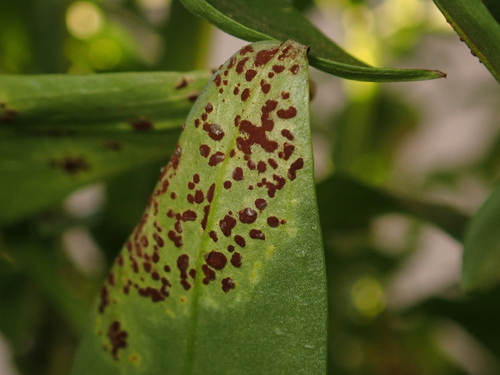
Infected snapdragon culture developed aerial P. antirrhini mycelium.
- Taxon
- snapdragonAntirrhinum majuse0
- Interactor
- P. antirrhini
 Puccinia antirrhinie0pathogen
- Outcome
- Development of aerial mycelium of P. antirrhinie0
Not reportedDirection
Organisms pictured · Representative pictures of the matched species, not figures from the paper.
Verbatim
e0“Development of aerial mycelium of P. antirrhini was induced in infected snapdragon leaf tissue cultured on a defined medium”
Claim · model-written summary
Aerial mycelium formed white tufts 1-3 mm long.
- Taxon
- snapdragonAntirrhinum majuse1
- Outcome
- Aerial mycelium developed as white tuftse0
- Value
- 1-3 mme0
Not reportedDirection
Organisms pictured · Representative pictures of the matched species, not figures from the paper.
Verbatim
e0“Aerial mycelium developed as white tufts, 1-3 mm long”
e1“Tissue cultures were isolated from healthy tissues of snapdragon and sunflower.”
Claim · model-written summary
Transferred mycelium did not continue growth on nutrient medium.
- Taxon
- snapdragonAntirrhinum majuse1
- Treatment
- nutrient mediume0
- Outcome
- mycelium did not continue growthe0
Not reportedDirection
Organisms pictured · Representative pictures of the matched species, not figures from the paper.
Verbatim
e0“This mycelium did not continue growth when transferred to a nutrient medium”
e1“Tissue cultures were isolated from healthy tissues of snapdragon and sunflower.”
Claim · model-written summary
The mycelium could not infect host tissue cultures.
- Taxon
- snapdragonAntirrhinum majuse1
- Outcome
- not capable of infecting host tissue culturese0
Not reportedDirection
Organisms pictured · Representative pictures of the matched species, not figures from the paper.
Verbatim
e0“It was not capable of infecting host tissue cultures”
e1“Tissue cultures were isolated from healthy tissues of snapdragon and sunflower.”
Claim · model-written summary
Urediospore inoculation of epidermis covered snapdragon cultures did not produce infection.
- Taxon
- snapdragonAntirrhinum majuse0
- Treatment
- Inoculation of snapdragon tissue cultures covered by host leaf epidermis with urediosporese0
- Outcome
- infectione0
Not reportedComparatorDirection
Organisms pictured · Representative pictures of the matched species, not figures from the paper.
Verbatim
e0“Inoculation of snapdragon tissue cultures covered by host leaf epidermis with urediospores did not produce infection”
Claim · model-written summary
Contact with germinated urediospores failed to infect callus.
- Taxon
- snapdragonAntirrhinum majuse1
- Outcome
- infect callus tissuee0
Not reportedDirection
Organisms pictured · Representative pictures of the matched species, not figures from the paper.
Verbatim
e0“Attempts to infect callus tissue by placing in contact urediospores germinated on collodion membranes also failed”
e1“Tissue cultures were isolated from healthy tissues of snapdragon and sunflower.”