Abstract
Increasingly, lupins ( Lupinus spp.) are being grown as a dryland crop in marginal rainfall areas, yet their water relations characteristics and adaptation to water deficits are largely undescribed. The present study was initiated to determine the waterelations and degree of osmotic adjustment in leaves and roots of lupins in the greenhouse and in the field. Four experiments were conducted. In the first two, the leaf water relations of Lupinus angustifolius and L. cosentinii were compared. The results showed the L. angustifolius leaves were morelastic and had a higher osmotic pressure under adequately watered conditions, but the degree of osmotic adjustment to a slowly imposed water deficit was negligible in L. angustifolius and about 0.2 MPa in L. cosentlnii . In the third experiment, the waterelations and osmotic adjustment of leaves and roots of five lupin species/cultivars were compared at a predawn leaf water potential of ‒ 1.6 MPa. Leaf elasticity in general was not influenced by water deficits. In the leaves, osmotic adjustment varied among species; L. pilosus and L. atlanticus had the greatest degree of osmotic adjustment (0.4–0.5 MPa) and L. augustifolius the least (0.1 MPa). The increases in osmotic pressure arising from a water deficit were paralleled by decreases in the turgid weight/dry weight ratio. In this greenhouse experiment, no osmotic adjustment was observed in the roots of any of the species. In the fourth experiment, conducted in the field, the leaves of L. angustifolius adjusted osmotically by 0.2 to 0.3 MPa and roots by about 0.4 MPa. The osmotic adjustment in both leaves and roots was accompanied by a decrease in the turgid weight/dry weight ratio. The data suggest that changes in turgid weight/dry weight ratio may provide a simple screening method for osmotic adjustment in Lupinus .
Abstract from the paper’s OpenAlex record, shown for indexing and research. Copyright remains with the authors or the publisher. Read at the source ↗
The text the model read, with the source record’s inline markup (italics, sub- and superscripts) rendered and its character entities decoded; quote offsets refer to the raw text.
Claims 14
Claim · model-written summary
L. angustifolius leaves were more elastic under adequate watering.
- Taxon
- L. angustifolius
 Lupinus angustifoliuse0
- Organ / stage
- leavese0
- Outcome
- morelastice0
- Direction
- morelastice0
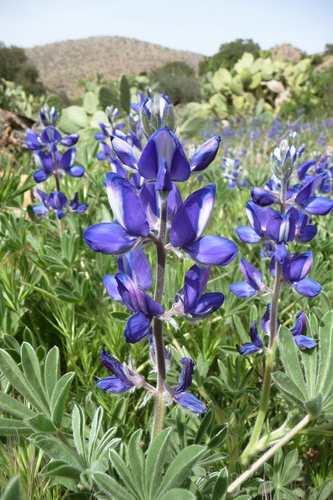
Organisms pictured · Representative pictures of the matched species, not figures from the paper.

Verbatim
e0“L. angustifolius leaves were morelastic and had a higher osmotic pressure under adequately watered conditions”
Claim · model-written summary
L. angustifolius leaves had higher osmotic pressure.
- Taxon
- L. angustifoliusLupinus angustifoliuse0
- Organ / stage
- leavese0
- Outcome
- osmotic pressuree0
- Direction
- highere0
Organisms pictured · Representative pictures of the matched species, not figures from the paper.
Verbatim
e0“L. angustifolius leaves were morelastic and had a higher osmotic pressure under adequately watered conditions”
Claim · model-written summary
Osmotic adjustment under slow deficit was negligible in L. angustifolius.
- Taxon
- L. angustifoliusLupinus angustifoliuse0
- Treatment
- slowly imposed water deficite0
- Outcome
- osmotic adjustmente0
- Direction
- negligiblee0
Organisms pictured · Representative pictures of the matched species, not figures from the paper.
Verbatim
e0“the degree of osmotic adjustment to a slowly imposed water deficit was negligible in L. angustifolius”
Claim · model-written summary
L. cosentlnii adjusted by about 0.2 MPa.
Not reportedDirection
Verbatim
e0“about 0.2 MPa in L. cosentlnii”
Claim · model-written summary
Leaf elasticity generally was unchanged by deficit.
 Lupinus
Organisms pictured · Representative pictures of the matched species, not figures from the paper.

Verbatim
e0“Leaf elasticity in general was not influenced by water deficits.”
t0“Water Relations and Osmotic Adjustment of Leaves and Roots of Lupins in Response to Water Deficits1”
Claim · model-written summary
L. pilosus showed 0.4–0.5 MPa leaf adjustment.
- Taxon
- L. pilosus
 Lupinus pilosuse0
- Outcome
- osmotic adjustmente0
- Direction
- greateste0
- Value
- 0.4–0.5 MPae0
Organisms pictured · Representative pictures of the matched species, not figures from the paper.

Verbatim
e0“L. pilosus and L. atlanticus had the greatest degree of osmotic adjustment (0.4–0.5 MPa)”
Claim · model-written summary
L. atlanticus showed 0.4–0.5 MPa leaf adjustment.
- Taxon
- L. atlanticus
 Lupinus atlanticuse0
- Outcome
- osmotic adjustmente0
- Direction
- greateste0
- Value
- 0.4–0.5 MPae0
Organisms pictured · Representative pictures of the matched species, not figures from the paper.
Verbatim
e0“L. pilosus and L. atlanticus had the greatest degree of osmotic adjustment (0.4–0.5 MPa)”
Claim · model-written summary
L. augustifolius had the least leaf adjustment, 0.1 MPa.
Verbatim
e0“L. augustifolius the least (0.1 MPa)”
Claim · model-written summary
Osmotic pressure increases tracked falling turgid weight to dry weight ratio.
Organisms pictured · Representative pictures of the matched species, not figures from the paper.
Verbatim
e0“The increases in osmotic pressure arising from a water deficit were paralleled by decreases in the turgid weight/dry weight ratio.”
t0“Water Relations and Osmotic Adjustment of Leaves and Roots of Lupins in Response to Water Deficits1”
Claim · model-written summary
No species showed root osmotic adjustment in the greenhouse.
Organisms pictured · Representative pictures of the matched species, not figures from the paper.
Verbatim
e0“In this greenhouse experiment, no osmotic adjustment was observed in the roots of any of the species.”
t0“Water Relations and Osmotic Adjustment of Leaves and Roots of Lupins in Response to Water Deficits1”
Claim · model-written summary
Field L. angustifolius leaves adjusted by 0.2 to 0.3 MPa.
- Taxon
- L. angustifoliusLupinus angustifoliuse0
- Organ / stage
- leavese0
- Outcome
- adjusted osmoticallye0
- Value
- 0.2 to 0.3 MPae0
Not reportedDirection
Organisms pictured · Representative pictures of the matched species, not figures from the paper.
Verbatim
e0“the leaves of L. angustifolius adjusted osmotically by 0.2 to 0.3 MPa and roots by about 0.4 MPa.”
Claim · model-written summary
Field L. angustifolius roots adjusted by about 0.4 MPa.
- Taxon
- L. angustifoliusLupinus angustifoliuse0
- Organ / stage
- rootse0
- Outcome
- roots by about 0.4 MPae0
- Value
- 0.4 MPae0
Not reportedDirection
Organisms pictured · Representative pictures of the matched species, not figures from the paper.
Verbatim
e0“the leaves of L. angustifolius adjusted osmotically by 0.2 to 0.3 MPa and roots by about 0.4 MPa.”
Claim · model-written summary
Field osmotic adjustment coincided with a decrease in turgid weight to dry weight ratio.
Organisms pictured · Representative pictures of the matched species, not figures from the paper.
Verbatim
e0“The osmotic adjustment in both leaves and roots was accompanied by a decrease in the turgid weight/dry weight ratio.”
t0“Water Relations and Osmotic Adjustment of Leaves and Roots of Lupins in Response to Water Deficits1”
Claim · model-written summary
Authors propose turgid weight to dry weight ratio as an adjustment screening measure.
Organisms pictured · Representative pictures of the matched species, not figures from the paper.
Verbatim
e0“changes in turgid weight/dry weight ratio may provide a simple screening method for osmotic adjustment in Lupinus”