Abstract
During the summer of 2000, circular, yellow-to-brown, blighted, 2- to 4-cm-diameter patches were observed on creeping bentgrass (Agrostis stolonifera) putting greens (cv. Pennlinks) maintained at a 4- to 5-mm height on a golf course in Pilar (Buenos Aires, Argentina). Symptomatic leaves had transverse chlorotic bands that sometimes extended to the tip with brown lesions inside the bands. A fungus was isolated from symptomatic tissue after surface sterilization with 2% bleach for 1 min and plating on 2% potato dextrose agar (PDA). The mycelium was fluffy and white. The culture turned olive to brown and developed black stromata on the lower side of the plate base after 2 weeks. Pathogenicity tests were performed on 2-month-old healthy plants of A. stolonifera (cv. Crenshaw) grown in sterilized sand. Recently cut, 14-mm-diameter plugs of A. stolonifera were placed in 22- × 17-cm plastic trays filled with a sterilized mixture of 50:50 soil/sand (vol/vol). Plants were maintained at a 7-mm height. Two sources of inoculum were prepared; one was cultured on PDA at 22 to 25°C for 10 days and the other was prepared by incubating in sterilized soil at room temperature for 14 days. Twenty pieces of 1-cm-diameter agar blocks containing mycelium were placed in each plug at the base of the plants. In the infested soil inoculation, 25 g of soil were distributed among the plants on the substrate surface. Control plants were treated with either sterile PDA pieces or noninfested soil. The trays were irrigated with sterilized distilled water, covered with polyethylene bags, and kept in a controlled environment chamber at 25°C with 12 h per day of fluorescent light for 30 days. Leaf chlorosis appeared 7 and 10 days after inoculation for the agar-plug and infested-soil methods, respectively. Leaf necrosis was observed at day 23. Controls remained asymptomatic. The inoculated fungus was reisolated from symptomatic leaf tissue. The pathogen was identified as Sclerotinia homoeocarpa (1,2). To our knowledge, this is the first report of Sclerotinia homoeocarpa causing dollar spot disease on Agrostis stolonifera in Argentina and the first report of a disease on golf courses in our country. References: (1) J. E. M. Mordue. Sclerotinia homoeocarpa. No. 618 in: Descriptions of Pathogenic Fungi and Bacteria. CMI, Kew, Surrey, UK, 1979. (2) R. W. Smiley. Dollar Spot. Pages 14-16 in: Compendium of Turfgrass Diseases. The American Phytopathological Society, St. Paul, MN, 1983.
Abstract from the paper’s OpenAlex record, shown for indexing and research. Copyright remains with the authors or the publisher. Read at the source ↗
The text the model read, with the source record’s inline markup (italics, sub- and superscripts) rendered and its character entities decoded; quote offsets refer to the raw text.
Claims 5
Claim · model-written summary
Dollar spot symptoms were observed on creeping bentgrass putting greens in Argentina.
- Taxon
- Agrostis stolonifera
 Agrostis stoloniferae0
- Material
- cv. Pennlinkse0
- Organ / stage
- putting greense0
- Outcome
- yellow-to-brown, blighted, 2- to 4-cm-diameter patchese0
- Setting
- Pilar (Buenos Aires, Argentina)e0
Organisms pictured · Representative pictures of the matched species, not figures from the paper.

Verbatim
e0“circular, yellow-to-brown, blighted, 2- to 4-cm-diameter patches were observed on creeping bentgrass (Agrostis stolonifera) putting greens (cv. Pennlinks) maintained at a 4- to 5-mm height on a golf course in Pilar (Buenos Aires, Argentina)”
Claim · model-written summary
Inoculated creeping bentgrass developed chlorosis after seven days with agar plugs and ten days with infested soil.
- Taxon
- Agrostis stoloniferaAgrostis stoloniferat0
- Treatment
- inoculatione0
- Outcome
- Leaf chlorosise0
- Direction
- appearede0
- Value
- 7 and 10 dayse0
Not reportedComparator
Organisms pictured · Representative pictures of the matched species, not figures from the paper.
Verbatim
e0“Leaf chlorosis appeared 7 and 10 days after inoculation for the agar-plug and infested-soil methods, respectively.”
t0“First Report of Dollar Spot Caused by Sclerotinia homoeocarpa on Agrostis stolonifera in Argentina”
Claim · model-written summary
Leaf necrosis appeared by day 23 after inoculation.
- Taxon
- Agrostis stoloniferaAgrostis stoloniferat0
- Outcome
- Leaf necrosise0
- Value
- day 23e0
Organisms pictured · Representative pictures of the matched species, not figures from the paper.
Verbatim
e0“Leaf necrosis was observed at day 23.”
t0“First Report of Dollar Spot Caused by Sclerotinia homoeocarpa on Agrostis stolonifera in Argentina”
Claim · model-written summary
Control plants remained asymptomatic.
- Taxon
- Agrostis stoloniferaAgrostis stoloniferat0
- Outcome
- asymptomatice0
Organisms pictured · Representative pictures of the matched species, not figures from the paper.
Verbatim
e0“Controls remained asymptomatic.”
t0“First Report of Dollar Spot Caused by Sclerotinia homoeocarpa on Agrostis stolonifera in Argentina”
Claim · model-written summary
Sclerotinia homoeocarpa was recovered from symptomatic bentgrass and identified as the pathogen.
- Taxon
- Agrostis stoloniferaAgrostis stoloniferat0
- Interactor
- Sclerotinia homoeocarpa
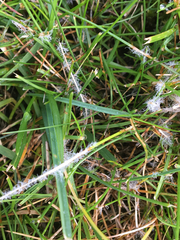 Clarireedia homoeocarpae0pathogen
- Outcome
- reisolated from symptomatic leaf tissuee0
Organisms pictured · Representative pictures of the matched species, not figures from the paper.
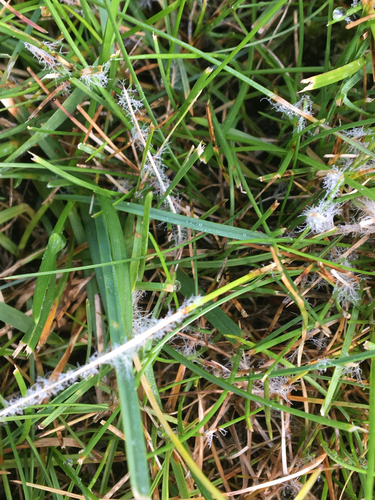
Verbatim
e0“The inoculated fungus was reisolated from symptomatic leaf tissue. The pathogen was identified as Sclerotinia homoeocarpa”
t0“First Report of Dollar Spot Caused by Sclerotinia homoeocarpa on Agrostis stolonifera in Argentina”
The same questions in other papers
inoculation · physiology: pigments · Agrostis stolonifera (creeping bent grass)Positive and negative results
2 papers in the same direction as this paper · 1 in the opposite direction
- positive
- no effect
- negative
Claims are grouped by organism, treatment and what was measured or targeted. A paper counts as positive when any of its claims in the group is positive.