Abstract
The study was conducted to assess the impact of natural seed-borne inoculum levels of Bipolaris sorokiniana on seedling emergence and growth, seedling blight and the early establishment of foliar blight in field. Three levels of seed-borne inoculum (11, 19 and 29%) of one cultivar (Sonalika) and four levels of seed-borne inoculum (5, 35, 65 and 95%) of two wheat cultivars (Sonalika and BL 1473) were evaluated in 2002 and 2003 field experiments, respectively. Seedling vigour study was conducted in the greenhouse in 2003. Seed-borne inoculum levels higher than 35% reduced seedling emergence and seedling vigour substantially, and also increased the seedling blight indicating that the seed-borne inoculum of B. sorokiniana played a crucial role in seedling health and early establishment of the pathogen on wheat. The findings will help to reduce the inoculum pressure of spot blotch and common root rot on wheat.
Abstract from the paper’s OpenAlex record, shown for indexing and research. Copyright remains with the authors or the publisher. Read at the source ↗
The text the model read, with the source record’s inline markup (italics, sub- and superscripts) rendered and its character entities decoded; quote offsets refer to the raw text.
Claims 3
Claim · model-written summary
Seed-borne inoculum levels higher than 35% reduced seedling emergence and seedling vigour.
- Taxon
- spring wheat
 Triticum aestivumt0
- Treatment
- Seed-borne inoculum levels higher than 35%e1
- Interactor
- B. sorokiniana
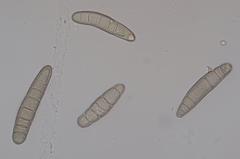 Bipolaris sorokinianae1pathogen
- Outcome
- seedling emergence and seedling vigoure1
- Direction
- reducede1
Not reportedComparator
Organisms pictured · Representative pictures of the matched species, not figures from the paper.

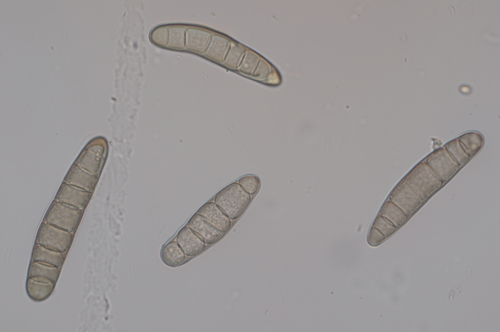
Verbatim
t0“Effect of natural seed-borne inoculum ofBipolaris sorokinianaon the seedling emergence and vigour, and early establishment of foliar blight in spring wheat”
e1“Seed-borne inoculum levels higher than 35% reduced seedling emergence and seedling vigour substantially, and also increased the seedling blight indicating that the seed-borne inoculum of B. sorokiniana played a crucial role in seedling health and early establishment of the pathogen on wheat”
Claim · model-written summary
Seed-borne inoculum levels higher than 35% increased seedling blight.
- Taxon
- spring wheatTriticum aestivumt0
- Treatment
- Seed-borne inoculum levels higher than 35%e1
- Interactor
- B. sorokinianaBipolaris sorokinianae1pathogen
- Outcome
- seedling blighte1
- Direction
- increasede1
Not reportedComparator
Organisms pictured · Representative pictures of the matched species, not figures from the paper.
Verbatim
t0“Effect of natural seed-borne inoculum ofBipolaris sorokinianaon the seedling emergence and vigour, and early establishment of foliar blight in spring wheat”
e1“Seed-borne inoculum levels higher than 35% reduced seedling emergence and seedling vigour substantially, and also increased the seedling blight indicating that the seed-borne inoculum of B. sorokiniana played a crucial role in seedling health and early establishment of the pathogen on wheat”
Claim · model-written summary
Seed-borne inoculum of B. sorokiniana played a crucial role in seedling health and early establishment of the pathogen on wheat.
- Taxon
- wheatTriticum aestivume1
- Interactor
- B. sorokinianaBipolaris sorokinianae1pathogen
- Outcome
- seedling healthe1
- Qualifier
- played a crucial rolee1
Organisms pictured · Representative pictures of the matched species, not figures from the paper.
Verbatim
e1“Seed-borne inoculum levels higher than 35% reduced seedling emergence and seedling vigour substantially, and also increased the seedling blight indicating that the seed-borne inoculum of B. sorokiniana played a crucial role in seedling health and early establishment of the pathogen on wheat”
The same questions in other papers
inoculation · Bipolaris sorokiniana · Triticum aestivum (wheat)Positive and negative results
3 papers in the same direction as this paper · 10 in the opposite direction
- positive
- positive
- positive
10 papers more in this group
See all 14 papers →Claims are grouped by organism, treatment and what was measured or targeted. A paper counts as positive when any of its claims in the group is positive.