Abstract
ABSTRACT Stenotrophomonas maltophilia strain C3 was evaluated for control of leaf spot on tall fescue (Festuca arundinacea) caused by Bipolaris sorokiniana. In growth chamber experiments, C3 inhibited conidial germination on leaf surfaces and reduced lesion frequency and percent diseased leaf area compared with nontreated controls. The amount of leaf spot suppression was related to the C3 dose applied. The highest dose tested, 10(9) CFU/ml, prevented nearly all B. sorokiniana conidia from germinating on treated leaf surfaces and provided nearly complete suppression of lesion development. When colloidal chitin was added to C3 cell suspensions of 10(7) or 10(8) CFU/ml, biocontrol efficacy was significantly increased over C3 applied alone, whereas addition of chitin to a C3 cell suspension of 10(9) CFU/ml had no effect. In field experiments, application of C3 to tall fescue turf resulted in significant reductions in infection frequency and disease severity compared with nontreated controls. Strain C3 applied at 10(9) CFU/ml was more effective than C3 applied at 10(7) CFU/ml, and amendment of the lower dose with colloidal chitin enhanced its efficacy. Populations sizes of C3 established on foliage in a growth chamber and in the field were directly related to dose applied. Chitin amendments did not affect C3 population size.
Abstract from the paper’s OpenAlex record, shown for indexing and research. Copyright remains with the authors or the publisher. Read at the source ↗
The text the model read, with the source record’s inline markup (italics, sub- and superscripts) rendered and its character entities decoded; quote offsets refer to the raw text.
Claims 12
Claim · model-written summary
C3 inhibited pathogen conidial germination on leaves.
- Taxon
- tall fescue
 Lolium arundinaceumt0
- Treatment
- C3e0
- Interactor
- Bipolaris sorokiniana
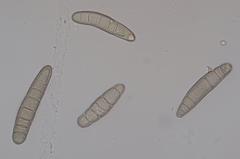 Bipolaris sorokinianat0pathogen
- Second interactor
- Stenotrophomonas maltophilia Strain C3
 Stenotrophomonas maltophiliat0biocontrol_agent
- Outcome
- conidial germinatione0
- Direction
- inhibitede0
- Comparator
- nontreated controlse0
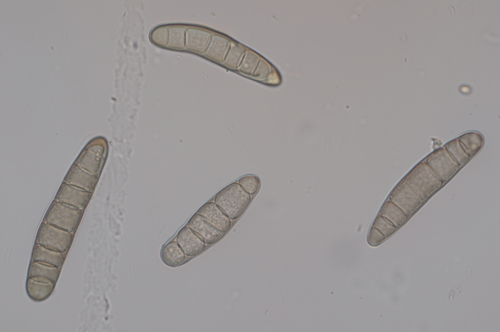
Organisms pictured · Representative pictures of the matched species, not figures from the paper.


Verbatim
e0“C3 inhibited conidial germination on leaf surfaces and reduced lesion frequency and percent diseased leaf area compared with nontreated controls.”
t0“Biological Control of Bipolaris sorokiniana on Tall Fescue by Stenotrophomonas maltophilia Strain C3”
Claim · model-written summary
C3 reduced lesion frequency and diseased leaf area against untreated controls.
- Taxon
- tall fescueLolium arundinaceumt0
- Treatment
- C3e0
- Interactor
- Bipolaris sorokinianaBipolaris sorokinianat0pathogen
- Second interactor
- Stenotrophomonas maltophilia Strain C3Stenotrophomonas maltophiliat0biocontrol_agent
- Outcome
- lesion frequency and percent diseased leaf areae0
- Direction
- reducede0
- Comparator
- nontreated controlse0
Organisms pictured · Representative pictures of the matched species, not figures from the paper.
Verbatim
e0“C3 inhibited conidial germination on leaf surfaces and reduced lesion frequency and percent diseased leaf area compared with nontreated controls.”
t0“Biological Control of Bipolaris sorokiniana on Tall Fescue by Stenotrophomonas maltophilia Strain C3”
Claim · model-written summary
Leaf spot suppression depended on C3 dose.
- Taxon
- tall fescueLolium arundinaceumt0
- Treatment
- C3 dosee0
- Outcome
- leaf spot suppressione0
Not reportedDirection
Organisms pictured · Representative pictures of the matched species, not figures from the paper.
Verbatim
e0“The amount of leaf spot suppression was related to the C3 dose applied.”
t0“tall fescue”
Claim · model-written summary
At 10(9) CFU/ml C3 prevented almost all conidial germination.
- Taxon
- tall fescueLolium arundinaceumt0
- Treatment
- 10(9) CFU/mle0
- Interactor
- B. sorokinianaBipolaris sorokinianae0pathogen
- Outcome
- B. sorokiniana conidia from germinatinge0
- Direction
- preventede0
- Value
- nearly alle0
Not reportedComparator
Organisms pictured · Representative pictures of the matched species, not figures from the paper.
Verbatim
e0“The highest dose tested, 10(9) CFU/ml, prevented nearly all B. sorokiniana conidia from germinating on treated leaf surfaces and provided nearly complete suppression of lesion development.”
t0“tall fescue”
Claim · model-written summary
At 10(9) CFU/ml C3 nearly completely suppressed lesion development.
- Taxon
- tall fescueLolium arundinaceumt0
- Treatment
- 10(9) CFU/mle0
- Outcome
- lesion developmente0
- Direction
- suppressione0
- Value
- nearly completee0
Not reportedComparator
Organisms pictured · Representative pictures of the matched species, not figures from the paper.
Verbatim
e0“The highest dose tested, 10(9) CFU/ml, prevented nearly all B. sorokiniana conidia from germinating on treated leaf surfaces and provided nearly complete suppression of lesion development.”
t0“tall fescue”
Claim · model-written summary
Chitin increased C3 efficacy at 10(7) or 10(8) CFU/ml.
- Taxon
- tall fescueLolium arundinaceumt0
- Treatment
- colloidal chitine0
- Outcome
- biocontrol efficacye0
- Direction
- increasede0
- Qualifier
- 10(7) or 10(8) CFU/mle0
- Comparator
- C3 applied alonee0
Organisms pictured · Representative pictures of the matched species, not figures from the paper.
Verbatim
e0“When colloidal chitin was added to C3 cell suspensions of 10(7) or 10(8) CFU/ml, biocontrol efficacy was significantly increased over C3 applied alone”
t0“tall fescue”
Claim · model-written summary
Chitin did not change efficacy at the 10(9) CFU/ml C3 dose.
- Taxon
- tall fescueLolium arundinaceumt0
- Treatment
- addition of chitine0
- Outcome
- effecte0
- Direction
- no effecte0
- Qualifier
- 10(9) CFU/mle0
Not reportedComparator
Organisms pictured · Representative pictures of the matched species, not figures from the paper.
Verbatim
e0“addition of chitin to a C3 cell suspension of 10(9) CFU/ml had no effect”
t0“tall fescue”
Claim · model-written summary
Field C3 application significantly reduced infection frequency and disease severity.
- Taxon
- tall fescueLolium arundinaceume0
- Treatment
- application of C3e0
- Outcome
- infection frequency and disease severitye0
- Direction
- reductionse0
- Comparator
- nontreated controlse0
Organisms pictured · Representative pictures of the matched species, not figures from the paper.
Verbatim
e0“application of C3 to tall fescue turf resulted in significant reductions in infection frequency and disease severity compared with nontreated controls”
t0“tall fescue”
Claim · model-written summary
The higher C3 dose was more effective than the lower dose.
- Taxon
- tall fescueLolium arundinaceumt0
- Treatment
- C3 applied at 10(9) CFU/mle0
- Outcome
- more effectivee0
- Direction
- more effectivee0
- Comparator
- C3 applied at 10(7) CFU/mle0
Organisms pictured · Representative pictures of the matched species, not figures from the paper.
Verbatim
e0“Strain C3 applied at 10(9) CFU/ml was more effective than C3 applied at 10(7) CFU/ml”
t0“tall fescue”
Claim · model-written summary
Chitin improved efficacy of the lower C3 dose.
- Taxon
- tall fescueLolium arundinaceumt0
- Treatment
- colloidal chitine0
- Outcome
- efficacye0
- Direction
- enhancede0
- Comparator
- lower dosee0
Organisms pictured · Representative pictures of the matched species, not figures from the paper.
Verbatim
e0“amendment of the lower dose with colloidal chitin enhanced its efficacy”
t0“tall fescue”
Claim · model-written summary
C3 foliage population size rose with dose in chamber and field.
- Taxon
- tall fescueLolium arundinaceumt0
- Treatment
- dose appliede0
- Outcome
- Populations sizes of C3 established on foliagee0
- Setting
- growth chamber and in the fielde0
Not reportedDirection
Organisms pictured · Representative pictures of the matched species, not figures from the paper.
Verbatim
e0“Populations sizes of C3 established on foliage in a growth chamber and in the field were directly related to dose applied.”
t0“tall fescue”
Claim · model-written summary
Chitin did not affect C3 population size.
- Taxon
- tall fescueLolium arundinaceumt0
- Treatment
- Chitin amendmentse0
- Outcome
- C3 population sizee0
- Direction
- did not affecte0
Not reportedComparator
Organisms pictured · Representative pictures of the matched species, not figures from the paper.
Verbatim
e0“Chitin amendments did not affect C3 population size.”
t0“tall fescue”
The same questions in other papers
resistance inducer · control · Lolium arundinaceum (tall fescue)Results agree
1 paper in the same direction as this paper
- positive
Claims are grouped by organism, treatment and what was measured or targeted. A paper counts as positive when any of its claims in the group is positive.