Abstract
Stenotrophomonas maltophifia C3 inhibited the germination of conidia and the growth of germtubes of Bipolaris sorokiniana (Sacc.) Shoemaker on tall fescue (Festuca arundinacea Schreb.) leaves. It reduced the incidence and severity of leaf spot disease caused by B. sorokiniana under growth chamber and field conditions. Chitinolysis was found to be one mechanism of action. Transposon mutants of C3 that are chitinase deficient or have reduced chitinase production colonized grass to lower levels and provided reduced disease protection in comparison to the wild type. Chitinase activity on grass leaves and bean blossoms colonized by C3 was higher than on the non-colonized plant parts; the addition of chitin with C3 further increased chitinase activity. When a chitinase-minus mutant was applied to plant parts with or without chitin, no additional chitinase activity was detected over the controls. Extracts from C3-colonized plant parts had antifungal activity, and this property was related to chitinase activity. Chitinase production by C3 was induced in vitro by chitin or chitin-containing fungal cell walls. Chitinolytic fractions of C3 in broth cultures, that were partially purified by chitin affinity chromatography, were more antifungal than non-chitinolytic fractions. They also exhibited strong exochitinase and slight endochitinase activities. When the major chitinolytic fraction was subjected to SDS-PAGE, five proteins were revealed (25, 32, 48, 65 and 75 KDa). Only the N-terminal amino acid sequence of the 32-Kda protein showed homology to known bacterial chitinases. Five chitinase-active bands were detected when the gels were probed with a fluorescent chitin substrate. These bands appeared only as 32-Kda and 48-Kda proteins when re-electrophoresed in denaturing gels, suggesting that the smaller proteins were cleavage products of the larger proteins. Several methods were identified that increased disease control efficacy: application of C3 cells in combination with chitin, application of cells in combination with fluid from, a chitin-containing broth culture, and use of C3 cells induced to produced chitinase. Thus, improvements in biocontrol can be achieved with knowledge of the modes of action.
Abstract from the paper’s OpenAlex record, shown for indexing and research. Copyright remains with the authors or the publisher. Read at the source ↗
The text the model read, with the source record’s inline markup (italics, sub- and superscripts) rendered and its character entities decoded; quote offsets refer to the raw text.
Claims 20
Claim · model-written summary
C3 inhibited B. sorokiniana conidial germination on tall fescue leaves.
- Taxon
- tall fescue (Festuca arundinacea Schreb.)
 Lolium arundinaceume0
- Treatment
- Stenotrophomonas maltophifia C3e0
- Interactor
- Bipolaris sorokiniana (Sacc.) Shoemaker
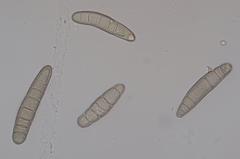 Bipolaris sorokinianae0pathogen
- Second interactor
- Stenotrophomonas maltophifia C3e0biocontrol_agent
- Outcome
- germination of conidiae0
- Direction
- inhibitede0
Not reportedComparator
Organisms pictured · Representative pictures of the matched species, not figures from the paper.

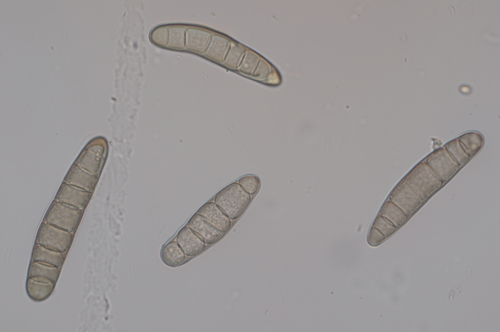
Verbatim
e0“Stenotrophomonas maltophifia C3 inhibited the germination of conidia and the growth of germtubes of Bipolaris sorokiniana (Sacc.) Shoemaker on tall fescue (Festuca arundinacea Schreb.) leaves”
Claim · model-written summary
C3 inhibited B. sorokiniana germ tube growth on tall fescue leaves.
- Taxon
- tall fescue (Festuca arundinacea Schreb.)Lolium arundinaceume0
- Treatment
- Stenotrophomonas maltophifia C3e0
- Interactor
- Bipolaris sorokiniana (Sacc.) ShoemakerBipolaris sorokinianae0pathogen
- Second interactor
- Stenotrophomonas maltophifia C3e0biocontrol_agent
- Outcome
- growth of germtubese0
- Direction
- inhibitede0
Not reportedComparator
Organisms pictured · Representative pictures of the matched species, not figures from the paper.
Verbatim
e0“Stenotrophomonas maltophifia C3 inhibited the germination of conidia and the growth of germtubes of Bipolaris sorokiniana (Sacc.) Shoemaker on tall fescue (Festuca arundinacea Schreb.) leaves”
Claim · model-written summary
C3 reduced B. sorokiniana leaf spot incidence on tall fescue in growth chambers and fields.
- Taxon
- tall fescueLolium arundinaceumt0
- Treatment
- C3e1
- Interactor
- B. sorokinianaBipolaris sorokinianae0pathogen
- Outcome
- incidencee0
- Direction
- reducede0
- Setting
- growth chamber and field conditionse0
Not reportedComparator
Organisms pictured · Representative pictures of the matched species, not figures from the paper.
Verbatim
e0“It reduced the incidence and severity of leaf spot disease caused by B. sorokiniana under growth chamber and field conditions”
t0“tall fescue”
e1“Stenotrophomonas maltophifia C3 inhibited the germination of conidia and the growth of germtubes of Bipolaris sorokiniana (Sacc.) Shoemaker on tall fescue (Festuca arundinacea Schreb.) leaves”
Claim · model-written summary
C3 reduced B. sorokiniana leaf spot severity on tall fescue in growth chambers and fields.
- Taxon
- tall fescueLolium arundinaceumt0
- Treatment
- C3e1
- Interactor
- B. sorokinianaBipolaris sorokinianae0pathogen
- Outcome
- severity of leaf spot disease caused by B. sorokinianae0
- Direction
- reducede0
- Setting
- growth chamber and field conditionse0
Not reportedComparator
Organisms pictured · Representative pictures of the matched species, not figures from the paper.
Verbatim
e0“It reduced the incidence and severity of leaf spot disease caused by B. sorokiniana under growth chamber and field conditions”
t0“tall fescue”
e1“Stenotrophomonas maltophifia C3 inhibited the germination of conidia and the growth of germtubes of Bipolaris sorokiniana (Sacc.) Shoemaker on tall fescue (Festuca arundinacea Schreb.) leaves”
Claim · model-written summary
Chitinolysis was identified as one mechanism of C3 action.
- Taxon
- tall fescueLolium arundinaceumt0
- Outcome
- mechanism of actione0
- Qualifier
- Chitinolysise0
Organisms pictured · Representative pictures of the matched species, not figures from the paper.
Verbatim
e0“Chitinolysis was found to be one mechanism of action”
t0“tall fescue”
Claim · model-written summary
Chitinase-deficient or low-chitinase C3 mutants colonized grass less than wild type.
Verbatim
e0“Transposon mutants of C3 that are chitinase deficient or have reduced chitinase production colonized grass to lower levels and provided reduced disease protection in comparison to the wild type”
Claim · model-written summary
Chitinase-deficient or low-chitinase C3 mutants provided less disease protection than wild type.
Verbatim
e0“Transposon mutants of C3 that are chitinase deficient or have reduced chitinase production colonized grass to lower levels and provided reduced disease protection in comparison to the wild type”
Claim · model-written summary
C3 colonization raised chitinase activity on grass leaves.
Verbatim
e0“Chitinase activity on grass leaves and bean blossoms colonized by C3 was higher than on the non-colonized plant parts”
Claim · model-written summary
C3 colonization raised chitinase activity on bean blossoms.
Verbatim
e0“Chitinase activity on grass leaves and bean blossoms colonized by C3 was higher than on the non-colonized plant parts”
Claim · model-written summary
Adding chitin with C3 further increased chitinase activity on plant parts.
- Taxon
- plant partse1
- Treatment
- addition of chitin with C3e0
- Interactor
- C3e0biocontrol_agent
- Outcome
- chitinase activitye0
- Direction
- increasede0
Not reportedComparator
Verbatim
e0“the addition of chitin with C3 further increased chitinase activity”
e1“Chitinase activity on grass leaves and bean blossoms colonized by C3 was higher than on the non-colonized plant parts”
Claim · model-written summary
A chitinase-minus C3 mutant gave no added chitinase activity on plant parts, with or without chitin.
Verbatim
e0“When a chitinase-minus mutant was applied to plant parts with or without chitin, no additional chitinase activity was detected over the controls”
Claim · model-written summary
Extracts from C3-colonized plant parts had antifungal activity associated with chitinase activity.
Not reportedDirection
Verbatim
e0“Extracts from C3-colonized plant parts had antifungal activity, and this property was related to chitinase activity”
Claim · model-written summary
Chitin induced C3 chitinase production in vitro.
- Taxon
- tall fescueLolium arundinaceumt0
- Treatment
- chitine0
- Interactor
- C3e0biocontrol_agent
- Outcome
- Chitinase production by C3e0
- Direction
- inducede0
- Setting
- in vitroe0
Not reportedComparator
Organisms pictured · Representative pictures of the matched species, not figures from the paper.
Verbatim
e0“Chitinase production by C3 was induced in vitro by chitin or chitin-containing fungal cell walls”
t0“tall fescue”
Claim · model-written summary
Chitin-containing fungal cell walls induced C3 chitinase production in vitro.
- Taxon
- tall fescueLolium arundinaceumt0
- Treatment
- chitin-containing fungal cell wallse0
- Interactor
- C3e0biocontrol_agent
- Outcome
- Chitinase production by C3e0
- Direction
- inducede0
- Setting
- in vitroe0
Not reportedComparator
Organisms pictured · Representative pictures of the matched species, not figures from the paper.
Verbatim
e0“Chitinase production by C3 was induced in vitro by chitin or chitin-containing fungal cell walls”
t0“tall fescue”
Claim · model-written summary
C3 chitinolytic fractions were more antifungal than non-chitinolytic fractions.
- Taxon
- tall fescueLolium arundinaceumt0
- Treatment
- Chitinolytic fractions of C3e0
- Interactor
- C3e0biocontrol_agent
- Outcome
- antifungale0
- Direction
- moree0
- Comparator
- non-chitinolytic fractionse0
Organisms pictured · Representative pictures of the matched species, not figures from the paper.
Verbatim
e0“Chitinolytic fractions of C3 in broth cultures, that were partially purified by chitin affinity chromatography, were more antifungal than non-chitinolytic fractions”
t0“tall fescue”
Claim · model-written summary
C3 chitinolytic fractions had strong exochitinase and slight endochitinase activities.
- Taxon
- tall fescueLolium arundinaceumt0
- Outcome
- strong exochitinase and slight endochitinase activitiese0
Organisms pictured · Representative pictures of the matched species, not figures from the paper.
Verbatim
e0“They also exhibited strong exochitinase and slight endochitinase activities”
t0“tall fescue”
e1“Stenotrophomonas maltophifia C3 inhibited the germination of conidia and the growth of germtubes of Bipolaris sorokiniana (Sacc.) Shoemaker on tall fescue (Festuca arundinacea Schreb.) leaves”
Claim · model-written summary
The major chitinolytic C3 fraction revealed five proteins of 25, 32, 48, 65 and 75 KDa.
- Taxon
- tall fescueLolium arundinaceumt0
- Outcome
- five proteinse0
- Value
- 25, 32, 48, 65 and 75 KDae0
Organisms pictured · Representative pictures of the matched species, not figures from the paper.
Verbatim
e0“five proteins were revealed (25, 32, 48, 65 and 75 KDa)”
t0“tall fescue”
e1“Stenotrophomonas maltophifia C3 inhibited the germination of conidia and the growth of germtubes of Bipolaris sorokiniana (Sacc.) Shoemaker on tall fescue (Festuca arundinacea Schreb.) leaves”
Claim · model-written summary
Only the 32-Kda protein N-terminus showed homology to known bacterial chitinases.
- Taxon
- tall fescueLolium arundinaceumt0
- Gene
- 32-Kda proteine0
- Outcome
- homology to known bacterial chitinasese0
Organisms pictured · Representative pictures of the matched species, not figures from the paper.
Verbatim
e0“Only the N-terminal amino acid sequence of the 32-Kda protein showed homology to known bacterial chitinases”
t0“tall fescue”
e1“Stenotrophomonas maltophifia C3 inhibited the germination of conidia and the growth of germtubes of Bipolaris sorokiniana (Sacc.) Shoemaker on tall fescue (Festuca arundinacea Schreb.) leaves”
Claim · model-written summary
Five chitinase-active C3 bands reduced to 32-Kda and 48-Kda proteins after denaturing re-electrophoresis, suggesting cleavage products.
- Taxon
- tall fescueLolium arundinaceumt0
- Outcome
- smaller proteins were cleavage products of the larger proteinse0
- Qualifier
- suggestinge0
Organisms pictured · Representative pictures of the matched species, not figures from the paper.
Verbatim
e0“Five chitinase-active bands were detected when the gels were probed with a fluorescent chitin substrate. These bands appeared only as 32-Kda and 48-Kda proteins when re-electrophoresed in denaturing gels, suggesting that the smaller proteins were cleavage products of the larger proteins”
t0“tall fescue”
e1“Stenotrophomonas maltophifia C3 inhibited the germination of conidia and the growth of germtubes of Bipolaris sorokiniana (Sacc.) Shoemaker on tall fescue (Festuca arundinacea Schreb.) leaves”
Claim · model-written summary
Combining C3 cells with chitin, chitin-broth fluid, or chitinase induction increased disease control efficacy.
- Taxon
- tall fescueLolium arundinaceumt0
- Treatment
- C3 cells in combination with chitine0
- Interactor
- C3e0biocontrol_agent
- Outcome
- disease control efficacye0
- Direction
- increasede0
Not reportedComparator
Organisms pictured · Representative pictures of the matched species, not figures from the paper.
Verbatim
e0“Several methods were identified that increased disease control efficacy: application of C3 cells in combination with chitin, application of cells in combination with fluid from, a chitin-containing broth culture, and use of C3 cells induced to produced chitinase”
t0“tall fescue”
The same questions in other papers
resistance inducer · control · Lolium arundinaceum (tall fescue)Results agree
1 paper in the same direction as this paper
- positive
Claims are grouped by organism, treatment and what was measured or targeted. A paper counts as positive when any of its claims in the group is positive.