Claim · model-written summary
C3 inhibited B. sorokiniana conidial germination on tall fescue leaves.
- Taxon
- tall fescue (Festuca arundinacea Schreb.)
 Lolium arundinaceume0
- Treatment
- Stenotrophomonas maltophifia C3e0
- Interactor
- Bipolaris sorokiniana (Sacc.) Shoemaker
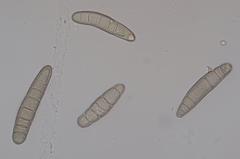 Bipolaris sorokinianae0pathogen
- Second interactor
- Stenotrophomonas maltophifia C3e0biocontrol_agent
- Outcome
- germination of conidiae0
- Direction
- inhibitede0
Not reportedMaterialGeneCompoundOrgan / stageComparatorSettingValueQualifier
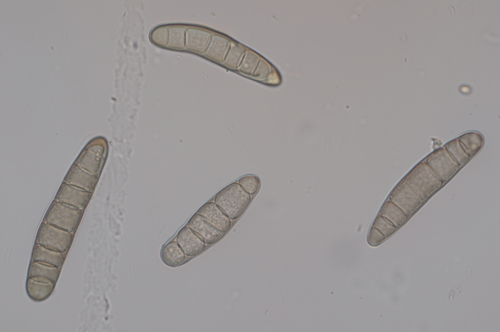
Organisms pictured · Representative pictures of the matched species, not figures from the paper.

Verbatim
e0“Stenotrophomonas maltophifia C3 inhibited the germination of conidia and the growth of germtubes of Bipolaris sorokiniana (Sacc.) Shoemaker on tall fescue (Festuca arundinacea Schreb.) leaves”
Title
Zhongge Zhang Lincoln (University of Nebraska) 1999
Other claims from this paper (19)
- Intervention effect C3 inhibited B. sorokiniana germ tube growth on tall fescue leaves.
- Intervention effect C3 reduced B. sorokiniana leaf spot incidence on tall fescue in growth chambers and fields.
- Intervention effect C3 reduced B. sorokiniana leaf spot severity on tall fescue in growth chambers and fields.
- Mechanism Chitinolysis was identified as one mechanism of C3 action.
- Intervention effect Chitinase-deficient or low-chitinase C3 mutants colonized grass less than wild type.
- Intervention effect Chitinase-deficient or low-chitinase C3 mutants provided less disease protection than wild type.
- Intervention effect C3 colonization raised chitinase activity on grass leaves.
- Intervention effect C3 colonization raised chitinase activity on bean blossoms.
- Intervention effect Adding chitin with C3 further increased chitinase activity on plant parts.
- Intervention effect A chitinase-minus C3 mutant gave no added chitinase activity on plant parts, with or without chitin.
- Association Extracts from C3-colonized plant parts had antifungal activity associated with chitinase activity.
- Intervention effect Chitin induced C3 chitinase production in vitro.
- Intervention effect Chitin-containing fungal cell walls induced C3 chitinase production in vitro.
- Intervention effect C3 chitinolytic fractions were more antifungal than non-chitinolytic fractions.
- Observation C3 chitinolytic fractions had strong exochitinase and slight endochitinase activities.
- Observation The major chitinolytic C3 fraction revealed five proteins of 25, 32, 48, 65 and 75 KDa.
- Observation Only the 32-Kda protein N-terminus showed homology to known bacterial chitinases.
- Mechanism Five chitinase-active C3 bands reduced to 32-Kda and 48-Kda proteins after denaturing re-electrophoresis, suggesting cleavage products.
- Intervention effect Combining C3 cells with chitin, chitin-broth fluid, or chitinase induction increased disease control efficacy.