Abstract
Azara spp. generally have dorsiventral shoots with the appearance of a large and a small ‘leaf’ at each node. On morphological grounds the small ‘leaf’ is usually considered to be derived from an upper stipule, while the lower stipule is reduced. This interpretation is reinforced by the changes during seedling development. Seedlings usually pass through a phase where the shoot is radially symmetrical and trilacunar nodes with small, glandular, non-vascular stipular structures are formed. Then nodes become more asymmetrical with the diminution of stipular development and lateral leaf trace development on one side, and accentuation on the other, and this process proceeds until the adult state is reached. Dorsiventrality depends on alternation of asymmetry at successive nodes and alternation may appear later than asymmetry. The changes in the seedling indicate that a recent interpretation of the adult structure of Azara based on homoeosis is not useful. The seedlings provide an interesting case in continuum morphology since they show a continuum of stipular structures from ‘gland’ through to ‘leaf’ but the continuum does not quite extend to the original leaf blade, which remains distinctive.
Abstract from the paper’s OpenAlex record, shown for indexing and research. Copyright remains with the authors or the publisher. Read at the source ↗
The text the model read, with the source record’s inline markup (italics, sub- and superscripts) rendered and its character entities decoded; quote offsets refer to the raw text.
Claims 6
Claim · model-written summary
Azara shoots generally have a large and small leaf at each node.
- Outcome
- dorsiventral shoots with the appearance of a large and a small ‘leaf’ at each nodee0
 Azara
Organisms pictured · Representative pictures of the matched species, not figures from the paper.
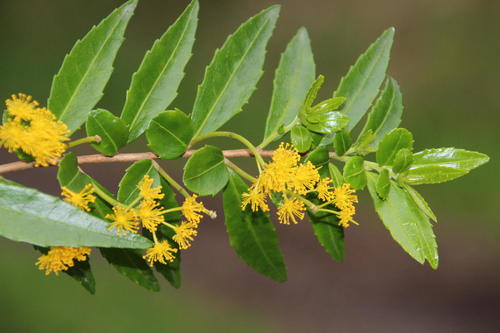
Verbatim
e0“Azara spp. generally have dorsiventral shoots with the appearance of a large and a small ‘leaf’ at each node.”
Claim · model-written summary
Young Azara seedlings usually have radially symmetrical shoots and trilacunar nodes with glandular nonvascular stipular structures.
- Taxon
- Azara serrata
 Azara serratat0
- Outcome
- the shoot is radially symmetrical and trilacunar nodes with small, glandular, non-vascular stipular structures are formede0
Organisms pictured · Representative pictures of the matched species, not figures from the paper.

Verbatim
e0“Seedlings usually pass through a phase where the shoot is radially symmetrical and trilacunar nodes with small, glandular, non-vascular stipular structures are formed.”
t0“Azara serrata”
Claim · model-written summary
Successive nodes become asymmetrical through opposite changes in stipule and lateral leaf trace development until the adult state.
- Taxon
- Azara serrataAzara serratat0
- Organ / stage
- nodese0
- Outcome
- nodes become more asymmetricale0
Organisms pictured · Representative pictures of the matched species, not figures from the paper.
Verbatim
e0“Then nodes become more asymmetrical with the diminution of stipular development and lateral leaf trace development on one side, and accentuation on the other, and this process proceeds until the adult state is reached.”
t0“Azara serrata”
Claim · model-written summary
Dorsiventrality depends on alternating asymmetry between successive nodes, with alternation sometimes appearing later.
- Taxon
- Azara serrataAzara serratat0
- Outcome
- Dorsiventralitye0
- Qualifier
- alternation of asymmetry at successive nodese0
Organisms pictured · Representative pictures of the matched species, not figures from the paper.
Verbatim
e0“Dorsiventrality depends on alternation of asymmetry at successive nodes and alternation may appear later than asymmetry.”
t0“Azara serrata”
Claim · model-written summary
Seedling changes do not support a homoeosis interpretation of adult Azara structure.
- Outcome
- interpretation of the adult structure of Azara based on homoeosis is not usefule0
Organisms pictured · Representative pictures of the matched species, not figures from the paper.
Verbatim
e0“The changes in the seedling indicate that a recent interpretation of the adult structure of Azara based on homoeosis is not useful.”
Claim · model-written summary
Azara seedlings show a continuum from glandular to leaflike stipules, while the original leaf blade remains distinct.
- Taxon
- Azara serrataAzara serratat0
- Outcome
- a continuum of stipular structures from ‘gland’ through to ‘leaf’e0
Organisms pictured · Representative pictures of the matched species, not figures from the paper.
Verbatim
e0“they show a continuum of stipular structures from ‘gland’ through to ‘leaf’ but the continuum does not quite extend to the original leaf blade, which remains distinctive.”
t0“Azara serrata”