Abstract
PREMISE OF THE STUDY: Plants that strongly accumulate metals may be practically beneficial, and also serve as novel resources for increasing fundamental understanding of plant biology. Australian Gossia (Myrtaceae) species are delineated by a conspicuous affinity for the heavy metal manganese (Mn), which is a micronutrient crucial to photosynthesis. This genus includes several Mn hyperaccumulators such as G. bidwillii. Unusually, in G. bidwillii foliar Mn is most highly concentrated in photosynthetic cells, an observation thus far restricted to foliar-Mn accumulation in Mn hyperaccumulators. Recent discovery that several of these Gossia species accumulate other metals in addition to Mn will enable investigation as to whether primary sequestration of metals in photosynthetic tissues is restricted to Mn. METHODS: Gossia species known to accumulate nickel (Ni) or aluminum (Al) in addition to Mn were sampled in the field. Complementary proton- and electron-probe data were combined to evaluate in vivo microdistribution patterns of excessively accumulated foliar metals. KEY RESULTS: It was discovered that in addition to Mn and Ni, Gossia fragrantissima accumulated foliar zinc (Zn) and cobalt (Co), with Mn, Ni, and Co most highly localized in mesophyll cells and Zn primarily located in the upper epidermis. In G. hillii, Mn and Al were highly concentrated in the palisade and epidermis, respectively. CONCLUSIONS: This investigation provides evidence that the primary disposal of excess foliar metals in photosynthetic cells is not exclusive to Mn. It offers rare intrageneric perspective on metal compartmentation, pointing to significant variation among tonoplastal metal transporters associated with detoxification.
Abstract from the paper’s OpenAlex record; open copy licensed cc-by. Read at the source ↗
The text the model read, with the source record’s inline markup (italics, sub- and superscripts) rendered and its character entities decoded; quote offsets refer to the raw text.
Claims 5
Claim · model-written summary
Gossia fragrantissima accumulated foliar zinc and cobalt in addition to manganese and nickel.
- Taxon
- Gossia fragrantissima
 Gossia fragrantissimae0
- Outcome
- foliar zinc (Zn) and cobalt (Co)e0
Organisms pictured · Representative pictures of the matched species, not figures from the paper.

Verbatim
e0“Gossia fragrantissima accumulated foliar zinc (Zn) and cobalt (Co)”
t0“Multiple metal accumulation”
Claim · model-written summary
Manganese, nickel, and cobalt were most localized in mesophyll cells of G. fragrantissima.
- Taxon
- Gossia fragrantissimaGossia fragrantissimae0
- Organ / stage
- mesophyll cellse0
- Outcome
- Mn, Ni, and Co most highly localized in mesophyll cellse0
Organisms pictured · Representative pictures of the matched species, not figures from the paper.
Verbatim
e0“Gossia fragrantissima accumulated foliar zinc (Zn) and cobalt (Co), with Mn, Ni, and Co most highly localized in mesophyll cells”
t0“Multiple metal accumulation”
Claim · model-written summary
Zinc in G. fragrantissima was primarily in the upper epidermis.
- Taxon
- Gossia fragrantissimaGossia fragrantissimae0
- Organ / stage
- upper epidermise0
- Outcome
- Zn primarily located in the upper epidermise0
Organisms pictured · Representative pictures of the matched species, not figures from the paper.
Verbatim
e0“Gossia fragrantissima accumulated foliar zinc (Zn) and cobalt (Co), with Mn, Ni, and Co most highly localized in mesophyll cells and Zn primarily located in the upper epidermis”
t0“Multiple metal accumulation”
Claim · model-written summary
Manganese in G. hillii was highly concentrated in the palisade.
- Taxon
- G. hillii
 Gossia hilliie0
- Organ / stage
- palisadee0
- Outcome
- Mn and Al were highly concentrated in the palisade and epidermis, respectivelye0
Organisms pictured · Representative pictures of the matched species, not figures from the paper.
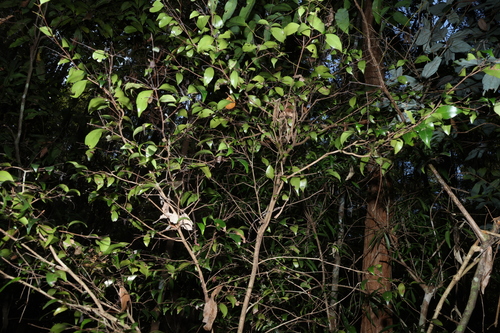
Verbatim
e0“In G. hillii, Mn and Al were highly concentrated in the palisade and epidermis, respectively”
t0“Multiple metal accumulation”
Claim · model-written summary
Aluminum in G. hillii was highly concentrated in the epidermis.
- Taxon
- G. hilliiGossia hilliie0
- Organ / stage
- epidermise0
- Outcome
- Mn and Al were highly concentrated in the palisade and epidermis, respectivelye0
Organisms pictured · Representative pictures of the matched species, not figures from the paper.
Verbatim
e0“In G. hillii, Mn and Al were highly concentrated in the palisade and epidermis, respectively”
t0“Multiple metal accumulation”