Abstract
Summary 1 Colonies of the aphid Rhopalosiphum maidis on Johnsongrass, Sorghum halepense , usually occur inside the whorl. The present work assessed the role of two biotic factors, plant quality and parasitism by Lysiphlebus testaceipes , in determining within‐plant distribution and performance of R. maidis . The mean relative growth rate of aphids inside the whorl and on a mature leaf was compared, and the concentration of hydroxamic acids in those tissues determined as an indicator of plant quality. Parasitism effectiveness and parasitoid behaviour were evaluated using three treatments: aphid colonies placed (1) wholly inside the whorl, (2) on the inner and outer surfaces of the whorl, and (3) on a mature leaf. 2 The mean relative growth rate of aphids was lower on the whorl than on the mature leaf, and hydroxamic acid concentration in the whorl was higher than in the mature leaf. 3 The number of parasitized dead aphids (mummies) inside the whorl was considerably lower than in the other two treatments. Mummies were present in 80% of the replicates in the whorl, whereas mummies were present in all replicates of the other treatments. 4 Host location time of the parasitoid was increased on the mature leaf compared with the other treatments. No significant differences in the residence time of the parasitoid in the aphid colony occurred between treatments. 5 Host location time showed a negative correlation, and residence time of the parasitoid a positive correlation with the number of aphids on the outer surface of the whorl.
Abstract from the paper’s OpenAlex record; open copy licensed cc-by-nc-nd. Read at the source ↗
The text the model read, with the source record’s inline markup (italics, sub- and superscripts) rendered and its character entities decoded; quote offsets refer to the raw text.
Claims 10
Claim · model-written summary
Corn leaf aphid colonies usually occur in the Johnsongrass whorl.
- Taxon
- Johnsongrass
 Sorghum halepensee0
- Organ / stage
- whorle0
- Interactor
- Rhopalosiphum maidis
 Rhopalosiphum maidise0pest
- Outcome
- Colonies of the aphid Rhopalosiphum maidis on Johnsongrass, Sorghum halepense , usually occur inside the whorle0
Organisms pictured · Representative pictures of the matched species, not figures from the paper.

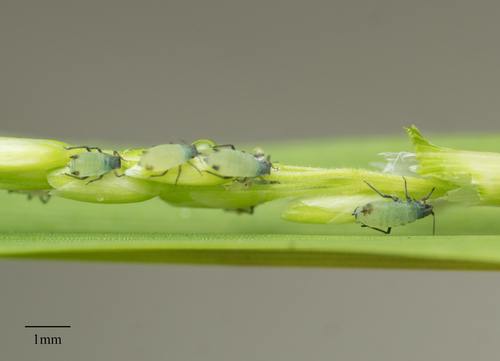
Verbatim
e0“Colonies of the aphid Rhopalosiphum maidis on Johnsongrass, Sorghum halepense , usually occur inside the whorl.”
Claim · model-written summary
Aphid growth rate was lower in the whorl than on a mature leaf.
- Taxon
- JohnsongrassSorghum halepensee1
- Organ / stage
- whorle0
- Interactor
- aphidsAphidomorphae0pest
- Outcome
- mean relative growth rate of aphidse0
- Direction
- lowere0
- Comparator
- mature leafe0
Organisms pictured · Representative pictures of the matched species, not figures from the paper.
Verbatim
e0“The mean relative growth rate of aphids was lower on the whorl than on the mature leaf”
e1“Johnsongrass, Sorghum halepense”
Claim · model-written summary
Whorl hydroxamic acid concentration exceeded that of mature leaves.
- Taxon
- JohnsongrassSorghum halepensee1
- Organ / stage
- whorle0
- Outcome
- hydroxamic acid concentratione0
- Direction
- highere0
- Comparator
- mature leafe0
Organisms pictured · Representative pictures of the matched species, not figures from the paper.
Verbatim
e0“hydroxamic acid concentration in the whorl was higher than in the mature leaf”
e1“Johnsongrass, Sorghum halepense”
Claim · model-written summary
Fewer parasitized dead aphids occurred inside the whorl than in the other placements.
- Taxon
- JohnsongrassSorghum halepensee1
- Organ / stage
- whorle0
- Interactor
- aphidsAphidomorphae0pest
- Second interactor
- Lysiphlebus testaceipesLysiphlebus testaceipese2biocontrol_agent
- Outcome
- number of parasitized dead aphids (mummies)e0
- Direction
- considerably lowere0
- Comparator
- other two treatmentse0
Organisms pictured · Representative pictures of the matched species, not figures from the paper.
Verbatim
e0“The number of parasitized dead aphids (mummies) inside the whorl was considerably lower than in the other two treatments.”
e1“Johnsongrass, Sorghum halepense”
e2“parasitism by Lysiphlebus testaceipes”
Claim · model-written summary
Mummies appeared in 80% of whorl replicates.
- Taxon
- JohnsongrassSorghum halepensee1
- Organ / stage
- whorle0
- Interactor
- Rhopalosiphum maidisRhopalosiphum maidise2pest
- Outcome
- Mummies were presente0
- Value
- 80%e0
Organisms pictured · Representative pictures of the matched species, not figures from the paper.
Verbatim
e0“Mummies were present in 80% of the replicates in the whorl”
e1“Johnsongrass, Sorghum halepense”
e2“aphid Rhopalosiphum maidis”
Claim · model-written summary
Mummies appeared in all replicates of the other placements.
- Taxon
- JohnsongrassSorghum halepensee1
- Interactor
- Rhopalosiphum maidisRhopalosiphum maidise2pest
- Outcome
- mummies were present in all replicates of the other treatmentse0
Organisms pictured · Representative pictures of the matched species, not figures from the paper.
Verbatim
e0“mummies were present in all replicates of the other treatments”
e1“Johnsongrass, Sorghum halepense”
e2“aphid Rhopalosiphum maidis”
Claim · model-written summary
Parasitoid host location time increased on mature leaves.
- Taxon
- JohnsongrassSorghum halepensee1
- Organ / stage
- mature leafe0
- Interactor
- Lysiphlebus testaceipesLysiphlebus testaceipese2biocontrol_agent
- Outcome
- Host location time of the parasitoide0
- Direction
- increasede0
- Comparator
- other treatmentse0
Organisms pictured · Representative pictures of the matched species, not figures from the paper.
Verbatim
e0“Host location time of the parasitoid was increased on the mature leaf compared with the other treatments.”
e1“Johnsongrass, Sorghum halepense”
e2“Lysiphlebus testaceipes”
Claim · model-written summary
Parasitoid residence time did not differ significantly among treatments.
- Taxon
- JohnsongrassSorghum halepensee1
- Treatment
- treatmentse0
- Interactor
- Lysiphlebus testaceipesLysiphlebus testaceipese2biocontrol_agent
- Outcome
- residence time of the parasitoide0
- Direction
- No significant differencese0
Organisms pictured · Representative pictures of the matched species, not figures from the paper.
Verbatim
e0“No significant differences in the residence time of the parasitoid in the aphid colony occurred between treatments.”
e1“Johnsongrass, Sorghum halepense”
e2“Lysiphlebus testaceipes”
Claim · model-written summary
Parasitoid host location time was negatively correlated with aphids on the outer whorl.
- Taxon
- JohnsongrassSorghum halepensee1
- Organ / stage
- outer surface of the whorle0
- Interactor
- aphidsAphidomorphae0pest
- Second interactor
- Lysiphlebus testaceipesLysiphlebus testaceipese2biocontrol_agent
- Outcome
- Host location timee0
- Direction
- negative correlatione0
Organisms pictured · Representative pictures of the matched species, not figures from the paper.
Verbatim
e0“Host location time showed a negative correlation, and residence time of the parasitoid a positive correlation with the number of aphids on the outer surface of the whorl.”
e1“Johnsongrass, Sorghum halepense”
e2“Lysiphlebus testaceipes”
Claim · model-written summary
Parasitoid residence time was positively correlated with aphids on the outer whorl.
- Taxon
- JohnsongrassSorghum halepensee1
- Organ / stage
- outer surface of the whorle0
- Interactor
- aphidsAphidomorphae0pest
- Second interactor
- Lysiphlebus testaceipesLysiphlebus testaceipese2biocontrol_agent
- Outcome
- residence time of the parasitoide0
- Direction
- positive correlatione0
Organisms pictured · Representative pictures of the matched species, not figures from the paper.
Verbatim
e0“residence time of the parasitoid a positive correlation with the number of aphids on the outer surface of the whorl.”
e1“Johnsongrass, Sorghum halepense”
e2“Lysiphlebus testaceipes”