Abstract
The objective of this study was to determine the host status in Mexico of commercially cultivated and marketed avocado, Persea americana (Mill.), 'Hass' to Anastrepha ludens (Loew), Anastrepha obliqua (Macquart), Anastrepha serpentina (Wiedemann), and Anastrepha striata (Schiner) (Diptera: Tephritidae). Experiments in Michoacán, Mexico, were carried out in six orchards located at three altitudes above sea level during two times (August-October 2001 and April-June 2002). They included choice ('Hass' avocado plus natural host) and no-choice foraging behavior tests on trees under field cages; no-choice, forced infestation trials on caged, fruit-bearing branches in the field, and with individual fruit under laboratory conditions; infestation trials using 'Hass' avocados left unprotected over 1 and 7 d on the ground of orchards; studies to ascertain depth of oviposition and determine egg hatchability; and experiments to determine susceptibility by using time elapsed since removal of fruit from tree as the experimental variable. We trapped adult Anastrepha (n = 7,936) in all orchards and dissected fruit (n = 7,695) from orchards and packing houses (n = 1,620) in search of eggs or larvae. Most (96.7%) A. ludens, A. obliqua, A. striata, and A. serpentina adults were captured in low-elevation orchards. No eggs or larvae were detected in any of the fruit from foraging behavior studies or dissected fruit from orchards or packing houses. Of 5,200 mature, intact fruit on trees in the field forcibly exposed to no-choice female oviposition activity (five females/fruit), we only found four fruit infested by A. ludens but no adults emerged. 'Hass' avocados only became marginally susceptible to attack by A. ludens (but not A. obliqua, A. serpentina, and A. striata) 24 h after being removed from the tree. Fruit placed on the ground in orchards (n = 3,600) were occasionally infested by Neosilba batesi (Curran) (Diptera: Lonchaeidae), a decomposer, but not Anastrepha spp. Based on our results, commercially cultivated and marketed P. americana 'Hass' should not be considered a natural host of A. ludens, A. obliqua, A. striata, and A. serpentina in Mexico.
Abstract from the paper’s OpenAlex record, shown for indexing and research. Copyright remains with the authors or the publisher. Read at the source ↗
The text the model read, with the source record’s inline markup (italics, sub- and superscripts) rendered and its character entities decoded; quote offsets refer to the raw text.
Claims 8
Claim · model-written summary
Most captured Anastrepha adults occurred in low-elevation orchards.
- Taxon
- A. ludens, A. obliqua, A. striata, and A. serpentina
 Anastrepha ludens
 Anastrepha serpentina
 Anastrepha obliqua
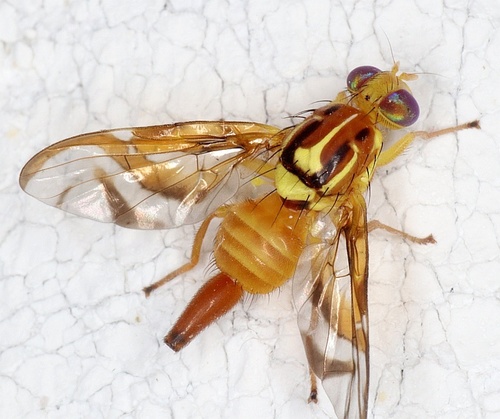
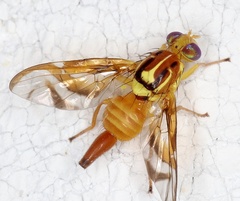 Anastrepha striatae0
- Outcome
- adults were captured in low-elevation orchardse0
- Value
- 96.7%e0
Organisms pictured · Representative pictures of the matched species, not figures from the paper.


Verbatim
e0“Most (96.7%) A. ludens, A. obliqua, A. striata, and A. serpentina adults were captured in low-elevation orchards.”
Claim · model-written summary
No eggs or larvae were found in fruit from foraging studies, orchards, or packing houses.
Verbatim
e0“No eggs or larvae were detected in any of the fruit from foraging behavior studies or dissected fruit from orchards or packing houses.”
Claim · model-written summary
Four of 5,200 mature intact avocados forcibly exposed to A. ludens were infested, but no adults emerged.
- Taxon
- fruite0
- Interactor
- A. ludensAnastrepha ludense0pest
- Outcome
- fruit infested by A. ludense0
- Value
- four fruite0
- Qualifier
- 5,200 mature, intact fruite0
Organisms pictured · Representative pictures of the matched species, not figures from the paper.
Verbatim
e0“Of 5,200 mature, intact fruit on trees in the field forcibly exposed to no-choice female oviposition activity (five females/fruit), we only found four fruit infested by A. ludens but no adults emerged.”
Claim · model-written summary
Hass avocados became marginally susceptible to A. ludens attack 24 hours after removal from trees.
- Taxon
- 'Hass' avocadose0
- Interactor
- A. ludensAnastrepha ludense0pest
- Outcome
- susceptible to attacke0
- Direction
- became marginally susceptiblee0
- Qualifier
- 24 h after being removed from the treee0
Organisms pictured · Representative pictures of the matched species, not figures from the paper.
Verbatim
e0“'Hass' avocados only became marginally susceptible to attack by A. ludens (but not A. obliqua, A. serpentina, and A. striata) 24 h after being removed from the tree.”
Claim · model-written summary
Hass avocados were not susceptible to A. obliqua, A. serpentina, and A. striata after tree removal.
- Taxon
- 'Hass' avocadose0
- Interactor
- A. obliqua, A. serpentina, and A. striataAnastrepha serpentinaAnastrepha obliquaAnastrepha striatae0pest
- Outcome
- susceptible to attacke0
- Direction
- note0
Organisms pictured · Representative pictures of the matched species, not figures from the paper.
Verbatim
e0“'Hass' avocados only became marginally susceptible to attack by A. ludens (but not A. obliqua, A. serpentina, and A. striata) 24 h after being removed from the tree.”
Claim · model-written summary
Avocados placed on orchard ground were occasionally infested by N. batesi.
- Taxon
- Fruite0
- Interactor
- Neosilba batesiNeosilba batesie0other
- Outcome
- infestede0
- Direction
- occasionally infestede0
Verbatim
e0“Fruit placed on the ground in orchards (n = 3,600) were occasionally infested by Neosilba batesi (Curran) (Diptera: Lonchaeidae), a decomposer, but not Anastrepha spp.”
Claim · model-written summary
Avocados placed on orchard ground were not infested by Anastrepha species.
- Taxon
- Fruite0
- Interactor
- Anastrepha spp.
 Anastrephae0pest
- Outcome
- infestede0
- Direction
- note0
Organisms pictured · Representative pictures of the matched species, not figures from the paper.

Verbatim
e0“Fruit placed on the ground in orchards (n = 3,600) were occasionally infested by Neosilba batesi (Curran) (Diptera: Lonchaeidae), a decomposer, but not Anastrepha spp.”
Claim · model-written summary
Commercial Hass avocado in Mexico should not be considered a natural host of the four Anastrepha species.
- Taxon
- P. americana 'Hass'
 Persea americanae0
- Interactor
- A. ludens, A. obliqua, A. striata, and A. serpentinaAnastrepha ludensAnastrepha serpentinaAnastrepha obliquaAnastrepha striatae0pest
- Outcome
- should not be considered a natural hoste0
- Setting
- Mexicoe0
Organisms pictured · Representative pictures of the matched species, not figures from the paper.

Verbatim
e0“commercially cultivated and marketed P. americana 'Hass' should not be considered a natural host of A. ludens, A. obliqua, A. striata, and A. serpentina in Mexico”