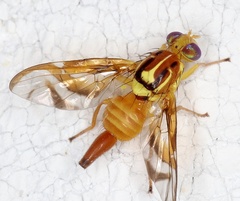
Anastrepha serpentina 4 claims

species · family Tephritidae · animal · NCBI Taxonomy ↗

NCBI synonyms: Dacus serpentinus

2 spellings

Anastrepha serpentina
Anastrepha serpentinaJorge Valdez, Colegio de Postgraduados, Mexico. jvaldez@colpos.mx · CC BY-SA 3.0 · Wikimedia Commons ↗
Observationobservedoriginal resultmeasured

Claim · model-written summary

A. serpentina made up 5.79% of the captured Anastrepha specimens.

Taxon
A. serpentinaAnastrepha serpentinae2
Outcome
specimense1
Value
5.79%e2

Verbatim

e1

“21,708 specimens of four species were captured”

✓ located verbatim in the source · abstract, characters 554–600
e2

“A. serpentina (5.79%)”

✓ located verbatim in the source · abstract, characters 622–643

Title

Analysis of Diversity of Pest Species of Anastrepha1 in ‘Barranqueño’ Mango (Mangifera indica L.)

Paulina Guadalupe Hernández-Salcido; William David Rodríguez; José Luis Navarrete Heredia; et al. Southwestern Entomologist 2023. doi:10.3958/059.048.0212

Other claims from this paper (7)
Observationobservedoriginal resultmeasured

Claim · model-written summary

Most captured Anastrepha adults occurred in low-elevation orchards.

Taxon
A. ludens, A. obliqua, A. striata, and A. serpentinaAnastrepha ludensAnastrepha serpentinaAnastrepha obliquaAnastrepha striatae0
Outcome
adults were captured in low-elevation orchardse0
Value
96.7%e0

Verbatim

e0

“Most (96.7%) A. ludens, A. obliqua, A. striata, and A. serpentina adults were captured in low-elevation orchards.”

✓ located verbatim in the source · abstract, characters 1201–1314

Title

Nonhost Status of Commercial Persea americana ‘Hass’ to Anastrepha ludens, Anastrepha obliqua, Anastrepha serpentina, and Anastrepha striata (Diptera: Tephritidae) in Mexico

Martín Aluja; Francisco Díaz-Fleischer; José Arredondo Journal of Economic Entomology 2004. doi:10.1603/0022-0493-97.2.293

Other claims from this paper (7)
Observationobservedoriginal resultmeasured

Claim · model-written summary

Five-day old human urine caught numerically more A. serpentina females than males.

Taxon
A. serpentinaAnastrepha serpentinae0
Treatment
Five-day old human urinee0
Outcome
femalese0
Direction
moree0
Comparator
malese0

Verbatim

e0

“Five-day old human urine attracted numerically more A. serpentina females than males”

✓ located verbatim in the source · abstract, characters 968–1052

Title

Human Urine and Chicken Feces as Fruit Fly (Diptera: Tephritidae) Attractants for Resource-Poor Fruit Growers

Jaime Piñero; Martín Aluja; Alejandro Vázquez; et al. Journal of Economic Entomology 2003. doi:10.1093/jee/96.2.334

Other claims from this paper (6)
Observationobservedoriginal resultmeasured

Claim · model-written summary

Chicken feces was as attractive as aged torula yeast/borax for A. serpentina.

Taxon
A. serpentinaAnastrepha serpentinae0
Treatment
Chicken fecese0
Outcome
attractivee0
Direction
as attractive ase0
Comparator
aged torula yeast/borax treatmentse0

Verbatim

e0

“Chicken feces proved to be as attractive as the aged torula yeast/borax treatments for A. obliqua and A. serpentina”

✓ located verbatim in the source · abstract, characters 1181–1296

Title

Human Urine and Chicken Feces as Fruit Fly (Diptera: Tephritidae) Attractants for Resource-Poor Fruit Growers

Jaime Piñero; Martín Aluja; Alejandro Vázquez; et al. Journal of Economic Entomology 2003. doi:10.1093/jee/96.2.334

Other claims from this paper (6)