Abstract
Bioinoculants contribute to soil environment through their versatile role. Whereas weeds are a limitation and herbicide carryover can also be injurious to subsequent crops. The residual/carryover herbicides may influence sowing decisions for the next crop due to reduced herbicide breakdown. The present study aimed at exploring the contribution of bio-fertilizer microbes (Azospirillum) to mitigate the inhibitory effect of herbicide residue in soil, and their inhibitory effect on weed seeds. The crops studied under laboratory conditions were Brassica spp. and Zea mays while Phalaris minor was the test weed. In first experiment, Brassica and maize, grown in soils having residues of either Triasulfuron+Terbutryn (Logran) or Sulfosulfuron (Leader), were found to significantly mitigate (% increase in root length, shoot length, fresh weight and dry weight) the inhibitory effect of residues , when inoculated with Azospirillum A4. In second experiment two Azospirillum (B2 and B3) and two Azorhizobium (3.6ksk and srsn2k4) isolates reduced seed germination of Phalaris minor by 95%. The results imply that biofertilizer microbes can mitigate the carryover effect of the two sulfonylureas; they can also inhibit Phalaris minor. Therefore, the use of bio-inoculants, weed seed germination and residual effect of weedicide can be manipulated for the betterment of the crops and these microbes can be used for a positive interaction of maintaining a threshold of weeds in a crop field.
Abstract from the paper’s OpenAlex record, shown for indexing and research. Copyright remains with the authors or the publisher. Read at the source ↗
The text the model read, with the source record’s inline markup (italics, sub- and superscripts) rendered and its character entities decoded; quote offsets refer to the raw text.
Claims 3
Claim · model-written summary
Azospirillum A4 inoculation significantly mitigated the inhibitory effect of herbicide residues on Brassica growth.
- Treatment
- inoculated with Azospirillum A4e1
- Interactor
- Azospirillum A4e1symbiont
- Outcome
- root length, shoot length, fresh weight and dry weighte1
- Direction
- mitigatee1
- Qualifier
- soils having residues of either Triasulfuron+Terbutryn (Logran) or Sulfosulfuron (Leader)e1
- Setting
- laboratory conditionse2
 Brassica
Not reportedComparator
Organisms pictured · Representative pictures of the matched species, not figures from the paper.

Verbatim
e2“The crops studied under laboratory conditions were Brassica spp. and Zea mays while Phalaris minor was the test weed”
e1“Brassica and maize, grown in soils having residues of either Triasulfuron+Terbutryn (Logran) or Sulfosulfuron (Leader), were found to significantly mitigate (% increase in root length, shoot length, fresh weight and dry weight) the inhibitory effect of residues , when inoculated with Azospirillum A4”
Claim · model-written summary
Azospirillum A4 inoculation significantly mitigated the inhibitory effect of herbicide residues on maize growth.
- Treatment
- inoculated with Azospirillum A4e1
- Interactor
- Azospirillum A4e1symbiont
- Outcome
- root length, shoot length, fresh weight and dry weighte1
- Direction
- mitigatee1
- Qualifier
- soils having residues of either Triasulfuron+Terbutryn (Logran) or Sulfosulfuron (Leader)e1
- Setting
- laboratory conditionse2
 Zea mays
Not reportedComparator
Organisms pictured · Representative pictures of the matched species, not figures from the paper.

Verbatim
e2“The crops studied under laboratory conditions were Brassica spp. and Zea mays while Phalaris minor was the test weed”
e1“Brassica and maize, grown in soils having residues of either Triasulfuron+Terbutryn (Logran) or Sulfosulfuron (Leader), were found to significantly mitigate (% increase in root length, shoot length, fresh weight and dry weight) the inhibitory effect of residues , when inoculated with Azospirillum A4”
Claim · model-written summary
Two Azospirillum and two Azorhizobium isolates reduced seed germination of Phalaris minor by 95%.
- Taxon
- Phalaris minor
 Phalaris minore3
- Treatment
- two Azospirillum (B2 and B3) and two Azorhizobium (3.6ksk and srsn2k4) isolatese3
- Interactor
- Azospirillum
 Azospirillume3biocontrol_agent
- Second interactor
- Azorhizobium
 Azorhizobiume3biocontrol_agent
- Outcome
- seed germinatione3
- Direction
- reducede3
- Value
- 95%e3
Not reportedComparator
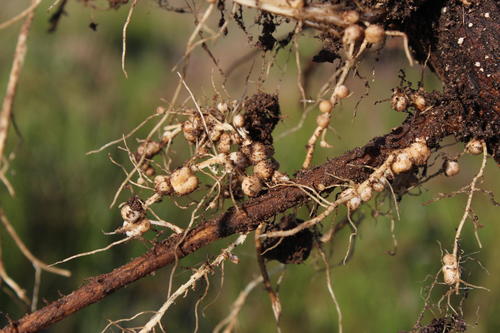
Organisms pictured · Representative pictures of the matched species, not figures from the paper.


Verbatim
e2“The crops studied under laboratory conditions were Brassica spp. and Zea mays while Phalaris minor was the test weed”
e3“In second experiment two Azospirillum (B2 and B3) and two Azorhizobium (3.6ksk and srsn2k4) isolates reduced seed germination of Phalaris minor by 95%”
The same questions in other papers
Azospirillum · growth · Zea mays (maize)Results agree
27 papers in the same direction as this paper
- positive
- positive
- positive
24 papers more in this group
See all 28 papers →inoculation · growth · BrassicaPositive and negative results
2 papers in the same direction as this paper · 1 in the opposite direction
- negative
- positive
- positive
inoculation · growth · Zea mays (maize)Positive and negative results
634 papers in the same direction as this paper · 61 in the opposite direction · 3 reporting no difference from an alternative
- negative
- no effect
- no effect
695 papers more in this group
See all 699 papers →Claims are grouped by organism, treatment and what was measured or targeted. A paper counts as positive when any of its claims in the group is positive.